




To include your event in the Briefing and Live Calendar, please fill out this form.
Weather: Mostly sunny. Highs in the upper 70s. Friday Night: Mostly cloudy. Lows in the upper 50s.
- Daily weather briefing from the National Weather Service in Jacksonville here.
- Drought conditions here. (What is the Keetch-Byram drought index?).
- Check today’s tides in Daytona Beach (a few minutes off from Flagler Beach) here.
- Tropical cyclone activity here, and even more details here.
Today at a Glance:



Free For All Fridays with Host David Ayres, an hour-long public affairs radio show featuring local newsmakers, personalities, public health updates and the occasional surprise guest, starts a little after 9 a.m. after FlaglerLive Editor Pierre Tristam’s Reality Check. Today, Palm Coast City Manager Michael McGlothlin and House Rep. Sam Greco. See previous podcasts here. On WNZF at 94.9 FM, 1550 AM, and live at Flagler Broadcasting’s YouTube channel.
The Scenic A1A Pride Committee meets at 9 a.m. at the Hammock Community Center, 79 Mala Compra Road, Palm Coast. The meetings are open to the public.
Acoustic Jam Circle At The Community Center In The Hammock, 2 to 5 p.m., Picnic Shelter behind the Hammock Community Center at 79 Mala Compra Road, Palm Coast. It’s a free event. Bring your Acoustic stringed Instrument (no amplifiers), and a folding chair and join other local amateur musicians for a jam session. Audiences and singers are also welcome. A “Jam Circle” format is where musicians sit around the circle. Each musician in turn gets to call out a song and musical key, and then lead the rest in singing/playing. Then it’s on to the next person in the circle. Depending upon the song, the musicians may take turns playing/improvising a verse and a chorus. It’s lots of Fun! Folks who just want to watch or sing generally sit on the periphery or next to their musician partner. This is a monthly event on the 4th Friday of every month.
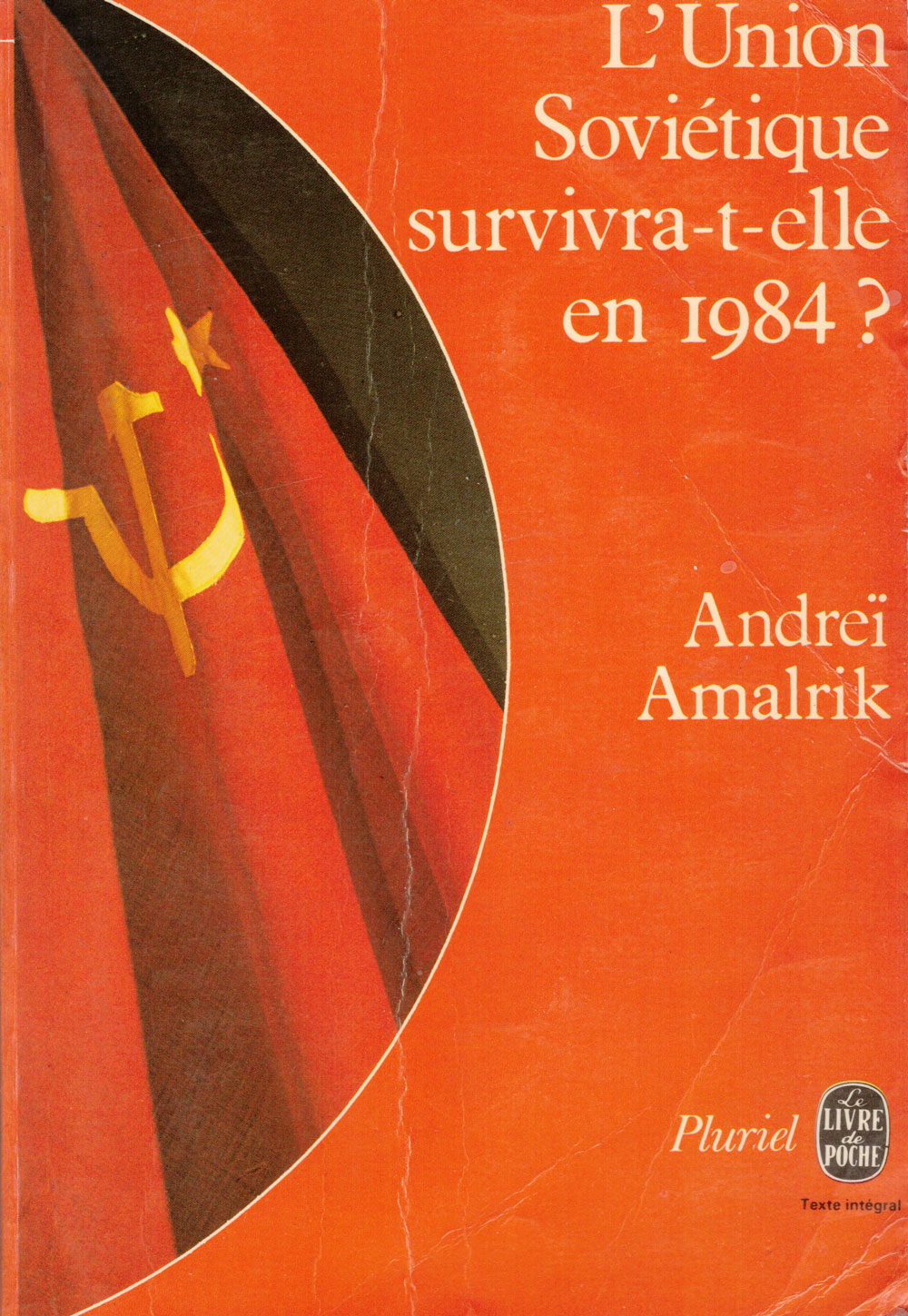
Notably: Sometime in the early to mid-1970s either my mother bought or I bought for her Andrei Amalrik’s book, Will the Soviet Union Survive in 1984?, a French paperback, cheekily titled, though Amalrik was in dead earnest about the crumbling empire: correctly diagnosed but wrongly prognisticated in its details. He thought the Soviets would lose a showdown with China. Amalrik was in the top league of Soviet dissidents. He’d put in his time in Siberia and written about it, like Dostoevsky. He won exile to the Netherlands in 1976. His prediction was off by only five years. Somebody had it in for him, because he did not himself survive until 1984. In November 1980 he was to be in Madrid for an international conference to review the implementation of the 1975 Helsinki accords, where the Soviet Union had finally made concessions on human rights, but had not followed through. Amalrik was among the sharpest voices holding his country to account. He was on his way to Madrid for the conference when, according to the Times, “Mr. Amalrik, coming from southern France, swerved out of his lane on a wet road near the city of Guadalajara and his car struck an oncoming truck. Mr. Amalrik was instantly killed by a piece of metal, probably from the steering column, which was embedded in his throat, according to the police. His widow, Gyuzel, received only slight injuries, as did Vladimir Borisov and Viktor Feinberg.” I remember our shock my mother and I, by then in New York, and my mother claiming that the accident was no accident. The day the Times carried the obituary on page B12, with Amalrik’s picture at the bottom of Page 1, Anthony Lewis’s column had been about the brutality of Soviet torture of political dissidents, noting along the way: “The Soviets’ desperate effort to avoid being called to account at Madrid shows that such international shame bothers them. Why should we give up the opportunity to point to their cynicism and brutality? Why should we disagree with the Soviet victims who want the West to stand firm on Helsinki? For example, Vaclav Havel, the imprisoned Czech playwright, and two colleagues recently managed to get out a letter urging action on human rights at Madrid.” All those familiar names. Vaclav Havel of course would become president of the Czech Republic. I found Will the Soviet Union Survive in my library earlier this week, still in good shape. Among the pages, I found a little letter to the editor my mother had clipped out, from the Nov. 12 Times, two days after the death: “I wish I were an ancient master of the elegaic hexameter that I might in two or four chiseled lines imperishably commemorate the passing of Andrei Amalrik. Fate was never more malevolent than in decreeing that he, who had survived Siberian prison camps, should come to a banal end in an automobile accident on his way to the Helsinki treaty conference in Madrid. May this indomitable young man’s abrupt extinction serve at least to call sharper attention to the Soviet Union’s open violation of its Helsinki obligations in the treatment of his fellow dissidents. Amalrik will live in his country’s memory with the Decembrists and Herzen and Tolstoy and our own time’s honored Sakharov to inspire the continued struggle, though it often seems hopeless, for a free Russia.” The letter’s writer? The great I.F. Stone, who today is rolling in his grave, wondering who America’s Decembrists are, what its dissidents must do, ” to inspire the continued struggle, though it often seems hopeless, for a maga-free America.”

The Live Calendar is a compendium of local and regional political, civic and cultural events. You can input your own calendar events directly onto the site as you wish them to appear (pending approval of course). To include your event in the Live Calendar, please fill out this form.
January 2026

Flagler Beach Farmers Market
Coffee With Flagler Beach Commission Chair Scott Spradley

Grace Community Food Pantry on Education Way

Gamble Jam at Gamble Rogers Memorial State Recreation Area

Stetson University Concert Choir in Concert with Orlando Philharmonic

ESL Bible Studies for Intermediate and Advanced Students
Grace Community Food Pantry on Education Way

Palm Coast Farmers’ Market at European Village
Stetson University Concert Choir in Concert with Orlando Philharmonic

Al-Anon Family Groups

Temple Beth Shalom Blessing of the Pets

Nar-Anon Family Group

Palm Coast Charter Review Committee Meeting

Bunnell City Commission Meeting
For the full calendar, go here.


If any of us safe in the West can imagine being a victim of Soviet repression, one of the most terrifying possibilities today would be confinement in a mental hospital. The K.G.B. has done that to many dissidents. Diagnosed as disturbed, they are treated with disabling drugs and physically brutalized. The only defense against the monstrous practice has been the courage of a few Soviet victims and psychiatrists who spoke out against it. The outside world began to notice, and some of these brave people set up an unofficial Commission to Investigate the Use of Psychiatry for Political Purposes. But now the voices are being silenced. In September, Vyacheslav Bakhmin, a 33-year-old computer operator who helped found the commission, was sentenced to three years of forced labor for “slandering the Soviet system.” At his trial he asked the court to hear defense witnesses who would support what he had said about the perversion of psychiatry. The witnesses were not allowed to testify. Other members of the commission face repression. Two doctors, Alexander Podrabinek and Leonard Ternovsky, and another computer specialist, Irina Grivnina, are awaiting trial. The attack on those protesting the misuse of psychiatry is just one part of a massive Soviet purge of dissidents this year. It began before the Olympic Games, when Western specialists thought the object was to prevent contacts between dissidents and people visiting Moscow for the Games. But the crackdown has continued since the Olympics ended in August. All kinds of groups have been swept up in the systematic K.G.B. effort. They include editors of underground journals, nationalists from the Ukraine and the Baltic states, religious leaders and people working for human rights.
–From Anthony Lewis’s column, “The Stakes in Madrid,” The New York Times, November 13, 1980.






















No more funding for you says
This cartoon is disgusting, immature and cruel.
You are no better than the subject you hate.
Skibum says
This cartoon’s disgustingly accurate caricature of the immature and cruel man-child in the WH is priceless… and funny as hell! But maga misfits have to whine even though they know damn well it is true.
Jim says
At least we can agree that Trump is disgusting, immature and cruel!
I can’t speak for anyone else but I’d rather have a disgusting, immature and cruel cartoon than an actual president.
I propose Trump resign and then no more disgusting, immature and cruel cartoons….
I Agree says
Your description of the subject of the cartoon is correct. The subject is disgusting, immature, and cruel.
Ray W. says
Ben Cahill, a financial analyst who specializes in energy policy, recently wrote an editorial published by Barton’s.
One of his inferred premises is that just as Europe pivoted away from Russian compressed pipeline natural gas and Russian liquefied natural gas after the Russian invasion of the Ukraine, and just as Europe greatly expanded its reliance on American LNG to fill the vacuum created by the pivot, Europe just might pivot away from American LNG, too.
The main premise of the editorial seems to be that President Trump has internalized a calculus that Europe has become so dependent on American energy that it might yield to US pressure on Greenland, among the continent possibly yielding to US pressure on other disputed trade issues, too.
Interesting points, and points I argue are worth considering.
The author wonders whether President Trump would have acted as he did on Iran and Venezuela as he did were there not an energy surplus in the international energy marketplace.
Ray W. says
From a Syracuse University study, of the 65,735 immigrants in detention on November 30, 2025, documented or undocumented, 73.6% had zero criminal convictions of any type.
From a CATO Institute study, of all the immigrants booked into detention centers from October 1st through November 15th, 2025, 5% had a history of conviction for violent crime.
From a New York Times study, of all of the immigrants booked into detention centers from January 20th to October 15th, 2025, 7% had a history of conviction for violent crime.
Uniquely, Texas is one of the few states that distinguishes undocumented immigrants from documented immigrants in its crime records. Because of this statistical opportunity, the National Institute of Justice funded a federal study of all Texas crime records for the seven years between 2012 and 2018.
Regarding the commission of violent crimes, native born Americans convicted in Texas are just over twice as likely to commit violent crimes than are undocumented immigrants. And, regarding all types of crime, native born Americans convicted in Texas are approximately two-and-a-half times as likely to commit crimes than are the undocumented.
Other studies of crime commission find that immigrants are statistically significantly less likely per capita to commit crimes than are the native born.
Make of this what you will.
Pogo says
@Ray W
Thank you again for separating the wheat from the chaff.
https://www.google.com/search?q=separating+the+wheat+from+the+chaff
Your comments are a genuine service to your community.