



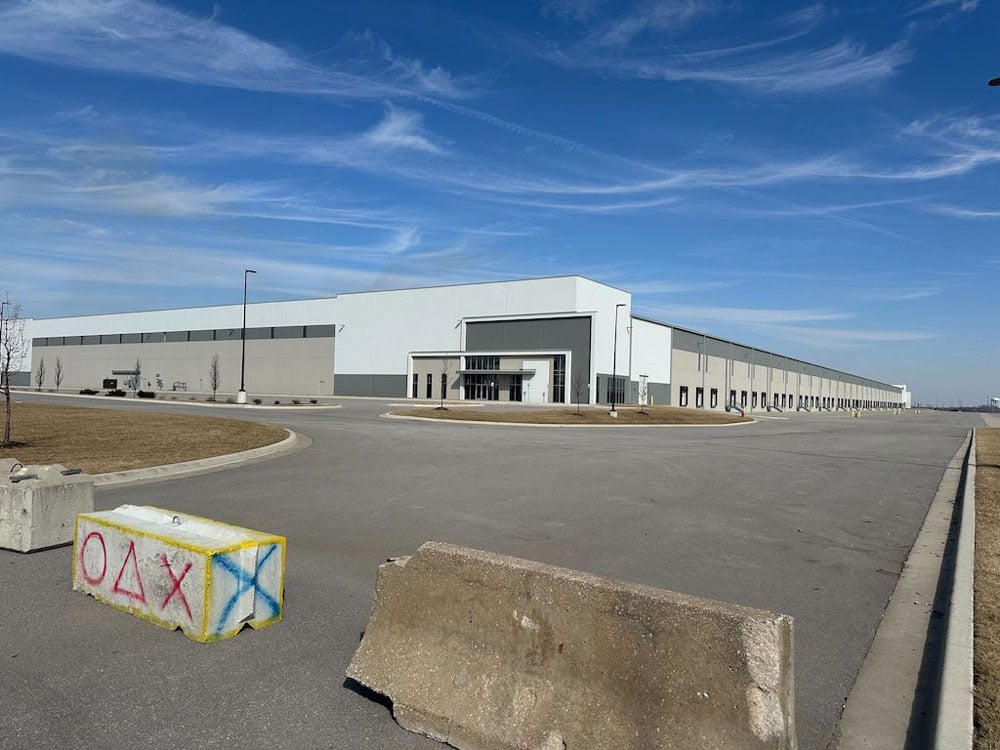
Outrage erupted last month when Oklahoma City residents learned of plans to convert a vacant warehouse into an immigration processing facility.
Making matters worse was the secrecy of the federal government: City leaders received no communication from U.S. Immigration and Customs Enforcement aside from a mandated disclosure related to historic preservation.
Planning a major development without city input is antithetical to the in-depth, sometimes arcane permitting, planning and zoning process in Oklahoma City. Mayor David Holt, a former Republican state senator, said those land use decisions are among the most crucial of any municipal government.
“For any entity to be able to open a detention center in our communities, potentially next to neighborhoods or schools, regardless of your views on immigration policy or enforcement, is very challenging, because that’s a very high-impact use, and that’s the kind of thing that we would expect to talk about,” he told Stateline.
Communities across the country are facing similar prospects as ICE undertakes a massive expansion fueled in large part by the record $45 billion approved for increased immigration detention by Congress last summer.
During President Donald Trump’s second term, ICE is holding a record number of detainees — more than 70,000 as of January — across its own facilities as well as in contracted local jails and private prisons. ICE documents from last week show plans for acquiring and renovating 16 processing sites that hold up to 1,500 people each and eight detention centers that hold up to 10,000 each, for a total capacity of 92,600 beds. The agency also has plans for some 150 new leases and office expansions across the country, Wired reported.
But ICE’s plans to convert industrial buildings — often warehouses — into new detention facilities have recently faced fierce opposition over humanitarian and economic concerns. From Utah to Texas to Georgia, local governments have sought to block these massive facilities. But with limited legal authority, city and state officials have turned to the court of public opinion to deter private developers and the federal government.
Holt, who is the president of the U.S. Conference of Mayors, a nonpartisan organization representing the more than 1,400 leaders of cities with populations of 30,000 or more, said cities have little legal recourse over the ICE facilities.
“We all have a clear, unified position that really crosses party lines,” he said, “and then we also have a clear understanding of how limited our options are.”
Local leaders often cite the U.S. Constitution’s supremacy clause, which says federal laws supersede conflicting state laws. That leaves cities with limited influence over projects that could take industrial space off tax rolls, cause new strains on city services and raise serious humanitarian concerns given the Trump administration’s aggressive immigration enforcement, including the high-profile killings of two Americans in Minnesota.
Facing bipartisan opposition, the out-of-state owner of the Oklahoma City warehouse ultimately decided to end talks of selling or leasing its warehouse to the federal government.
Similar public pressure has proved effective in reversing plans in several other cities: In late January, a Canadian firm said it would not proceed with a planned sale of a Virginia warehouse after it faced calls for a boycott from Canadian politicians and businesses. In Mississippi, U.S. Sen. Roger Wicker announced the federal government would “look elsewhere” after he spoke with Department of Homeland Security Secretary Kristi Noem, who oversees ICE. Wicker, a Republican who said he supports immigration enforcement, echoed local economic concerns of a project planned in Byhalia.
Some officials have welcomed the new facilities: Missouri Republican U.S. Rep. Mark Alford has lobbied to land a detention and processing center in his district. And last week, a Maryland county approved a resolution expressing its “full support” for ICE, which is considering purchasing a warehouse there, despite local protests. But most communities have fought them.
Neither DHS nor ICE responded to Stateline’s questions.
Holt said the discussion resembles other local development concerns where NIMBY — short for Not in My Backyard — is a common description of opponents.
“There are plenty of people who are very law-and-order and supporters of law enforcement who don’t want a jail next to their house,” he said. “That’s why it’s got such broad opposition: NIMBYism is the most powerful force sometimes in American politics and nobody wants a detention center next to their home, their business or their school.”
A political and legal fight
After learning that ICE planned to take over a vacant warehouse within its city limits, the Kansas City Council in January swiftly approved a five-year ban on nonmunicipal detention facilities.
 Kansas City Council member Andrea Bough, who is also a private development attorney, said the move was both political and legal: The city wanted to send a clear signal opposing ICE facilities, but it also wants to exert its local authority over planning and zoning.
She acknowledged the legal hurdle posed by the supremacy clause, but said there was enough ambiguity over the city’s ability to regulate land use that it may take the issue to the courts.
“Some would say local building codes and zoning regulations do not apply to the federal government,” she said. “That’s something I think we would probably in this situation be willing to fight until we had clear guidance on that.”
Following weeks of pressure, the Kansas City firm that owns the 920,000-square-foot warehouse announced Thursday it was no longer “actively engaged with the U.S. Government or any other prospective purchaser,” the Kansas City Star reported.
Jackson County, which includes portions of Kansas City and the potential detention facility, is considering a similar ban. And across the state line, the Unified Government of Wyandotte County and Kansas City, Kansas, is considering a similar two-year moratorium.
But there are clear limitations on cities’ ability to stop federal projects, said Nestor Davidson, a professor who teaches land use and local government law at Harvard University’s Graduate School of Design.
“The federal government can assert immunity from certain state and local laws, including zoning, but it’s complicated, and there are nuances,” he said.
Still, Davidson said some case law has shown cities may have stronger legal footing for zoning rules that are broad and not directly targeted at specific federal government projects.
“I expect to see litigation,” he said. “I think you’re going to see these conversations play out as land use fights often do: both in a legal venue and in a political venue.”
Governments pressured to act
Kansas City’s moratorium has sparked interest among local activists who have pressured elected officials in other cities across the country to act. But many local officials are adamant that federal law ties their hands.
In a legal opinion provided to the Orlando City Council in Florida, City Attorney Mayanne Downs rejected “suggestions of actions we can supposedly take,” including moratoriums or using zoning ordinances to block ICE detention centers.
“However well motivated these suggestions are, the law is very clear: ICE, as an agency of our federal government, ICE is immune from any local regulation that interferes in any way with its federal mandate,” Downs wrote to the mayor and city commissioners.
ICE is reportedly considering a new $100 million processing center in southeast Orlando.
The county commission in Orange County, which includes Orlando, discussed the issue last week after receiving similar legal advice. County Commissioner Nicole Wilson said the board is even more constrained because of a recent Florida law limiting certain local governments’ ability to regulate development through 2027.
After being advised against passing a moratorium, the board agreed with Wilson’s follow-up suggestion to draft a resolution expressing its opposition. That will be considered at a future meeting.
“It doesn’t sound like it has the teeth that a moratorium would have, but it essentially gives an awareness that we’ve established a position in opposition to this type of facility in Orange County,” Wilson told Stateline.
An attorney by trade, Wilson said the case law regarding federal projects largely centers on disputes about post offices, which she said is not an appropriate comparison to the massive detention centers currently contemplated.
“A post office has the same water consumption and sewage as probably a lot of other uses,” she said. “If you take a warehouse that was designed for 25,000 widgets and put 15,000 humans in it, you’ve got a very different set of local needs and services that are being used and being taxed and being burdened.”
Working with the feds
Communities have often opposed various other federal projects, such as federal courthouses. But the federal government generally takes the time to listen to local concerns and communicate building plans with communities, said Jason Klumb, a former regional administrator with the U.S. General Services Administration, which manages the federal government’s real estate.
“Generally, GSA has had kind of a good neighbor approach, understanding that they have requirements for federal facilities, and some of those facilities may not always be popular,” said Klumb, an Obama appointee.
But the federal government has not been shy about exerting its constitutional authority.
For example, late last month, GSA announced it would build a new $239 million federal courthouse in downtown Chattanooga, Tennessee, despite bipartisan lobbying from city and federal officials for a different site.
“The feds get what the feds want, ultimately,” Klumb said.
In a statement, a GSA spokesperson declined to clarify the agency’s current role in acquiring ICE detention facilities. The statement said the agency was “following all lease procurement procedures in accordance with all applicable laws and regulations.”
Communities have largely been left out of the administration’s immigration decision-making process.
“Most of the information we have received on this facility has been through news leaks and the government has not reached out to us yet,” said Paul Micali, the town manager of Merrimack, New Hampshire.
Through an open records request, the ACLU of New Hampshire confirmed that ICE was planning to convert a 43-acre warehouse property in the town of about 28,200.
The federal plans were obtained from the state’s historic preservation office, which came under fire for not informing Republican Gov. Kelly Ayotte of ICE’s proposal. That agency’s top official resigned last week after pressure from Ayotte.
Ayotte’s office did not respond to a request for comment. On Thursday, her office released documents detailing how the federal government’s $158 million plan to retrofit the property would create hundreds of long-term jobs for the region.
Testifying before Congress Thursday, an ICE official said the feds will not cancel the project over local concerns.
Micali said the vacant warehouse currently provides about $529,000 in annual property taxes — a substantial sum given the town’s property tax base of about $20 million.
In a letter to Noem, the Town Council said converting the property to a tax-free federal facility would result in higher local taxes for residents. Merrimack is also concerned about potential demands for water, fire and other city services, Micali said, but can’t even begin to assess needs without more details from the federal government.
He’s speaking with lawyers about what options, if any, the town may have to assert local zoning power.
“We’re looking at every possibility,” he said.
–Kevin Hardy, Stateline



























joe says
It’s been asked online – if the goal is to deport all these people, why all the massive detention facilities designed to hold thousands and thousands at a time? If you don’t think these facists are only going after and detaining “the worst the worst”, you’ve believed a lie.
Me says
Why are these being build and wasting taxpayers money? Why can’t our government come up with a human immigration system? These facilities are cruel inhumane and not what our country is about.
Pogo says
@Publicly sanctioned and funded concentration camps
… are happening like Hitler’s mustache under your noses — a clue:
https://www.google.com/search?q=private+correctional+company+as+a+us+economic+sector
You provide your blessing with your cooperation and acquiescence, property, and funding; the usual suspects get rich, and leave everyone else with the cover-up, cleanup, debt, and disgrace.
When you elect thieving monsters, you’re saying that IS who YOU are too. Period.
Sherry says
Dear Pogo. . . one of your very best! Thank You! The last line is perfection!
Land of no turn signals says says
Build them they will come.
Deborah Coffey says
We should be calling these what they are: concentration camps
Dictionary
Definitions from Oxford Languages · Learn more
con·cen·tra·tion camp
/ˌkän(t)sənˈtrāSHən ˌkamp/
noun
a place where large numbers of people, especially political prisoners or members of persecuted minorities, are deliberately imprisoned in a relatively small area with inadequate facilities, sometimes to provide forced labor or to await mass execution. The term is most strongly associated with the several hundred camps established by the Nazis in Germany and occupied Europe in 1933–45, among the most infamous being Dachau, Belsen, and Auschwitz.
James says
With all the news regarding ICE and illegal immigrants lately, does anyone notice that we hardly hear anything about the homelessness problem?
Perhaps they’ve solved it… and we’re looking at it.
Just a frightening observation.
Laurel says
Consentration camps with Kristian Kristi Noem in charge. Your tax money at work. Private industry needs bodies.