



By Charlie Hunt
Every election cycle sees its share of controversial, scandal-plagued candidates running for office. But the 2026 midterm elections will feature two such candidates – one from each party – in two of the highest-profile U.S. Senate races.
In Texas, the state’s attorney general, Ken Paxton, recently secured the Republican Party’s nomination over incumbent Sen. John Cornyn.
Cornyn and others have insisted that Paxton’s substantial legal and personal baggage – including corruption and bribery accusations that got him impeached by the GOP-led state House of Representatives – might lose Republicans a seat they’ve held for decades.
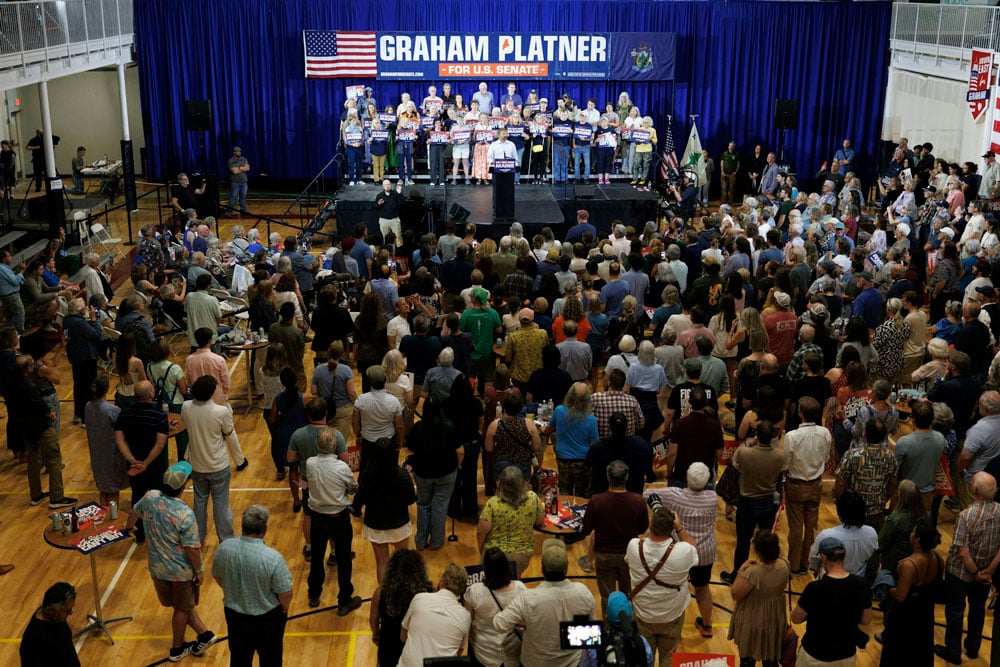
Democrats in Maine, meanwhile, have nominated Graham Platner, a political novice whose grassroots campaign and brash communication style propelled him to a decisive victory over the state’s Democratic governor, Janet Mills, who remained on the ballot but suspended her campaign in April.
This, despite Platner facing a series of personal scandals ranging from alleged sexual misconduct to a tattoo that turned out to be an emblem of Hitler’s paramilitary Schutzstaffel, or SS. Platner has claimed he was unaware of the symbol’s origins and has since covered it up.
Both Paxton and Platner won resounding victories in their primaries over more establishment candidates who were comparatively free of scandal.
As a scholar who studies Congress and elections, and the co-host of a podcast about political scandals, I believe political science offers answers about how Paxton and Platner pulled off victories in their states’ primaries – and why they might win in November.
Historic distance and distaste between the parties
Both Paxton’s and Platner’s flaws were well known prior to primary voting.
Early polling indicates that most of Texas’ Republican voters are likely to back Paxton in November. Polling also shows that Platner will continue to consolidate his party’s support in Maine.
Both parties’ leadership in Congress and beyond have also rallied behind their respective candidates. And both parties have used the opposing candidate’s scandals against them in the campaign, despite propping up flawed candidates themselves.
These actions can coexist thanks to two forces that political science has much to say about, precepts that have been steadily increasing in relevance over the past few decades: party polarization – or the distance between the two parties – and negative partisanship, voters’ tendency to vote based on negative feelings toward the other party.

AP Photo/Tony Gutierrez
Democrats and Republicans are far away from each other on policy preferences, issue positions and culture. They are also distant in terms of where they live, whom they support, how they feel and even whom they love.
Political science tells us that this polarized distance has increased feelings of personal animus between members of the two parties. Political psychology says the more different Americans are from each other, the easier it is for them to not just disagree with the other side but to dislike the other side to the point of viewing them as a threat.
These are trends Americans frequently see reflected in public opinion studies, many of which use the “feeling thermometer” to ask respondents to rate their personal feelings toward a person or party on a scale of zero degrees, or coldest/most unfavorable, to 100 degrees, or warmest/most favorable.
In the late 1970s, the average voter in each party was more or less neutral toward the opposing party, with scores hovering just below 50 degrees. By 2024, the average voter sentiment toward the other party had plummeted to 19 degrees.
In 1978, only 9% of Democrats and 7% of Republicans had a very negative opinion of the opposing party. By 2024, vast majorities in both parties – 64% apiece – reported such negative opinions.
Political science also tells us that these negative feelings about the other party are not simply prevalent. They are the driving force behind many voters’ election choices.
In other words, Americans are increasingly making voting decisions based not on who should win elections but rather on who shouldn’t. The opposing party is not just the less preferred option – it’s a threat that must be stopped at all costs.
When feelings about the other side are this negatively polarized, then winning – even with a less-than-ideal candidate as your standard-bearer – becomes more crucial than ever.
In fact, researchers have found that scandals involving candidates in a voter’s own party trigger a “defensive partisanship” that increases their hostility toward the other side. That is, scandals in a voter’s own party can make them more – not less – loyal to their team.
SDI Productions/Getty Images
The higher the stakes, the lower the standards
Polarization and negative partisanship are not the only factors at work. The tight competition for control over major political institutions such as Congress and the presidency have raised the stakes of elections higher than ever. And, in the process, it has lowered standards for whom Americans are willing to support.
In her 2016 book, “Insecure Majorities,” political scientist Frances Lee found that partisan control over the federal government is more in question now that it has been in over a century. Lee says that closely fought elections that determine control of government help explain changing governing strategies in Congress.
But Lee’s findings also help explain our choices in elections and how – even in closely fought, high-profile races such as the 2026 Senate contests in Texas and Maine – voters end up nominating such blemished candidates.
In theory, closely fought competition should drive a “race to the top” in terms of candidate selection. Because control over institutions rests constantly on a knife’s edge, Americans might expect both sides to put forward their best, brightest and most electorally compelling candidates to try to win.
But thanks to polarization and negative partisanship, it isn’t always so. Instead, hard-fought elections among a closely divided electorate mean that individual votes matter more; that power hangs by a thread; and as a result, that one’s personal and political enemies are inches away from controlling the government.
Thus, closely divided elections only raise the stakes of one’s vote, along with the cost of defecting from your party’s candidate, however flawed they might be.
The lesser of 2 evils?
Voters constantly report feeling the need to “hold their noses” and vote for the “lesser of two evils.” The alternative – the other party taking power – is too grave to permit a truly principled stand. As a result, the race to the bottom continues, because the other side will always be worse.
These trends can help explain why, for example, Republicans circled the wagons around Donald Trump in 2016 despite his many scandals and serious misgivings within the party. They also illustrate why Democrats rallied around Joe Biden well into 2024, even as serious questions were raised about his physical age and mental fitness for office.
Whether Paxton’s or Platner’s partisan voters end up coalescing around them despite their scandals remains to be seen. Regardless, the reappearance of such imperfect candidates each cycle tells a bitter story about what voters will put up with to win.

Charlie Hunt is Associate Professor of Political Science at Boise State University.




























Laurel says
Fear and Loathing on the Campaign Trail hits a new low.
I don’t live in Maine, so what they do is their business. It doesn’t sound as bad as Texas, but I am disappointed in Platner, and wouldn’t vote for him now.
In Texas, however, something else is going on. This is blatantly good v. evil! Paxton is about as corrupt as one can get, and the picture at the beginning of the article, with women holding his sign and smiling, is highly offensive to me. Here are a few of Paxton’s scandals:
https://thebarbedwire.com/2026/02/17/ken-paxton-scandal-timeline/
Here is further reason to not back this person:
“Yes, Texas Attorney General Ken Paxton’s office offered a plea deal that allowed a man charged with repeatedly sexually abusing a child to serve only one day in jail and not register as a sex offender. This decision has faced significant criticism from political opponents and local officials.”
– Search Assist, joemygod.com, The Texas Tribune
Seriously? Sure looks like another pedophile protector representing the Republican Party, doesn’t it? Am I wrong? Would any of you Republicans vote for him?
Who is he running against for Senator? James Talarico. The worst things said about Talarico are made up lies, such as he’s a vegan, he’s a trans, he’s a woman. All lies, and no real baggage to dig up. James Talarico is an eighth generation Texan, who is a practicing, devout Christian. The real deal. The fake Christians fear him as they use the religion to control people. They spout lies. They condemn people. They can’t have someone who actually walks the walk and talks the talk beat them. The fact that he has no scandals, means the opposition has to pull lies out of their asses, and this is what people will vote for? Amazing, isn’t it?
Ed P says
Hello Laurel,
Your bias is so openly on display. What they do in Maine (with a dem) is their business, but boy oh boy, those Texas Republicans.
It’s beyond pathetic.
If the partisan lens is removed, none of the three candidates you referenced are senatorial material. Period.
If this is indicative of the future, greed and corruption will be the least of the problems.
Laurel says
Here in Florida, YouTube is flush with Byron Donalds’ ads. He starts out with “The radical Democrats don’t want…” Oh, so a large population of our family, friends and neighbors are immediately “radical.” Not just a different party, but all “radical.” Division! He is not running for Floridians, he is running for a portion of the public, and his own butt. The rest of Floridians are not worthy of his attention, other than to condemn. He moves his lips and Trump’s words come out. No real plan of his own, but plenty of out of state PAC money to spend.
Just FYI, when I pick a video to watch, and Donalds’ ad comes up, I back out, wait a few seconds, and go back in. Poof! Ad gone! If his ad comes up in the middle of a segment, I go out. His bs, and lack of real leadership offends me.
C’mon, people, stop holding your noses! What does the Republican Party do for you? Just wind you up over stupid culture wars? The vast majority of it are lies, anyway. Why waste your time? What are the Democrats doing for saving your Social Security and Medicare? Not much. Leave the culture crap behind. Search for candidates who work on REAL issues. Stop being manipulated! They are abusing you! Where’s your healthcare? Where’s your affordability? Stop worrying about trans people, and start worrying about issues that really effect you.
Both Republicans and Democrats need to consider becoming NPA (Non Pary Associated) and throw the manipulating politicians off balance, and realize you will no longer vote for the “R” or the “D,” and that they have to start working for you instead of lining their pockets. Maybe, just maybe, the trash will be thrown out, and the sincere brought in.
Ray W. says
Is it possible that there may come a time when party polarization and negative partisanship can no longer restrain the drive toward cheaper electricity? Will we ever stop giving political power to those who want us to pay more for the electricity we consume?
On June 16th, the U.S. Energy Information Administration (EIA) published a Today in Energy study focused on the amount of electricity produced by California’s Independent System Operator (CAISO) from January 1st to May 31st.
Solar electricity generation is up 21% over the same time period in 2024. Natural gas electricity generation is down 60% from 2024, though overall natural gas generating capacity has remained “flat.”
Overall, the actual power produced by solar surpassed the quantity of electricity produced by natural gas. During the five-month interval, 82% of the days saw solar outproduce natural gas. Both battery storage and solar plant capacity is up from 2024.
Natural gas generating capacity, according to the publication, remains at 29 gigawatts. Solar plant generating capacity increased to 25 gigawatts.
Make of this what you will.
Me?
I argue that having the capacity to produce electricity is not the same as having the demand to produce electricity. So long as electricity produced by solar farms is less costly, solar farms will be called on first to supply electricity to the CAISO grid whenever possible. Natural gas plants, if more expensive, will be secondary. This explains why solar, having less overall capacity, produces more electricity for the CAISO grid than natural gas, which has more overall capacity.
I also argue that there was a time when political differences could be maintained about renewables. No more. Renewables have become comparatively too inexpensive to maintain the old political argument. No political party can maintain an argument that people ought to pay more for their electricity without lying. That doesn’t mean that pestilential partisan members of faction won’t continue to lie about renewables.
Ed Danko, former Vice-Mayor, PC says
Some candidates have baggage, and some baggage have candidates. In this case the baggage with candidates are Platner, Talarico, and a handful of socialist communist running in various blue states. It is shameful that Democrats would support a candidate who has a Nazi tattoo, especially considering how they call all Republicans Nazis. Also, shameful how they support Platner despite the sexual misconducts. Democrats say we should always believe the woman when it comes to sexual accusations, unless of course it involves a liberal candidate they support.
Deborah Coffey says
LOL. Shameful that you support a Nazi in our White House. Your hypocrisy is dripping all over this page.
Callmeishmael says
I don’t think you’re a Nazi, Danko. You’re just a bigoted, dumbass still trying to fit in with your bigoted dumbass social circle.
Feel sorry for you, kinda. . .
Nah, not really.
Pogo says
Graham Platner is disgraceful, but the female defense contract pork producer who gave trump a pass in 2 trials, voted to criminalize women’s choice with her approval of MAGA ayatollahs who like beer and bribes for the SCOTUS is okay?
W T F ! ! !
The ERA passed in 1972, and still waits, but intersectionality (coined by a fashionable fish hag, for fashionable fish hags, in 1989, continues to cancel people who could make a difference for the better.
SMH, in total disgust.
Sherry says
A huge THANK YOU Pogo!
Pogo says
You’re welcome, and likewise.
Sherry says
DJT. . . is the perfect example of “how fear and loathing can cause people to vote for scandalous/”CRIMINAL” candidates!!!
Ed P says
Or the opposing party run severely flawed candidates that leaves voters with a stomach churning decision.
Competent or character?