



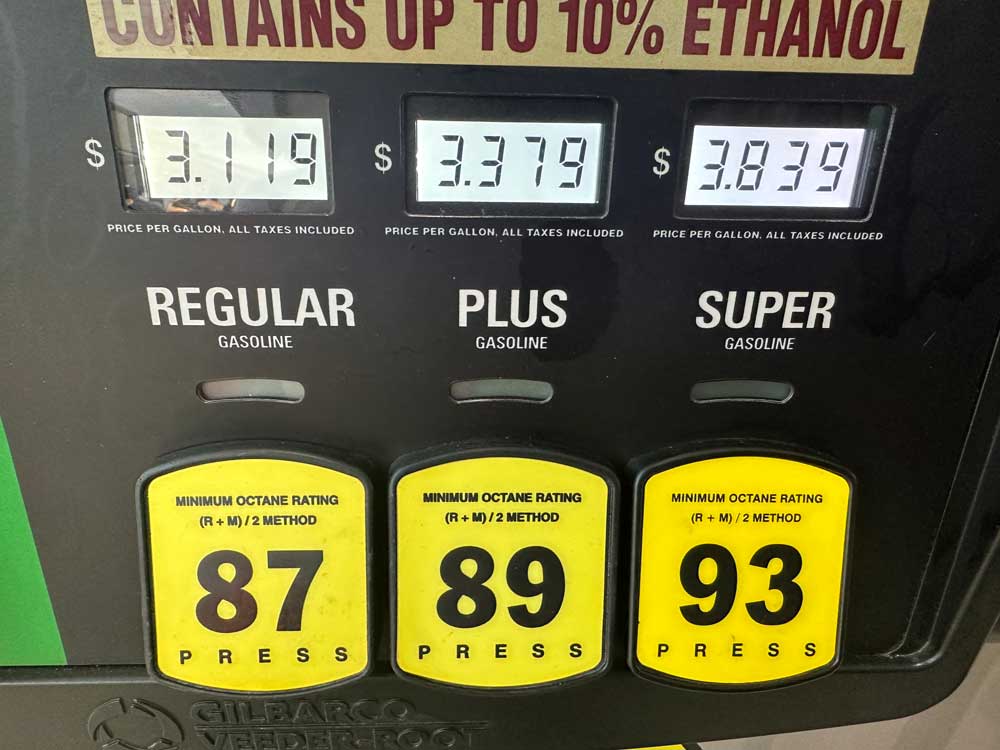
As gas prices fell for a fourth consecutive week, analysts continue to caution that it could be weeks or months before returning to pre-war prices.
On Monday, the auto club AAA reported the average gallon of gas in Florida was $3.62, down 20 cents from the previous week following the announcement of an agreement to end the war with Iran.
“The real test now shifts to the Strait of Hormuz, where any reopening and resumption of normal oil flows would be the clearest signal that this relief is durable,” wrote Patrick De Haan, head of petroleum analysis at GasBuddy. “For now, the national average could continue falling, provided there isn’t a drastic reversal and the U.S. and Iran continue moving in a positive direction.”
The average in Florida has fallen 88 cents over the past month and on Monday was at the lowest since $3.49 on March 9.
Averages were lowest across Central Florida and the Panhandle, while the Big Bend region and South Florida displayed the highest pump prices.
“Even so, relief at the pump won’t arrive overnight, as analysts caution it could take months for shipping and refining to normalize, and crude remains more than 20 percent higher than when the war began and over 40 percent higher than at the start of the year,” De Haan wrote.
The average in Florida was $2.90 on February 28 when the U.S. and Israel began attacks on Iran, which responded in part by closing the Strait of Hormuz, where about 20 percent of the global supply of oil is shipped.
Retailers are also slow to bring prices down because pump numbers are based on what they already paid rather than current market prices of crude.
AAA noted that as the pump price declines, there is additional demand as motorists rev up for summer travel.
AAA estimates 4.62 million Floridians will travel at least 50 miles for the holiday period, 1 percent more than in 2025 and about 4.3 percent more than in 2024.
–News Service of Florida




























Ray W. says
Goldman Sachs published a “research note” to subscribers, in which note researchers published findings after investigating a worldwide surge in EV sales triggered by onset of war. The note adopted two surge models, either long-term or temporary.
Should the recent EV buying surge prove permanent, the war alone will prompt enough additional EV purchases that worldwide crude oil consumption will drop by up to 320,000 barrels per day by the end of 2027, excluding all other variables.
In the temporary surge impact scenario, worldwide crude oil consumption will drop by 120,000 barrels per day by the end of 2027.
Make of this what you will.
Me?
Of what value energy independence?
If the note proves correct, then either way a measure of fossil fuel demand destruction will ensue.
One recent news story quotes an economist who argues that the economic impact from the Iran War on worldwide GDP is already at $2.2 trillion and rising. More news stories are bound to follow. The arguments among economists will likely persist for decades. If nations most dependent on Gulf state crude oil, mainly Asian nations, i.e., South Korea, Japan, Vietnam, Australia, etc., pivot toward less costly and more dependable renewables, will long-term productivity gains accomplished by access to cheaper renewable electricity offset some of the projected GDP war losses?
Will nations all over the world be persuaded to invest in upgrades to their electricity grids in order to reduce waste brought on by transmission corridor congestion?
I don’t claim to know. I am not an economist. At best, I am a curious student.
But I caution every FlaglerLive reader against listening to any of the many pestilential partisan members of faction who wander among us; their modus operandi has long been to lie in hopes that the gullibly stupid will launder their lies.