



A Personnel Review Board appointed by the Flagler Beach City Commission held an afternoon-long, trial-like “name-clearing hearing” today for Stephen Cox, the former fire chief City Manager Dale Martin fired in May after seven members of the fire department signed a no-confidence letter.
The board has the authority to issue a recommendation either affirming the city manager’s decision or finding against it. (The recommendation is submitted to the city manager.) It did neither today: the hearing was recessed after five hours, with three witnesses yet to testify, Cox among them. It will resume sometime in the second half of July: the board members have not settled on a date.
The hearing was inconclusive except in one regard: it brought to light systemic problems with an overworked, underpaid and under-supported department that predate Cox and that likely will persist, whether he is there or not. But none of those issues are in the board’s purview to address, the hearing’s purpose being limited to Cox’s name-clearing. Those issues are the city manager’s and the City Commission’s problem. Two commissioners attended the entirety of the hearing–Scott Sopradley and John Cunningham.
Cox was fired on May 11 after one year as fire chief and 16 years at the department, and less than a month after a majority of the 12-member department had resigned. The hearing revealed a bounty of granular details about the weeks that led to the firing.
It did not change the essence of what has been reported until now: that Martin fired Cox exclusively on the strength of a letter of no-confidence signed by seven members of the department:
- That Martin had not been aware of internal conflicts at the fire department until the resignations and the no-confidence letter.
- That Martin’s investigation of the causes behind the resignations and discontent was limited to verbal interviews with most of the department’s employees, without notes, recordings or any other documentation.
- That Martin had no cause to fire Cox on the basis of any policy violations, misconduct or wrongdoing.
- And that he felt he had to fire him–or allow him to resign–for the sake of keeping the remaining employees from resigning as well. He assumed they would resign if he did not act, though he had no evidence to that effect other than the no-confidence letter by the others–and that four of the employees who had resigned had done so for reasons predating or independent of issues with Cox.
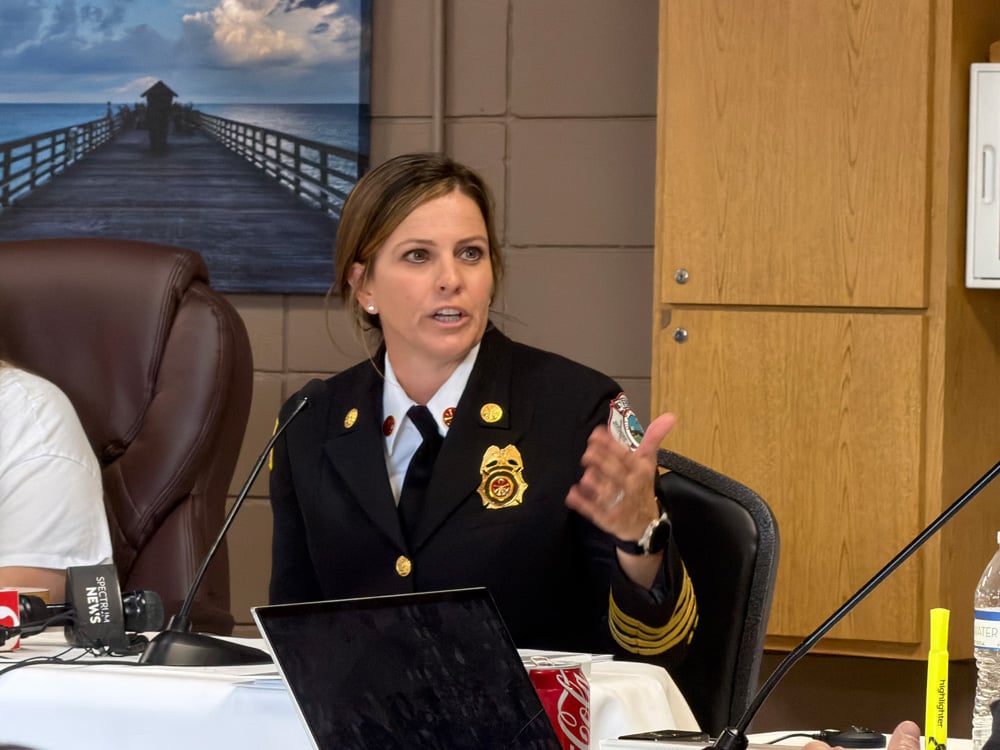
“It was time for a change and without a change effected I was at risk of losing the entire department, and that would be the truly public safety issue,” Martin testified. He echoed what the former deputy fire chief and current acting chief, Jennifer Fiveash, testified: she’d lost trust in Cox. Fiveash is leaving the job Friday.

Fiveash’s resignation was the domino that began the unraveling at the department, even though she had planned to resign months before regardless as she was moving to Colorado for family reasons (her oldest son had grave health issues). Frustrations with Cox’s leadership contributed to her decision.
Fiveash testified that Cox would repeatedly blame the previous administration of retired Fire Chief Bobby Pace for the many internal problems. She told him he had been part of that administration, and she discovered that the problems had not exclusively been caused by pace, but that Cox himself was part of the problems. “Everybody was on his team was what I was given, and that’s not the case,” Fiveash said. “There was a lot of issues with how he was doing things.”
She described some of those issues, including in one case having to deal with a problem employee while she was off in Colorado, because Cox was not stepping up back in Flagler Beach. The problematic firefighter had become belligerent and was not willing to get on a firetruck.
Fiveash wanted to take the firetruck out of service so as not to jeopardize two other firefighters who’d have been on the truck with the problem employee. It is the only firetruck in the city. Cox refused, and also refused to be the third firefighter on the truck if necessary. They butted heads, Cox considered her insubordinate and prevailed. The truck was not taken out of service. In effect, Fiveash took herself out of service as a consequence.
Testifying today, she drew the portrait of Cox as someone who “says all of the words” and could have his own podcast, but did not follow through in the field and as an administrator, and that there were “little things that kept happening,” she said, rather than one big thing. “And it was always, ‘I’m sorry, I’ll do better.’ But it never got better. Never got better.”
“Did the crews want him on the scene?” the city’s labor attorney asked her.
“No,” Fiveash said, in one of the most damaging part of her testimony against Cox.
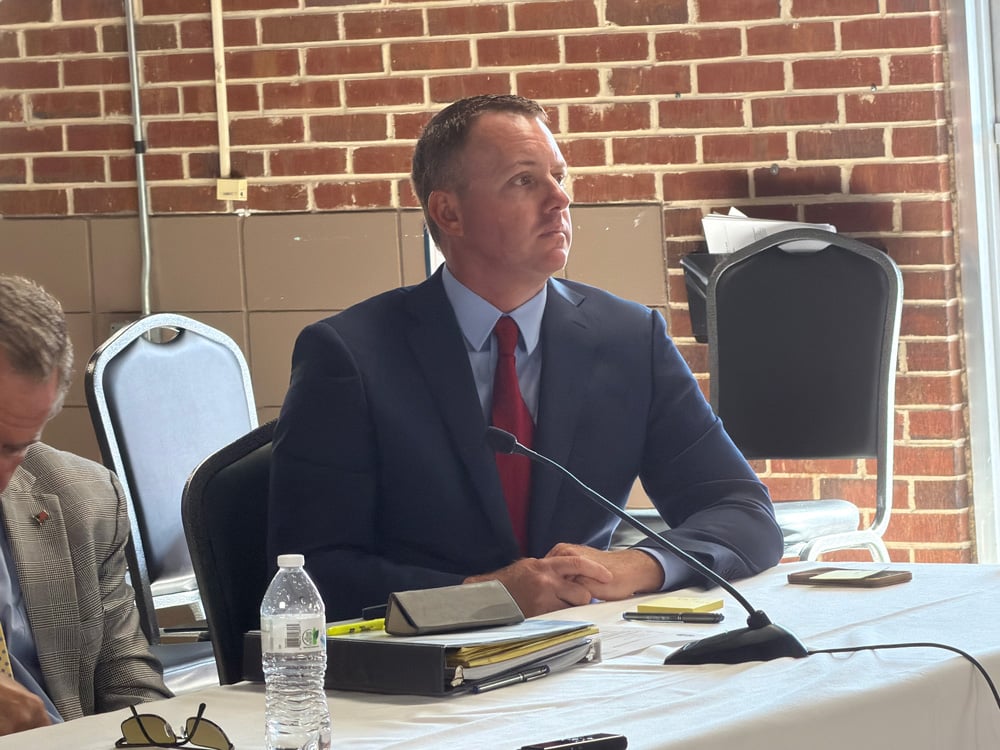
It was a formal hearing following very formal rules before the four-member Personnel Review Board, with City Attorney Drew Smith serving as a procedural referee, but separate, seasoned labor attorneys representing the two sides. Gary Wilson represented Cox. Jeff Mandel represented Martin and the city. The two sides each sat at a separate, white-clothed table, facing the board from the floor of City Hall’s commission chamber.
Fiveash, Acting Deputy Fire Chief Morgan Rainey and one other firefighter, along with Martin, Cox and Liz Mathis, the city’s human resources director, were the listed witnesses. The attorneys examined each on direct or cross-examination, and at length.
Mandel argued on behalf of the city that it is irrelevant how Martin fired Cox or whether he had cause to fire him. By policy, Martin could fire him any time he chose, with or without a reason. “As a public at-will employee, you can be fired for anything, including the type of sunglasses you wear,” Mandel said. “Nor do you have due process rights by virtue of working for the government. The charter, the code and the personnel policies control what process you may have.” He added, “unless there is something out there in writing that says that the city manager cannot remove somebody when he, in his discretion and authority, deems it to be in the best interest of the city, he’s allowed to do that.”
Martin was unapologetic as he testified calmly and consistently about the firing the chief he’d elevated to the job then given an exceptional evaluation months before the firing. To Martin, new evidence came to light, ending his confidence in Cox. There were numerous inconsistencies and some contradictions in Martin’s testimony. They may raise questions about his administrative methods, such as documenting some meetings but not others, detecting some red flags but not others, remembering some emails or documents but not others.
None of the inconsistencies undermined the city’s case against Cox, as Mandel focused as much on Martin’s authority to fire the chief as he did on the internal conflicts that had developed on Cox’s watch.
Wilson, Cox’s attorney, was just as focused on a recurring theme: the absence, until today’s testimonies, of any documented evidence of Cox as a problem. “Not only was there no evidence,m but there’s no record of evidence, no audio recording of interviews, no transcripts, no notes,” Wilson said. There was only the city manager’s authority and the no-confidence letter signed by the seven employees. Today, a nine-page “letter of accusations” that Fiveash wrote on June 13 was made part of the record. It had not existed at the time of Cox’s firing. “We literally had this plopped on the table at the start of this” hearing, Wilson said.
How did it come about, Wilson had asked Martin.
“I asked for it,” Martin said. “I needed more specifics.”
The document was not dated, but Fiveash testified about the day she completed it. It was hand-delivered to Martin by Mathis, the HR director. It was another odd revelation that Wilson underscored several times: that the case against Cox was largely filled in after the fact, though the facts that kept filling in through testimony today were not necessarily in dispute, or disputed. The question for the board as framed by Wilson would be whether those issues rose to the level of a firing.
“You will be left with the conclusion that there was no basis to terminate chief Cox, and moreover the damage that was done to him and his reputation is possibly irrevocable,” Wilson had told the board. “The damage that has been done to his name, he can’t get hired now.”
By late afternoon, each side had put on the substance of its case and circled for any possible detail that could buttress what had already been established. At times it misfired, as when Wilson tried to show that Fiveash, among others, had planned to leave the department for personal reasons, and that Cox wa snot the reason.
“The truth is you’re leaving first and foremost because of what’s in Colorado,” Wilson told Fiveash.
“No,” Fiveash said, her assertiveness grazing the aggressive. “I told him I was leaving because of him.” She added, “I would not work for him. I told him that. He knows that.” It was that sort of drain Martin had referred to, to justify stopping a bleed Wilson had argued had not been Cox’s doing.




























CHARLES Bub ROBSON says
Reinstate the Fire Chief, I see a conflict and it is not the Fire Chief.
Samuel L. Bronkowitz says
Dale Martin seems kinda like a dipshit, maybe someone should fire him.
Pig Farmer says
As someone who used to manage a group of people, I can say that if you do not lead by example, your staff will not have respect for you. Managers must be willing to perform any of their subordinates jobs as necessary. Not just to fill in when nobody else is available, but to “walk a mile in their shoes”.
Michael John says
My view as a Flagler Beach resident.
1. Poor management. Poor Leadership.
2. Lack of professional decorum.
3. Where are the “Counseling records”.
If there’s concern with an employee there should be counseling records showing the circumstances causing the problem and solutions presented to the workers involved. This should be public knowledge.
Past History says
I can tell you that Jen Fiveash lady is the issue here. She caused waves with her last job at Palm Coast Fire and has now brought that over to the Flagler Beach Fire. Dale Martin needs to be fired for the shady way he handled this. Reinstate the fire chief!
Tony says
Sounds like a proverbial “Witch Hunt” and smear campaign toward Chief Cox. Perhaps he was holding them to a more professional standard and they wanted their playpen instead.
RobdaSlob says
Poster child for why people think local governments waste our dollars and we need changes to their funding stream – aka property tax reform.
While Martin was clearly coached on how to message Cox’s termination to stay within the bounds of at-will, we are on a pathway to a wrongful termination suite – and whether successful or not the expense of this comes out of the tax payers pockets. All because we can’t seem to hire managers that use common sense. Further events like this damage Flagler Beach’s reputation as an employer which costs taxpayers money…
Since Flagler Beach can’t manage a fire department – let’s roll it under Flagler County and just have one chief and then resources can move between facilities at the discretion of the one chief.
Dan Jones says
Just have the county take it over, makes more fiscal sense anyway.
Mothersworry says
WOW!! If the City Manager is having a bad day he can just go out and terminate an employee in Flagler Beach. I get that if there is a probationary period he has that right. But why the hell would anybody want to work for the city?? People fought and died for workers rights and fair treatment in the work place, but apparently the message never crossed the bridge. This is absolutely nuts!! How does the city expect to hire qualified, competent employees to staff its departments. A case like this will poison any relationship between the employees who actually show up and do the work and management. The message is pretty clear. If you don’t like your boss write a few letters to the City Manager and problem solved. Shame on those who support and participate this manner of “labor relations” to me it is totally unacceptable.
Rookie mistake says
The City manager should have talked to the chief and documented what he thought the issues were. He should’ve met with all the firefighters and documented their complaints. He should’ve consulted with his HR person and an employment attorney. He should’ve asked outside fire officials to review these reports and make recommendations. Once properly informed, he could then make the best decision.
The picture is unclear still but it seems the City Manager didn’t do his job at all. Maybe he panicked because of the optics. Sounds like some of these firefighters need to be fired. Making problems go away is not the same thing as solving problems. It doesn’t look like anyone was respected here.
CHARLES Bub ROBSON says
No violations of Policy, No criminal Violations, Reinstate the Fire Chief, Tax papers do not need pay for a wrongful dismissal suit.