


Florida Republicans have promised for nearly a year to provide what they call meaningful property tax relief to Floridians in the form of a constitutional amendment they could vote on this November.
Despite that hype, no such proposal has received the three-fifths support in both chambers in the Legislature that is required to get a legislatively backed constitutional amendment on the ballot. Gov. Ron DeSantis promises that will come during a special legislative session yet to be scheduled, but some of the most aggressive GOP advocates for cutting property taxes are indicating they don’t expect whatever is announced to be wide-ranging enough.
The one proposal that House Republicans approved this year (but is officially dead after the Senate declined to vote on it) called for eliminating all non-school property taxes for homesteaded properties beginning in January.
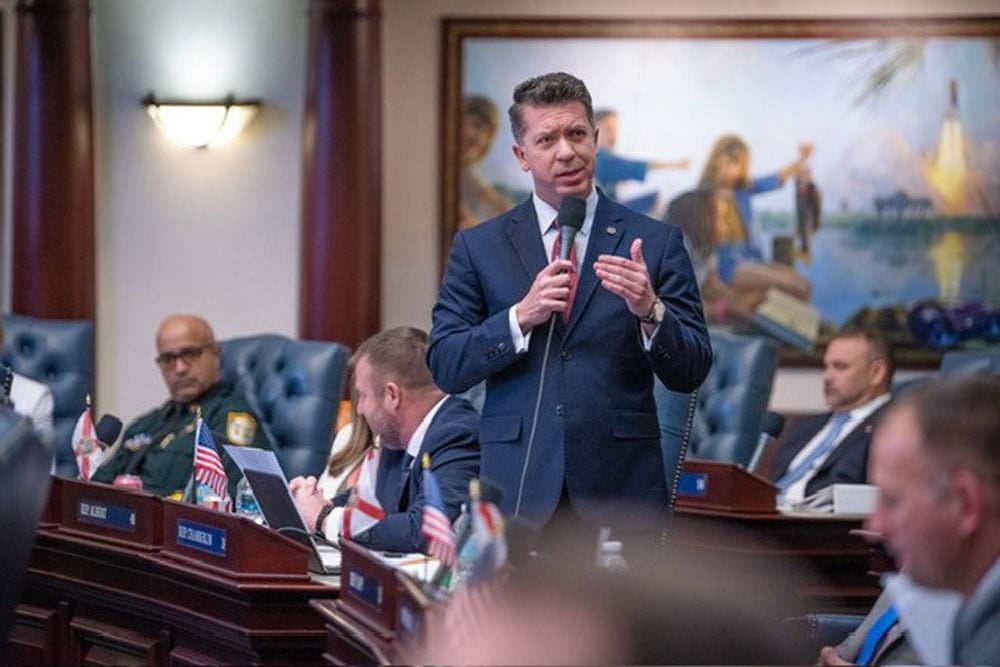
But that wasn’t nearly enough tax relief for homeowners, says Rep. Ryan Chamberlin, R-Belleview, who is leading an effort to place a citizen-led constitutional amendment on the ballot in 2028 that would eliminate all property taxes.
“Last year, we collected $18 billion in homestead property taxes,” Chamberlin told the Phoenix in a phone interview.
“I’m trying to eliminate all property taxes, but if we just went after homestead, the last four years we’ve increased the property tax revenues by as much or more than what all the homestead properties are even collecting right now. So, if we just wiped-out homestead properties, we would just be taking our revenue stream back a few years.”
Property taxes in Florida are levied by counties, municipalities, school districts, and some special districts based on the value of real and tangible personal property. Those revenues pay for law enforcement, social services, parks, environmental programs, and more.
During the recently concluded regular legislative session, House Republicans proposed seven constitutional amendments addressing property taxes. Halfway through the session, they opted to put all of their chips behind a measure that would have gradually increased the homestead exemption for non-school-related property taxes by $100,000 each year for 10 years.
The bill sponsor, Rep. Monique Miller, R-Palm Bay, said her proposal was structured that way to avoid an immediate financial shock to local governments and give them time to adjust to working with those reduced revenues.
However, Miller filed an amendment to her own bill (HJR 203) when it reached the floor that jettisoned the planned 10-year phase in, instead completely ending non-school property taxes for homesteaded properties starting next January.
It came the day after Senate Appropriations Committee Chair Ed Hooper said the Senate’s version “won’t be as generous.” The House measure would have cost $14.7 billion in local non-school property tax revenues in fiscal year 2027-2028.
Senate Republicans ultimately declined to support any property tax reduction bill during the session, seemingly taking their cues from DeSantis, who preferred that they deal with the issue after the regular session.
“I highly respect and work with and support Rep Monique Miller’s work on this,” Chamberlin said.
“But if you remember, all of the tax relief bills on the House side excluded any reduction in funding for police, fire, and schools. Which is about 80% of property tax revenue. So, in essence, there’s no way that you can eliminate property taxes if you can’t touch 82% of what needs to be eliminated.”
Chamberlin now says he’s “pessimistic” about the state putting any serious tax property reform proposal before the voters this year.
“There’s still a chance that it could end up on the ballot, but I believe the only way to ensure this is to make sure that we take this to the people, and that’s where this ballot initiative idea was birthed,” he said.
“It’s going to take a lot of work to get that done, but it’s also going to keep the conversation alive. In the next eight months, we’re going to have a new governor in the state of Florida. We’re going to have a new Senate president. A new speaker of the House. And I am optimistic that if we keep this conversation alive, we can be the first state in the United States to actually allow people to own their property rather than rent it from the government.”
Attack on local spending
Florida Chief Financial Officer Blaise Ingoglia has been traveling around the state since being appointed to his position last summer making the case that local governments’ spending is out of control and that they can withstand reductions in revenues if and when the amount of property taxes they collect is reduced. That’s been met with fierce pushback from locally elected officials, who dispute Ingoglia’s claims of “wasteful spending.”
 Lawmakers in several other states have proposed reducing or ending property taxes, but none have succeeded (see list of states below).
Chamberlin is fully cognizant that advocates for the complete elimination of property taxes must show that the revenues lost can be replaced to secure the approval of the necessary 60% of Florida voters.
“I do not believe that the government should have a lien on anybody’s property,” he said.
“I think that there are other ways in a $1.8 trillion dollar economy like Florida has to generate the revenue needed — there’s smarter ways. There’s even ways for us to benefit from the travelers and the things that come to Florida that we haven’t taken seriously. We haven’t seriously explored alternative revenue streams. Instead, we’re just taxing people indefinitely for property.”
Citizen-led constitutional amendments have never had a higher bar to get on the ballot. Efforts to legalize recreational cannabis and enshrine abortion rights on the ballot in 2024 came up short of the 60% required for passage, even though both campaigns spent well north of $100 million. Legislation signed into law a year ago has made it even more difficult for such groups to qualify for the ballot, resulting in no citizen-led constitutional amendments getting on the ballot this year.
Nevertheless, Chamberlin says he’s “dead serious” about getting such a proposal on the ballot in 2028.
“I’ve got teams of people in addition to the attorneys to make sure that we do all of this the right way. We know that there’s going to have be money raised but we also know the amount of support across the 23 to 24 million people here in the state of Florida” he said.
“This conversation has been elevated. And I’ll give thanks to our governor and the speaker, but definitely the governor, who has used his platform to elevate this conversation. People are wanting and needing relief. We believe that if any topic has a chance on getting on the ballot, it would be a topic like this. And I can help lead and guide this so it will be a statewide promotional effort.”
Chamberlin hopes a meaningful property tax reform proposal will be introduced in the Legislature this year, “but I don’t sit around and wait for things to get perfect, because it’ll never get perfect.”
What other states are doing
Florida is one of a number of states seriously exploring the repealing or reduction property taxes.
In Georgia, House Republicans originally proposed eventual elimination of property taxes for homeowners. That measure failed to clear that chamber last month. A more modest measure that did get approved includes options for cities and counties to repurpose optional sales taxes for property tax cuts, but it does not cap overall property tax collections or enact new statewide homestead exemptions, according to the Georgia Budget and Policy Institute.
In Ohio, lawmakers have proposed replacing property taxes with a land-value tax. The bill is still in committee and would ultimately go before voters if passed in the Legislature. There is a separate citizen-led campaign to get a ballot measure on the Ohio ballot to remove property taxes.
In Nebraska, organizers were trying to get a measure on the 2026 ballot that would eliminate property, income, and inheritance taxes and replace them with a broad consumption tax but failed. Those organizers now are aiming for the 2028 ballot.
In South Dakota, lawmakers enacted what Gov. Larry Rhoden called “the largest property tax cut in South Dakota history” last month. The state raised its sales tax rate to make up for the property tax cut.
In Oklahoma, there is a campaign to get a proposed constitutional amendment on the ballot this fall that would eliminate property taxes on owner-occupied homesteads through a three-year phase in period.
In Indiana, a bill that would have abolished the assessment of tangible property after 2026 and end the imposition of property taxes by the end of 2027 was introduced but did not pass during the legislative session that ended in late February.
–Mitch Perry, Florida Phoenix


























Atwp says
We will see what happens.in my head eliminating property taxes to raise other taxes dosent make sense.
Deborah Coffey says
People that own their homes can usually afford to pay their property taxes and sales taxes when they make purchases. Other folks are not that fortunate. They can barely afford rent and new sneakers for their kids. THESE are the people that Republicans want to raise the sales tax on so that the wealthier people don’t have to pay property taxes for their local services? What kind of selfish, self-centered people have we become in America? No wonder the rest of the world now looks at us with disdain and a lack of respect.
Do many of us think that our local governments waste a lot of our tax dollars? We sure do! But, we can vote them out of office. The answer to this problem is not to get rid of property taxes. What you don’t hear Republicans in Tallahassee planning on fixing is Big Insurance rates and Big Builders’ profits that leave people with bad roads, not enough roads, traffic problems, water shortages, huge electricity costs, etc. Take your party back, Republicans, and focus on the real needs of ALL people…young, old, rich, poor, sick. There will never be a Fascist majority in The United States of America. So, let’s focus on creating the best democracy the world has ever seen.
Skibum says
You are exactly right. And those republi-cons are being disingenuous proposing legislation that ONLY takes critically needed taxpayer dollars away from local governments, NOT the state. It is not the state that funds public safety, i.e. police and fire response and 911 call centers! It is NOT the state that funds essential local infrastructure maintenance. It is NOT the state that funds local capital projects, recreation and libraries.
People should be very thoughtful and careful when presented with this same old scheme that does more harm than good. Nothing is free. Property taxes are essential to pay for, in part or full, the things citizens both need as well as desire in our own communities that help with the quality of life we demand from our government representatives.
Me says
How’s that going to work when Trump feels each state should pay for childcare, Medicare and Medicaid?
Shark says
So they get rid of property taxes and increase local government taxes – schools -police and fire departments – EMS – road and bridge maintenance – parks and recreation – libraries and sanitation !!!
Laurel says
Nobody like taxes, but we need taxes as a society to function. But I believe that what only the Republicans are proposing is disingenuous at best. Something’s up, and we need to get to the bottom of it. It sounds more like a dangling carrot to entice us to vote their way before they lose altogether. But the problem here is, it is not presented to us in a form that is well thought out. Is that intentional? Are these politicians betting on our short attention spans? What is the revenue make up plan? There is none so far. That’s not a good scenario.
“I do not believe that the government should have a lien on anybody’s property,” Republican Representative Chamberlain said. There will be no complete removal of taxes as the school tax will still be present, as well as a few others, and your assessments remain. So, will government apply a lien on our properties if we do not want to pay for, or cannot afford to pay for private, Christian and home school taxes, while removing funds from public schools? How will government make you pay? A lien on your property? Your assessments and fees, or sales taxes, will increase. They have to. No liens if you don’t pay? You’re still gonna pay. That’s why this seems like a ruse.
“We haven’t seriously explored alternative revenue streams. Instead, we’re just taxing people indefinitely for property” Chamberlain said. So a simple question is: Why haven’t they explored alternative revenue streams before removing property tax? South Dakota raised its sales tax to make up for the short fall. Won’t that hurt small businesses? Will you be far more careful about what you buy? Will you buy less, and go without? If you continue to shop the way you do now, will you not still be paying? Will that sales tax be put on the new house you buy, or will you just stay put? Will you be able to buy a house with a hard hit of extra sales tax?
In Ohio, lawmakers have proposed replacing property taxes with a land-value tax. What? How does that work?
This also appears to be another back door entry for the dissolvement of local, home rule. The Republicans are hell bent on that one. Local government is dependent on taxes and assessments. We’ll have both local and state sales tax increases. The fact of the matter is, you cannot escape it.
Since the Republicans are always looking out for the wealthy campaign donors, realize that the mansions along the coast, where the owners choose to live and can afford to live, often pay 50K, 100K, and up for annual taxes, and you pay 3K to 12K, who benefits the most with the removal of property taxes? Simple math. But you’ll still pay for their kids’ private, home and Christian schooling. Quite the deal, eh?
So this is about homestead properties, right? What about investment properties? Will this keep the average Joe from making that second house purchase possible? Will it keep the middle class in its place? What about the small business that gets hit with the extra sales tax AND higher property tax? What about homestead exemptions? We will lose them all. No regular exemption, no widow/widower exemption, no low income senior exemption, no first responder exemption. Gone for good. What if we don’t like the system, do we get assessed all over again at a higher rate? There will be no homestead cap. No investment property cap.
Look, again, if they had a good plan, with a means of filling the gap with the tax loss to local government, that, indeed would be exciting! But, as it is, there is no plan. Just brain candy for those who have no questions about “how does this work”?
celia says
If ain’t broke why fix it? Makes our tax burden uncertain as far is my concern…and I am used to what we have now…maybe a hook, reel and catch for us being the poor fish? Those paying high taxes in ocean or other water front front mansions won’t pay anymore and can afford to buy the expensive goods overseas….So? We know at least our Ad Valorem tax now, We don’t know what could be if changed…