



By Michael C. Horowitz and Lauren Kahn
Wars in Ukraine and the Middle East have propelled drones into the headlines. The word “drone” now stretches to cover everything from hobbyist camera rigs available on Amazon to the Predator and Reaper systems the United States has relied on to fight terrorist organizations over the past 20 years.
A common ancestor in the animal kingdom can give rise, under sufficient environmental pressure, to distinct species that demand their own classification. Drones have undergone their own rapid speciation: the one-way attack drone, the medium-altitude, long-endurance and high-altitude, long-endurance drones, the collaborative combat aircraft drone – these share a lineage and a label, but in terms of cost, range and use, increasingly little else.
Nowhere is this variation more consequential than in the category of one-way attack drones: systems designed not to return home like an airplane, but to fly directly into a target and destroy it, like a bullet or a missile. Russia and Ukraine have fired millions of these at each other since 2022, and Iran has launched thousands at United States military bases and embassies, Israel and other countries in the Middle East in 2026.
The world is now in an era we call “precise mass.” In the past, military power was often determined by size – the number of knights, soldiers, guns or tanks, depending on the era, that an army had. Since the Cold War, advanced militaries have emphasized precise munitions, such as cruise missiles, gaining advantage with fewer but more accurately targeted weapons. Inexpensive but technologically sophisticated drones bring mass and precision together.
Commercial manufacturing, precision guidance and advances in artificial intelligence and autonomy have democratized the ability of militaries and militant groups to accurately strike their adversaries. This includes first-person-view, or FPV, drones – a type of one-way attack drone with interfaces like video games – that groups aligned with Iran are already using to target American forces in the Middle East.
One-way attack drones
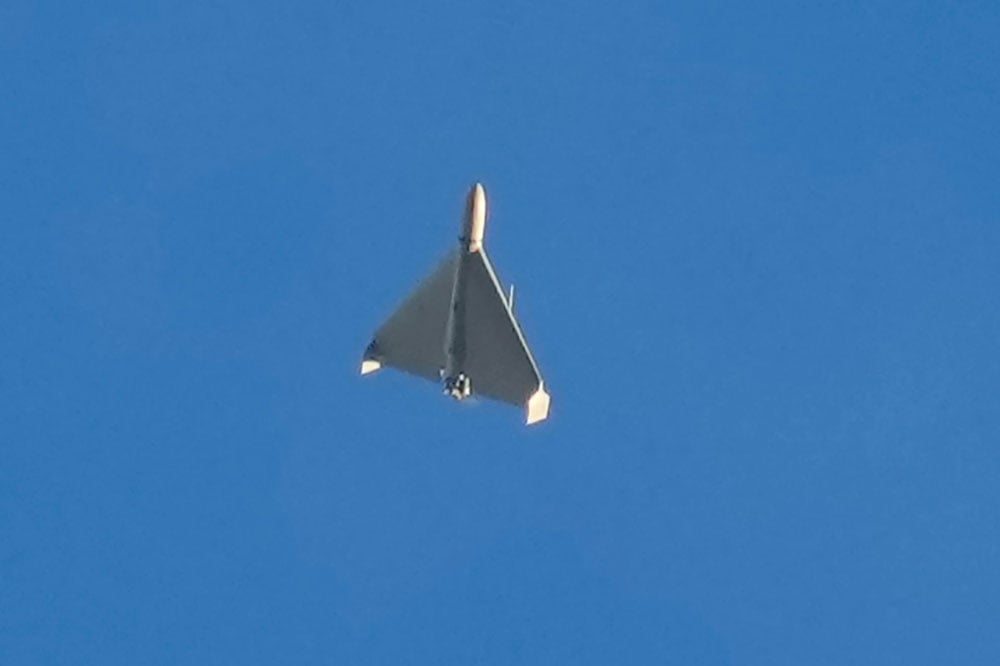
One-way attack drones have featured most prominently in the war between Russia and Ukraine, and in the Middle East today. The first category of one-way attack drones is longer range and can travel hundreds or even thousands of miles to strike targets deep in an adversary’s territory. They are like extremely cheap cruise missiles – Iran’s Shahed-136 one-way attack drone, for instance, has a reported range of up to 1,250 miles (2,000 km) and costs between US$20,000 and $50,000 each. In comparison, America’s Tomahawk cruise missile costs $2 million each.
Russia acquired the Shahed technology almost immediately after Iran debuted it in 2022, creating its own version, the Geran-2, and has since used these drones to pummel Ukrainian cities and energy infrastructure. Most recently, the U.S. military has followed Russia’s lead and reverse-engineered its own version, the LUCAS, which debuted in the earliest days of Operation Epic Fury, the U.S. military operation against Iran that started on Feb. 28, 2026.
Since late February 2026, Tehran has fired thousands of one-way attack drones at targets across the Middle East. Iran’s one-way attack drones have hit buildings in Bahrain, Kuwait and the United Arab Emirates, and damaged the United States Embassy in Saudi Arabia. The UAE alone was targeted by nearly 700 Iranian drones in the war’s early days. Iran’s one-way attack drones have killed U.S. service members and destroyed critical American radar systems.
Because long-range, one-way attack drones are so slow, they are easier to shoot down than, say, a Tomahawk missile, but attackers can fire so many of them that they can overwhelm air defense systems.
The second category of one-way attack drones operates more like traditional artillery – typically from short distances, up to about 100 miles (160 km). Ukraine’s battlefield has showcased these systems extensively, where they generate 60%-70% of the casualties on the front lines.

AP Photo/Andrii Marienko
FPV drones
One of the most common types of short-range, one-way attack drones is the FPV drone, sometimes built for a few hundred dollars each from commercial parts purchased online. In Ukraine, operators wearing video goggles fly FPV drones directly into Russian vehicles, fortifications and troops, and they feature guidance interfaces for remote operators that are not dissimilar to those of first-person video games.
FPV drones are not magic. Operating them requires a continuous data link between the operator and the drone, making them vulnerable to electronic jamming that can disrupt radio signals. To address this vulnerability, many Ukrainian FPV drones now use physical communication lines in the form of fiber-optic cables to avoid jamming, but the cables can be cut, and that limits the range of these systems. FPV drones with fiber-optic cables have ranges of about 12 miles (20 km). Effectively using FPV drones also requires skilled operators.
America and Israel’s war with Iran hit the pause button on April 7, but if it starts again and the U.S. deploys ground forces, they would likely face the kind of short-range, one-way attack drone barrages that have come to terrorize both Russian and Ukrainian forces alike.
The threat has proved so hard to stop that Ukraine has resorted to low-tech solutions: Hundreds of kilometers of roads are now covered with nets, donated by European fishermen and farmers. The nets stop FPV drones by tangling their propellers. Nets cover tanks and hospital courtyards and line supply routes and city streets. Ukraine’s government plans to install about 2,500 miles (4,000 km) of them on key roads by the end of 2026.

AP Photo/Efrem Lukatsky
Iranian forces could similarly deploy one-way attack drones against American convoys, personnel or parked aircraft in ways that are difficult to defend against. Additionally, just as American adversaries such as ISIS and al-Qaida used video footage of attacks to try to scare the American public, Iran is likely to use FPV strike footage – the operator’s-eye view of the attack, easily edited and uploaded – to try to shape American attitudes.
In March 2026, an Iran-backed militia used FPV drones to strike a parked U.S. Army medevac Black Hawk helicopter and destroy an air defense radar at the Victory Base Complex near Baghdad. The attackers then released footage from the drone’s perspective as propaganda, blurring out the red crosses identifying the Black Hawk as a medevac aircraft.
The new reality
Short-range, one-way attack drones have redefined the front lines; long-range ones have changed what it means to wage war at strategic distances. Iran’s battlefield record – thousands of drones launched, air defenses nearing exhaustion across multiple targeted countries, American troops killed – demonstrates what a mid-tier military can achieve with precise mass.
Any military that fails to invest in these capabilities – and in the ability to defend against them – places itself at risk, including the U.S. military.

Michael C. Horowitz is Professor of Political Science at the University of Pennsylvania and a senior fellow with the Council on Foreign Relations. From 2022 to 2024 he was Deputy Assistant Secretary of Defense and Director of the Emerging Capabilities Policy Office at the United States Department of Defense.. Lauren Kahn is Senior Research Analyst at the Center for Security and Emerging Technology at Georgetown University.




























Laurel says
https://apnews.com/article/drones-eric-donald-trump-powerus-iran-defense-089bff3892f921a10ef4ec785308e716
Need I say more?
Ed P says
Hello Laurel,
What about thank you?
Ai and robotics will evolve into the theatre of war, and the United States better be the leader. Who cares, as long as they are the best and cheapest.
Rhetoric over results is a useless strategy. The hypocritical bluster from the left isn’t resonating with anyone other than the low or no informational voters. They are proving to be gullible.
The left seems impervious to learning/admitting that they have moved too far left. Radical Progressivism will not be historically viewed as healthy for our Democratic Republic. The current Robin Hood mentality has been corrupted. The wealthy “earned” and did not steal their gold. Redistribution in a capitalist society destroys all incentives.
Spending is the problem.
The loons on the left promising free everything have tapped into the progressive ideology of entitlement.
Who votes against Santa Clause?
Free everything is impossible. Gullibility is replacing reality.
Let’s have more “no kings day” marches…yeah!
Keenan Hreib says
ED i’m sorry i started laughing out loud when you started talking about gullibility. That’s ironic man.
Wars can not be won from the air. We are obviosly very good at starting wars. We have been doing it for decades. We are the kings of “PROXY WAR PROFITEERING”.
People stupidly think that with AI dominance they can run the world, but with dominance come risks.
We need guardrails. Guardrails that can avoid the possible autonomy that AI CAN EASILY GARNER TO TAKE US ALL OUT. We need to deal with that possibility instead of attacking other countries unprovoked in the middle of a negotiation. Unprovoked attacks in the name of a de- stabalizer like ISRAEL.
Donald Trump needs to be removed from office yesterday, then we need to deal with the rest of his evil and unqualified cabinet.
I love my country, but the fact that anyone can think the world is safer or better with the U.S. at the helm of international power? Well….. That’s INSANE.
Ed P says
Hello Keenan,
I’m glad I have your engagement. Even though we see world events unfolding from very different perches, at least we have the love of country in common.
Differing thought filters and perceptions doesn’t suggest that either of us has a “lock” on being correct. Leave room for admission of being wrong.
I never suggested that any war has been won via an air assault. This war is not over. We don’t know if the newest precision war fare can’t win. Prematurely declaring success or failure is foolish. Railing against America is unpatriotic.
Thinking only in binary terms of win or lose restricts options and outcomes.
I disagree that the United States isn’t the best option as the world’s leader. World leadership transcends Trump.
I’m curious, who you believe has the ability and should to replace the U.S. leadership.
By your definition, give or take, about 1/2 the country is insane. I’m pretty certain the majority feels the world is safer with leading.
Keenan Hreib says
The Left doesn’t want everything for free, it just doesn’t want THE RADICAL RIGHT to steal everything from the American people. There is no Conservative party. That started going away during Reagan’s first term. Good man. Bad policies. TRICKLE DUMB ECONOMICS? Now we have TRUMP. A evil piece of shit with no policies at all other than literally lining his pockets with money meant for AMERICANS.
Pogo says
“I do not know with what weapons World War III will be fought, but World War IV will be fought with sticks and stones.”
— Albert Einstein
P.S.
Laurel,
Your comment on the usual self-dealing corruption of the trump tribe is on point; thank you.
Atwp says
Hum, Trump and America isn’t that smart anymore. A cheap one way destructive drone. A 2million tomahawk missle. Does money win wars or wise use of cheap technology.