• Skip to primary navigation
  • Skip to main content
  • Skip to primary sidebar
MENUMENU
MENUMENU
  • Home
  • About
    • Contact Us
    • FlaglerLive Board of Directors
    • Comment Policy
    • Mission Statement
    • Our Values
    • Privacy Policy
  • Live Calendar
  • Submit Obituary
  • Submit an Event
  • Support FlaglerLive
  • Advertise on FlaglerLive (386) 503-3808
  • Search Results

FlaglerLive

No Bull, no Fluff, No Smudges

MENUMENU
  • Flagler
    • Flagler County Commission
    • Beverly Beach
    • Flagler History
    • Mondex/Daytona North
    • The Hammock
    • Tourist Development Council
    • Marineland
  • Palm Coast
    • Palm Coast City Council
    • Palm Coast Crime
  • Bunnell
    • Bunnell City Commission
    • Bunnell Crime
  • Flagler Beach
    • Flagler Beach City Commission
    • Flagler Beach Crime
  • Cops/Courts
    • Circuit & County Court
    • Florida Supreme Court
    • Federal Courts
    • Flagler 911
    • Fire House
    • Flagler County Sheriff
    • Flagler Jail Bookings
    • Traffic Accidents
  • Rights & Liberties
    • First Amendment
    • Second Amendment
    • Third Amendment
    • Fourth Amendment
    • Fifth Amendment
    • Sixth Amendment
    • Seventh Amendment
    • Eighth Amendment
    • 14th Amendment
    • Sunshine Law
    • Religion & Beliefs
    • Privacy
    • Civil Rights
    • Human Rights
    • Immigration
    • Labor Rights
  • Schools
    • Adult Education
    • Belle Terre Elementary
    • Buddy Taylor Middle
    • Bunnell Elementary
    • Charter Schools
    • Daytona State College
    • Flagler County School Board
    • Flagler Palm Coast High School
    • Higher Education
    • Imagine School
    • Indian Trails Middle
    • Matanzas High School
    • Old Kings Elementary
    • Rymfire Elementary
    • Stetson University
    • Wadsworth Elementary
    • University of Florida/Florida State
  • Economy
    • Jobs & Unemployment
    • Business & Economy
    • Development & Sprawl
    • Leisure & Tourism
    • Local Business
    • Local Media
    • Real Estate & Development
    • Taxes
    • Sponsored Content
  • Commentary
    • The Conversation
    • Pierre Tristam
    • Diane Roberts
    • Guest Columns
    • Byblos
    • Editor's Blog
  • Culture
    • African American Cultural Society
    • Arts in Palm Coast & Flagler
    • Books
    • City Repertory Theatre
    • Flagler Auditorium
    • Flagler Playhouse
    • Special Events
  • Elections 2026
    • Amendments and Referendums
    • Presidential Election
    • Campaign Finance
    • City Elections
    • Congressional
    • Constitutionals
    • Courts
    • Governor
    • Polls
    • Voting Rights
  • Florida
    • Federal Politics
    • Florida History
    • Florida Legislature
    • Florida Legislature
    • Ron DeSantis
  • Health & Society
    • Flagler County Health Department
    • Ask the Doctor Column
    • Health Care
    • Health Care Business
    • Covid-19
    • Children and Families
    • Medicaid and Medicare
    • Mental Health
    • Poverty
    • Violence
  • All Else
    • Daily Briefing
    • Americana
    • Obituaries
    • News Briefs
    • Weather and Climate
    • Wildlife

The Increasingly Mythical American Dream

May 6, 2026 | FlaglerLive | Leave a Comment

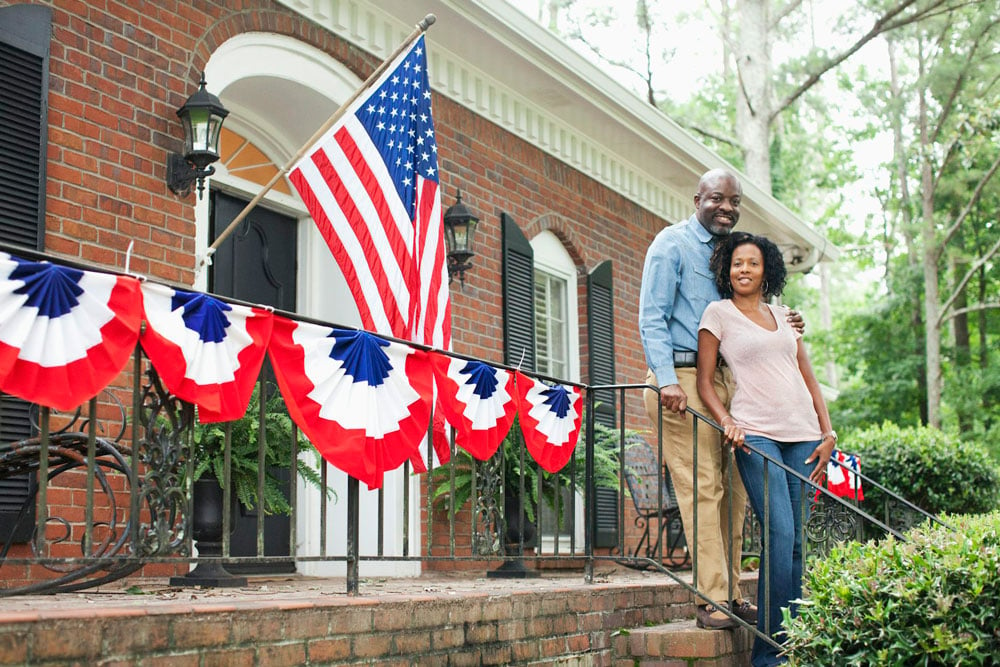
A couple poses in front of a brick home decorated with the American flag and bunting. Homeownership, often considered key to the American Dream, is difficult to achieve for many families due to rising housing costs. Kingfisher Productions via Getty Images
Homeownership, often considered key to the American Dream, is difficult to achieve for many families due to rising housing costs. (Kingfisher Productions via Getty Images)

By Mark Robert Rank

Few ideas are as central to the nation’s identity as that of the American Dream.

With the 250th birthday of the United States coming up in July 2026, it’s worth stepping back to examine a concept essential to the nation’s self-image.

The term “American Dream” was actually coined in the 1930s by historian James Truslow Adams. Ever since the establishment of the Colonies, however, America has been viewed as a land where individual and collective hopes and aspirations can be realized.

From the idea of America as a shining “city on a hill” to the Declaration of Independence’s guarantee of “life, liberty, and the pursuit of happiness,” the nation has been premised on high aspirations. The concept of the American Dream has epitomized these hopes, and it continues to be present throughout our cultural landscape.

As a social scientist, I set out to explore what Americans thought about the American Dream in today’s society. I interviewed scores of people, from an elderly man sleeping on the street to a billionaire entrepreneur.

I wanted to know exactly how they defined the American Dream – and whether it has become harder to achieve today than in the past.

Defining the dream

From pickup trucks and lawn tractor ads to the labeling of undocumented immigrant children as Dreamers, references to the American Dream in contemporary life are ubiquitous. Washington, D.C., is now home to a brand-new, US$500 million museum, the Milken Center for Advancing the American Dream, devoted to celebrating the idea and its history.

It turns out that for most people I interviewed, the American Dream consists of three basic ideas.

The first is what might be called an economic bargain: If you work hard and play by the rules, you should expect to have a financially secure life. This includes owning a home, being able to afford raising kids and retiring in comfort.
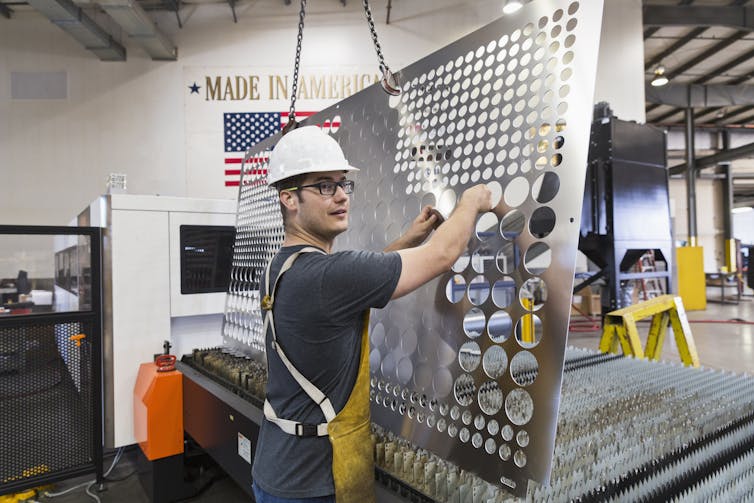
A man wearing a white safety helmet holds up a piece of sheet metal with holes punched through it.
With the shift of the U.S. economy from manufacturing to service, many jobs are inadequate for paying household bills.
Tetra Images/Don Mason via Getty Images

Second, the American Dream is centered on hope and optimism. It is about personal progress and the belief that the nation’s best days lie ahead. It’s the idea that each generation should do better than the previous one, and that upward economic mobility is essential for bringing this about.

The third and final idea people expressed was having the freedom to pursue their hopes to reach their full potential. For many, this is the epitome of the American Dream.

At its best, the U.S. is seen as allowing individuals the freedom to live the life they want. Liberty and rugged individualism have been hallmarks of America since its beginnings, so it should come as no surprise that they are also central to the American Dream.

Economically more elusive?

Given this, has the American Dream become more or less difficult to achieve over time? Unfortunately, for a growing number of Americans, it appears to be more difficult.

First, the goal of leading an economically secure life in exchange for hard work has become more elusive. Data from the Census Bureau indicates that median wages for full-time male workers have essentially flatlined since 1973. The economy has been producing more low-wage and part-time jobs. Many of these lack benefits, such as health insurance.

Less-skilled workers, such as truck drivers and postal clerks, have actually lost ground in terms of income. At the same time, housing, medical care, child care and higher education costs have dramatically increased over the past 40 years.
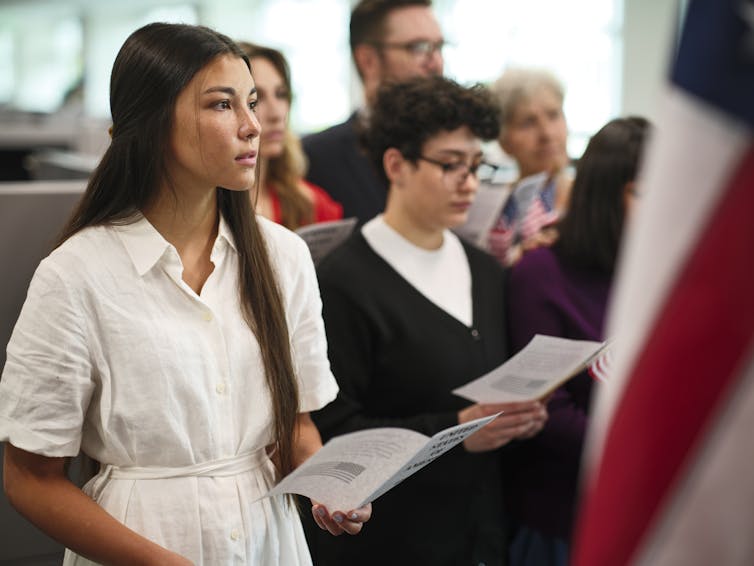
A woman holding a paper program listens attentively as part of a ceremony.
A small group of individuals prepare to take the naturalization oath to become U.S. citizens.
O2O Creative via Getty Images

What about upward mobility and the hope for each generation to do better economically than the previous one? There is some evidence that one reason the middle class is shrinking is that more people have entered upper-income tiers.

Still, younger generations will actually earn, on average, less as adults than their parents did. This is the first time in U.S. history that this is the case. The formerly taken-for-granted idea of generational progress and moving forward appears to have stalled.

Upward economic mobility for lower-income workers has also slowed over the past 50 years, making it harder to climb the ladder of opportunity.

Dissatisfied, not dreaming

Finally, what about personal freedom? Survey data indicates that greater numbers of Americans feel they have less control over their lives and futures than in the past.

For more than 20 years, Gallup has asked the question, “In this country, are you satisfied or dissatisfied with your freedom to choose what you do with your life?” The percentage of Americans reporting being satisfied has dropped notably over the past two decades. In 2007 it was 87%, but by 2024 it had fallen to 72%. For women, the number was even lower, declining from 85% in 2007 to 66% in 2024.

By comparison, the average for the wealthiest countries in the Gallup survey was 86%. Consequently, on all three counts it appears that the American Dream is becoming harder to achieve.

An aspirational hope

These trends are important for making sense of the polarization and general negativity found in America today. Too many Americans feel that they’ve been left behind and that the American Dream has become a distant reality.

For these Americans, the words of the late comedian and social commentator George Carlin ring true: “It’s called the American Dream because you have to be asleep to believe it.”

Yet the American Dream is a powerful metaphor and aspiration that continues to inspire many in this country. Among those I interviewed, there was a strong consensus that it represents the very best of what America has to offer.

There is no other country that has quite the equivalent of the American Dream. As the nation enters its next 250 years, working toward reestablishing the concept as a reality for millions of people who have fallen behind may be vital to maintaining the essence of the American promise.

Mark Robert Rank is Professor of Social Welfare at Washington University in St. Louis.


The Conversation arose out of deep-seated concerns for the fading quality of our public discourse and recognition of the vital role that academic experts could play in the public arena. Information has always been essential to democracy. It’s a societal good, like clean water. But many now find it difficult to put their trust in the media and experts who have spent years researching a topic. Instead, they listen to those who have the loudest voices. Those uninformed views are amplified by social media networks that reward those who spark outrage instead of insight or thoughtful discussion. The Conversation seeks to be part of the solution to this problem, to raise up the voices of true experts and to make their knowledge available to everyone. The Conversation publishes nightly at 9 p.m. on FlaglerLive.
See the Full Conversation Archives
Support FlaglerLive
The political climate—nationally and right here in Flagler County—is at war with fearless reporting. Your support is FlaglerLive's best armor. After 16 years, you know FlaglerLive won’t be intimidated. We dig. We don’t sanitize to pander or please. We report reality, no matter who it upsets. Even you. Imagine Flagler County without that kind of local coverage. Stand with us, and help us hold the line. There’s no paywall—but it’s not free. become a champion of enlightening journalism. Any amount helps. FlaglerLive is a 501(c)(3) non-profit news organization, and donations are tax deductible.
You may donate openly or anonymously.
We like Zeffy (no fees), but if you prefer to use PayPal, click here.
If you prefer the Ben Franklin way, we're at: P.O. Box 354263, Palm Coast, FL 32135.
 

Reader Interactions

Leave a Reply Cancel reply

Your email address will not be published. Required fields are marked *

This site uses Akismet to reduce spam. Learn how your comment data is processed.

  • Conner Bosch law attorneys lawyers offices palm coast flagler county
  • grand living realty
  • politis matovina attorneys for justice personal injury law auto truck accidents

Primary Sidebar

  • grand living realty
  • politis matovina attorneys for justice personal injury law auto truck accidents

Recent Comments

  • Paul Larkin on The Force Is Strong In Flagler As Jedi Clerk Tom Bexley Hosts Star Wars-Themed Mass Wedding
  • Deborah Coffey on Parents and Florida’s Teachers Union Sue State Over Universal Vouchers, Calling them Unconstitutional
  • Sherry on Parents and Florida’s Teachers Union Sue State Over Universal Vouchers, Calling them Unconstitutional
  • FlaglerLive on 7 Years in Prison for Levi ‘Feezy’ Ayers, 23, for String of Burglaries, Car and Gun Thefts in Palm Coast
  • Pierre Tristam on The Daily Cartoon and Live Briefing: Wednesday, May 6, 2026
  • Atwp on 7 Years in Prison for Levi ‘Feezy’ Ayers, 23, for String of Burglaries, Car and Gun Thefts in Palm Coast
  • White Sox on 7 Years in Prison for Levi ‘Feezy’ Ayers, 23, for String of Burglaries, Car and Gun Thefts in Palm Coast
  • Atwp on 7 Years in Prison for Levi ‘Feezy’ Ayers, 23, for String of Burglaries, Car and Gun Thefts in Palm Coast
  • Maureen Hutson on Catherine Pepper Wickline Wilson, 1930-2026
    Author and Flagler Beach Historical Museum Founder Leaves a Lasting Legacy
  • Maureen Price Hutson on Catherine Pepper Wickline Wilson, 1930-2026
    Author and Flagler Beach Historical Museum Founder Leaves a Lasting Legacy
  • Ray W. on The Daily Cartoon and Live Briefing: Wednesday, May 6, 2026
  • Dennis C Rathsam on The Daily Cartoon and Live Briefing: Wednesday, May 6, 2026
  • Anon on New Baseball League Coming to Palm Coast, But Council Delays Signing Off Over Sports Complex Concerns
  • the allmighty on Gas Prices Spike 40 Cents in a Week in Florida, to $4.34/Gallon Average
  • Connie on Educator and Business Owner Rob Wood Challenges Will Furry For School Board, Citing Civility and Experience
  • chris conklin on New Baseball League Coming to Palm Coast, But Council Delays Signing Off Over Sports Complex Concerns

Log in