


It is unfortunate that literary “classics” bear such an off-putting connotation, like great art sentenced to life in a museum gallery. The older the classics, the less they’re read–and the more they’re quoted, usually in less context than ether. When you actually read them you discover, like Richard Ford’s narrator in Independence Day, that they “aren’t a bit grinding, stuffy or boring, the way they seemed in school, but are brimming with useful, insightful lessons applicable directly or metaphorically to the ropy dilemmas of life.
 If you picked up Greek plays, for instance, you’d discover that a) they’re short enough to get through while waiting for your next doctor’s appointment, b) they’re as fresh as if they were written for a top-rated Netflix drama, and c) they’re much better than TV, because everything you see on TV today, from sitcoms to the president’s press conferences, is in one way or another derivative of those plays. Ajax is especially timely.
Ajax is the first of Sophocles’ seven surviving plays, performed around 442 BCE in Pericles’s Athens. The Parthenon was rising and the first Peloponnesian War (with Sparta) had ended. Greece, like Eisenhower’s America, was prosperous, powerful, at peace. Ajax’s plot is absurdly simple, if not absurd.
The setting is in a literary suburb of the Iliad. Paris has killed Achilles with that arrow to his heel, outside of Troy, where the Greeks have spent 10 futile years warring over Helen. Achilles’s armor is a talisman. It is to go to the next-greatest Greek warrior. But who is that warrior? Agamemnon and Menelaus, the two kings, award it to wise Ulysses, that “man of many turns.”
Hotheaded Ajax thought he should have the armor. He is furious. He decides to kill Agamemnon, Menelaus, and Ulysses, because really, when you’re an honorable warrior in the middle of a war, how better to show your honor than by decapitating your friends, your wingmen, your leadership over a personal slight. (What was dueling but a perversion of honor codes?)
As Ajax huffs off to his assassinations, the goddess Athena tricks him, making a herd of animals look like his three enemies. The slaughter is merciless. The undercurrent of animal cruelty–the animal being Ajax–is unbound. Blame Ajax’s jealousy, or what Henry Kissinger would mask as “prestige.” Ajax’s fury is also an example of the bloodlust disguised as heroism that the western warrior ethos exalts to this day as means become ends (see: Pete Hegseth).
Ajax, still deluded, drags the remains to his tent. He wants to enjoy his trophies. Athena boasts to Ulysses of the gods’ power, but Ulysses, the most noble of all creations of mythology despite his flaws is more godly than the gods: “Though he is my enemy,” he says, “I pity this wretch now that he is bowed down by a terrible error and I think of myself more than of him. I see that we, the living, are but a phantasm and a vain shadow.”
Ulysses makes two brief appearances in “Ajax,” one at the beginning and one at the end of the play, bracketing fanaticism in empathy and humanity. In between, Ajax comes to his senses, realizes what he’s done, and is ashamed—not over the slaughter of the innocent animals, not over the realization that he would have been a lowlife assassin had he murdered the three men, not that he would have single-handedly ensured that the Greeks lost Troy, but over looking foolish. His pride is hurt. He’s made an ass of himself by failing to murder the men.
Ajax doesn’t think he can face his father again. So he must die. He must kill himself. At first I thought Sophocles was digging the dagger into Ajax’s baseness here, a baseness become stupidity. But that assumes a critical distance between Sophocles and his hero, as opposed to a form of pragmatic admiration. Ajax’s father is a stand-in for Greece, the Greece Ajax can no longer face now that he has shamed himself so abjectly. Whatever heroic deeds made his name before, he is not the measure of his own virtue. Only Greece–only the opinion of his fellow warriors, the opinion of his countrymen, what we would call public opinion–is that measure. But is that true virtue? I don’t know Sophocles enough to know if he shared that perspective with Ajax, or if he portrayed it for its limitations, if not its deceptions. He seems to be endorsing Ajax’s madness at least a little, at least for its usefulness as a utilitarian example.
Sophocles is also manipulating his audience. Aren’t we cheering Ajax on just a little bit? We should all be speechless at Ajax’s prideful madness. We’re not. We, too, let others’ opinions take our own measure instead of trusting innate virtue regardless of how it may appear. We recognizing ourselves in him. We want him to die to expiate our shame. The actual dagger digs in soon enough.
“Don’t cure evil by evil,” the coryphee (the leader of the chorus in Greek plays) tells him, but no one ever pays attention to the chorus, the only voice of sympathy for innocent animals. (And from across the room on another shelf, Solzhenitsyn replies from his gulag: “Pride grows in the human heart like lard on a pig.”)
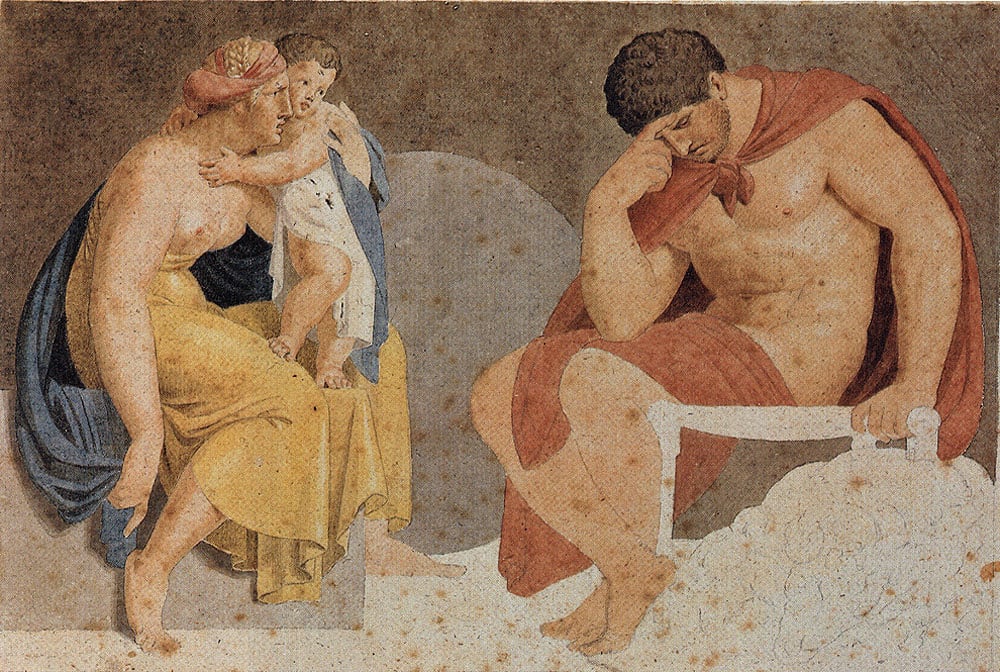
Ajax summons his slave wife Tecmessa and their mute son Eurysaces–the son is speechless for us who could not be–to bid them goodbye in a wonderfully tender moment, though Tecmessa’s abjection before her “master” is a bit hard to take with MeToo-ism-colored glasses , but so it is in so much Greek drama, the founding frat house of misogyny. The apostle Paul knew his Greeks.
Ajax plants his sword, point side up, and falls on it, giving birth to one of the great but usually misplaced clichés of journalism. There is nothing sacrificial in Ajax’s suicide. It is a self-absorbed perversion of pride and honor run amok. (Recall Falstaff’s lines in Henry IV: “What is/honour? a word. What is in that word honour? what/is that honour? air. A trim reckoning! Who hath it?/he that died o’ Wednesday. Doth he feel it? no./Doth he hear it? no.”)
Ajax dies barely offstage, hidden by a bush but for the point of the spear, after delivering an ode to suicide. It is almost a how-to guide. Had any of those moms for liberty read it back in the Covid day when Athena turned them into Gorgons, they would have demanded that all Greek tragedies be removed from our school libraries. But the Greeks aren’t taught anymore anyway.
We’re only halfway through Sophocles’s tragedy. The second part of the play is about Ajax’s body. To bury or not to bury. Here comes Menelaus, one of the three Ajax sought to kill. He wants Ajax’s body to rot in the sand. Teucer, Ajax’s half brother, wants it honorably buried. The two insult each other like two juvenile delinquents. Menelaus insults Teucer’s origins, Teucer tells him he could whip his ass without a weapon. For Menelaus, too, it’s entirely personal. It’s a wonder these Greeks could hold it together for 10 years against Troy (“to the great shame of Greece,” as the chorus says).
It’s not enough for Menelaus to act the hoodlum. Here comes Agamemnon, out-rapping Menelaus: “You there—I’ve been told you’ve dared to mouth foul threats against us with impunity. I’m talking about you, the son of a mere slave, a battle trophy.” Teucer calls Agamemnon’s father a barbarian, defends his own birthright, and in walks Ulysses, separating the two idiots and delivering that sublime speech that will make anyone think twice about insulting the memory of the dead, Charlie Kirk included:
Then listen. In deference to the gods
don’t be so unyielding you throw Ajax out
without a burial. You should not let
that spirit of violence at any time
seize control of you, not to the extent
that you then trample justice underfoot.
This man became my greatest enemy
in all our army on that very day
I beat him for the armor of Achilles.
But for all the man’s hostility to me,
I would not disgrace him. Nor would I deny
that in my view he was the finest warrior
among the Argive men who came to Troy,
after Achilles. So if you dishonor him,
you would be unjust. It would not harm him,
but you’d be contravening all those laws
the gods established. When a good man dies,
it is not right to harm him, even though
he may be someone you hate.
He offers to bury Ajax with Teucer, but Teucer declines the help, his superstitions taking the better of him. Ajax is buried honorably.
Ulysses leaves us with this line that sums up more than we can express, and that speaks to us so eloquently about who we are even today, especially today: “I hated when it was necessary to hate.” Sophocles does not show us a way to avoid the hate, but he lends us a path beyond it.

Pierre Tristam is the editor of FlaglerLive.



























Pogo says
@As stated
https://www.google.com/search?q=honor+definition
All over this world
https://www.google.com/search?q=your+honor+definition
Everywhere, all peoples
https://www.google.com/search?q=honor+student
Everywhere, all peoples — too
https://www.google.com/search?q=honor+killing
“Reputation is what other people know about you. Honor is what you know about yourself.”
https://www.google.com/search?q=quotes+about+honor
The complete, total absence of honor: donald j trump
EC: File
Deborah Coffey says
Smashingly great writing and pulling of threads together! It takes me back decades and makes me think some rereading will be even more meaningful. Thank you, Pierre. Well done!