


By Stephen DiKerby
The Moon is getting 1½ inches (3.8 centimeters) farther away from the Earth every year.
Scientists measure the distance to the Moon by bouncing lasers off mirrors placed there by space probes and astronauts.
By measuring the amount of time it takes light to travel to the Moon and back, scientists can very precisely measure the distance to the Moon and how the distance changes.
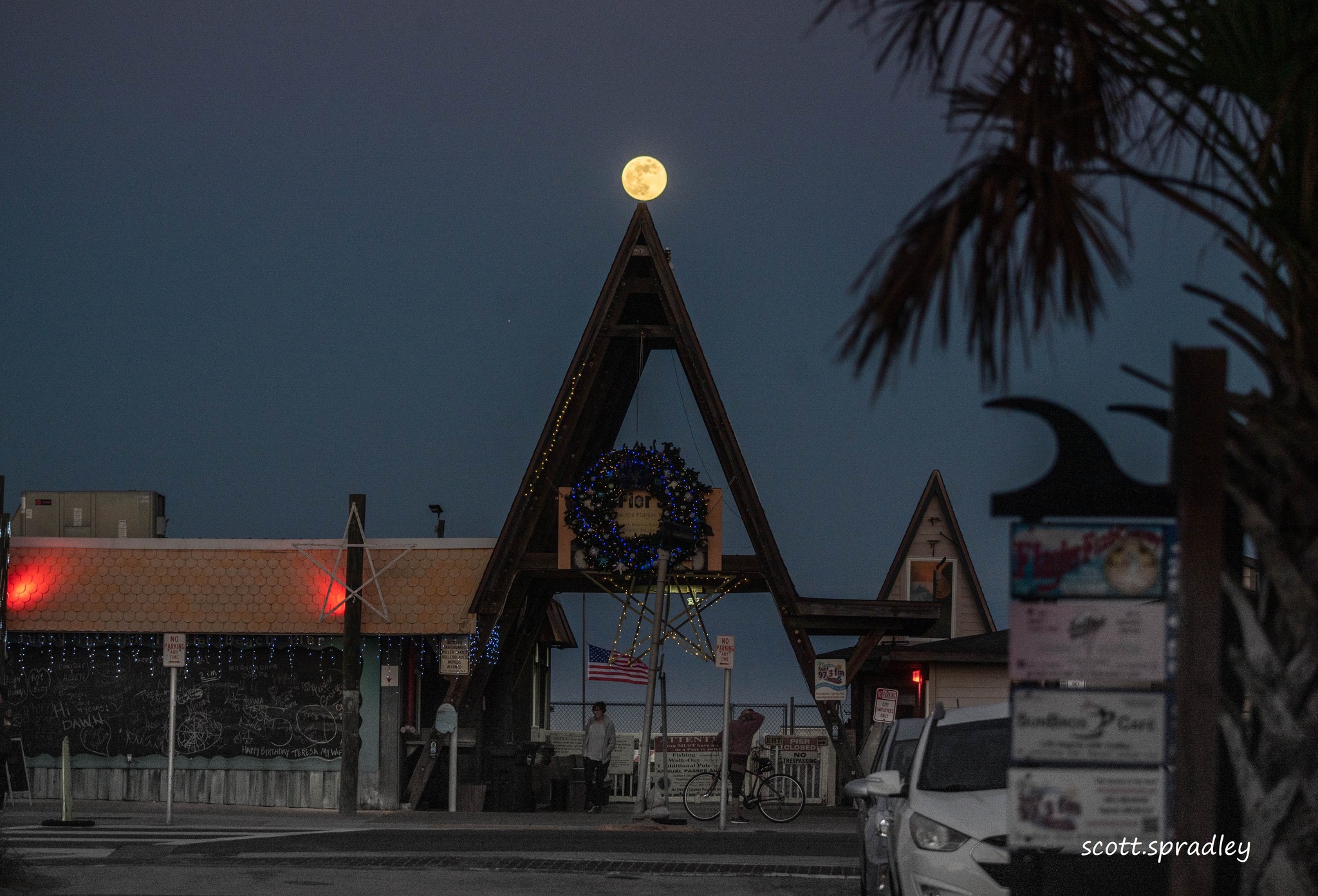
The distance to the Moon actually changes over a single month as it goes around the Earth. The Moon is typically 239,000 miles (385,000 km) away from the Earth, but its orbit is not a perfect circle and changes by about 12,400 miles (20,000 km) as it orbits the Earth. This change is why some full moons are a bit bigger than others; these are called supermoons.
As an astrophysics researcher, I’m interested in the motion and interaction of objects such as planets, stars and galaxies. The motions of the Earth and Moon have many interesting consequences, and studying how they move over time can help researchers better understand how each has changed over the 4½ billion years since the Earth and Moon formed.
Tidal forces
So, why is the Moon getting farther away? It’s all because of tides.
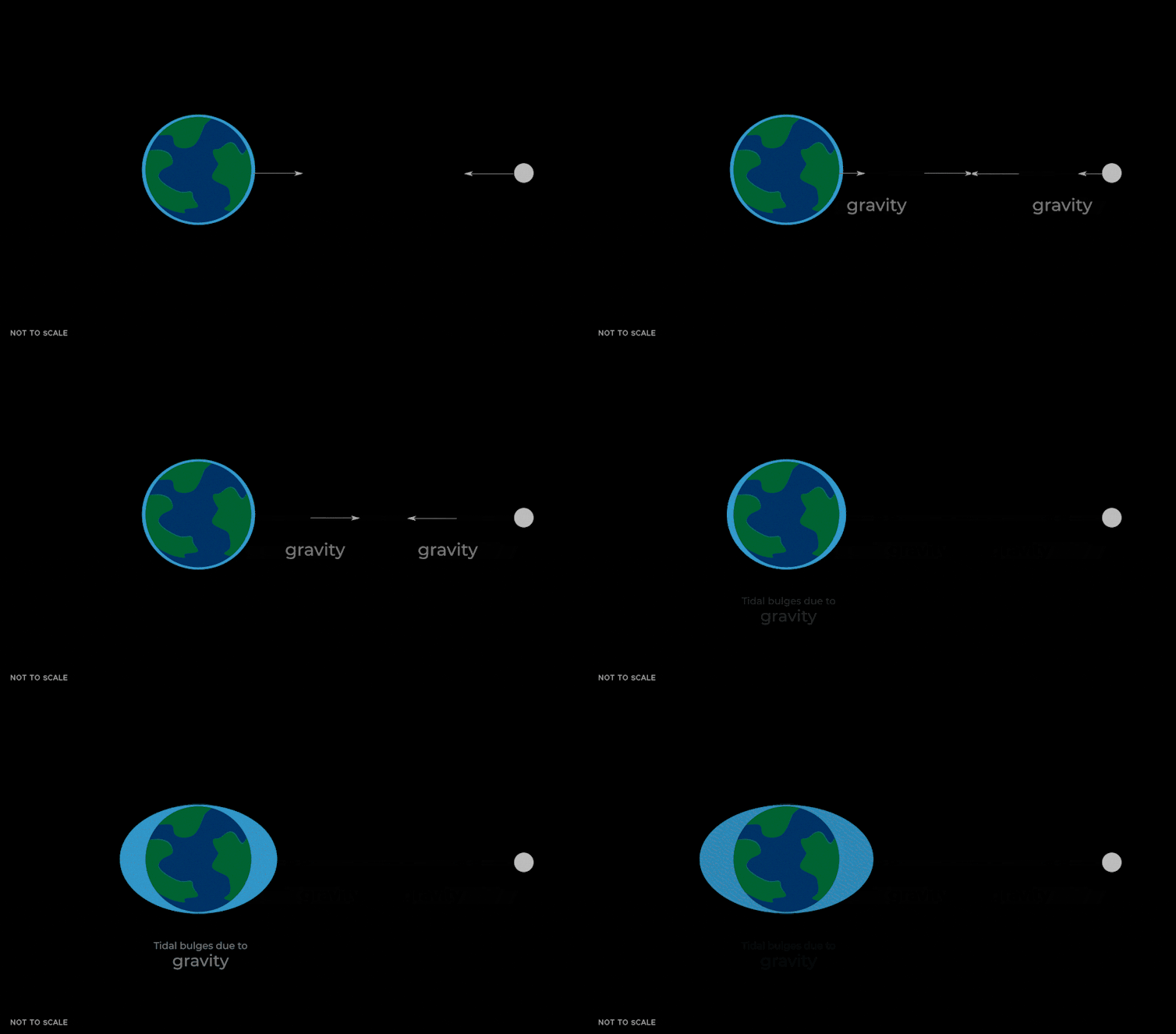
Tides come from a difference in gravity across an object. The force of gravity exerted by the Moon is about 4% stronger on the side of Earth that faces toward the Moon, compared to the opposite side of the Earth facing away, because gravity gets weaker with distance.
This tidal force causes the oceans to slosh around in two bulges that point toward and away from the Moon. They do this because the gravitational force pulling on Earth by the Moon isn’t just an average force that’s the same strength everywhere. The Moon’s gravity is strongest on the closer side of the Earth, creating a bulge of water pointing toward the Moon. It’s weaker on the opposite side of the Earth, which leaves another bulge of water that lags behind the rest of the Earth.
NASA/Vi Nguyen
As the Earth rotates, these bulges move around and keep pointing at the Moon because of its gravitational pull. In New York City or Los Angeles, the water level can change by about 5 feet due to these tidal bulges.
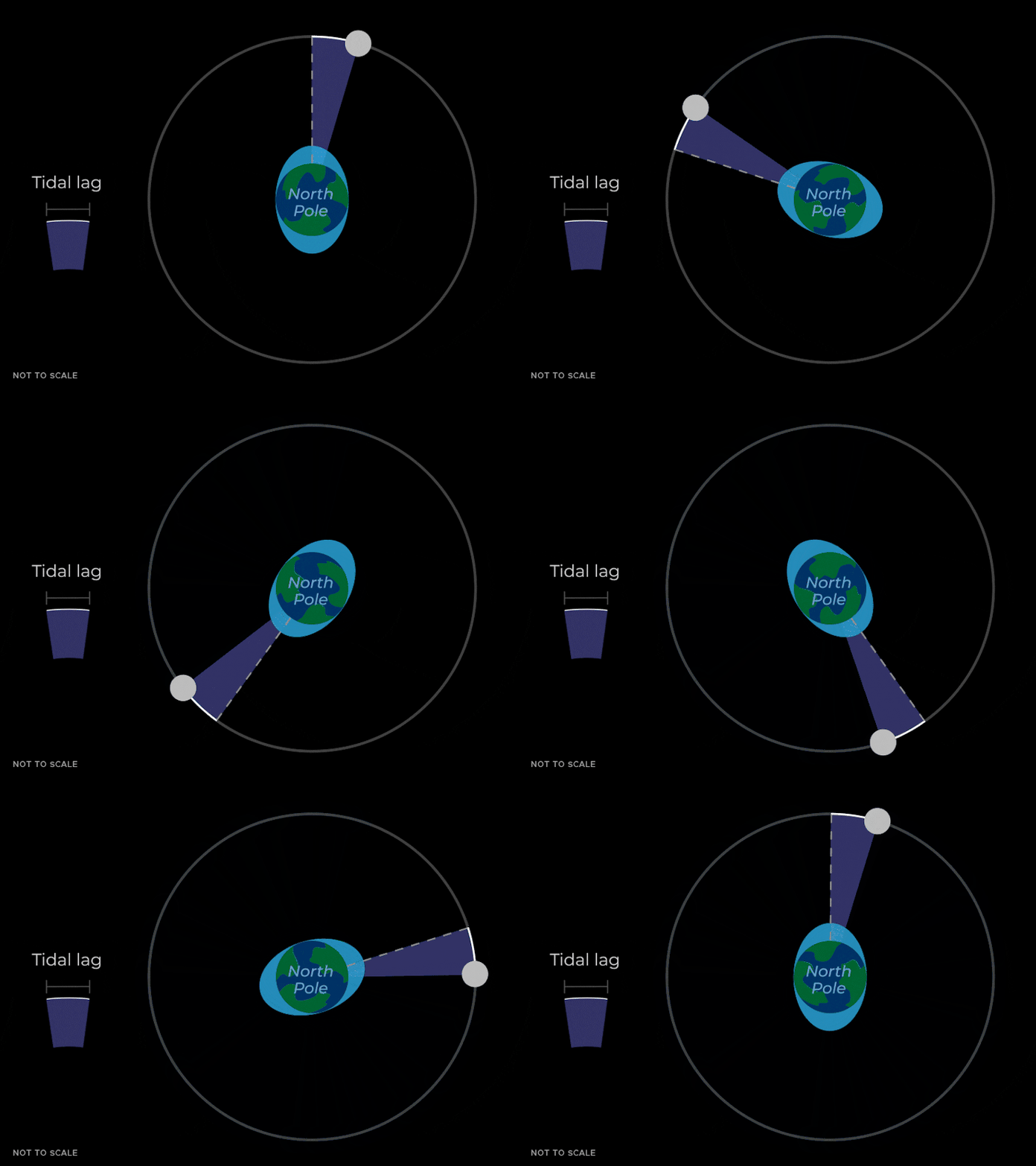
These liquid bulges do not quite line up with the Moon – they “lead” it a little bit because the Earth is rotating and dragging them forward. These bulges also exert a gravitational pull back on the Moon. The bulge closer to the Moon isn’t just pulling the Moon toward the center of the Earth, but also a little bit ahead in its orbit – like the boost a sports car gets as it goes around a curve.
NASA/Vi Nguyen
This forward pull from the closer tidal bulge causes the Moon to speed up, which causes the size of its orbit to increase. Think of a baseball player hitting a home run. If the player hits the ball faster at home plate, it’ll zoom higher up into the sky.
So the bottom line is that the gravity of the closer tidal bulge on the Earth is pulling the Moon forward, which increases the size of the Moon’s orbit. This means that the Moon gets slightly farther away from the Earth. This effect is very gradual and only detectable on average over years.
Does the Moon’s increasing distance affect Earth?
The Moon gains momentum as its orbit gets bigger. Think about spinning a weight attached to a string. The longer the string, the more momentum the weight has, and the harder it is to stop.
Because the Earth is doing the work of increasing the Moon’s momentum, the Earth’s rotation slows down in turn, as its momentum goes to the Moon. To put it another way, as the Moon’s orbital momentum increases, the Earth’s rotational momentum decreases in exchange. This exchange makes a day get very slightly longer.
But don’t worry, these effects are so small: 1.5 inches per year compared to a distance of 239,000 miles (384,000 km) is just 0.00000001% per year. We’ll keep having eclipses, tides and days that last 24 hours for millions of years.
Was the Moon closer to us in the past?
The Earth’s days were shorter in the past.
The Moon probably formed around 4.5 billion years ago, when a young Earth was hit by a Mars-size protoplanet, causing a lot of material to get knocked off into space.
Eventually, that material formed the Moon, and it was initially much closer to the Earth. Back then, you’d see the Moon much bigger in the sky.
By examining fossilized clam shells for material showing their daily growth patterns, paleontologists found evidence that 70 million years ago – near the end of the time of dinosaurs – the day was only 23.5 hours long, just as predicted by astronomical data.
What will happen in the future?
So, will the Moon eventually escape from the Earth’s gravitational pull as it moves away?
If we fast-forward tens of billions of years into the future, eventually the Earth’s rotation could slow down until it is tidally locked with the Moon. That means that it would take just as long for the Earth to rotate as the Moon does to orbit. At this point, the Moon would stop getting more distant, and you would see the Moon only from one side of the Earth.
But two things will stop that from happening. First, in a billion years or so, the Sun will get brighter and boil away the oceans. Then, there won’t be large tidal bulges of water to cause the Moon to get more distant. A few billion years later, the Sun will expand into a red giant, probably destroying the Earth and the Moon.
But these events are so far in the future that you don’t need to worry about them. You just get to enjoy tides on the beach, solar eclipses and our beautiful Moon.

Stephen DiKerby is a Postdoctoral Researcher in Physics and Astronomy at Michigan State University.





























JimboXYZ says
I think these scientists have way too much rime on their hands, too much recreational marijuana for something they can’t solve, change or do anything about to correct to what they think should be the ideal distance of the moon from planet Earth ? Amazing with mirrors they can be accurate to 1.5 inches/3.8 centimeters for make these assertions. Yet the GPS tracking systems on planet Earth is only accurate to about a meter for a smartphone ?
https://medium.com/@importanttech/we-tested-mobile-gps-gnss-accuracy-and-found-some-surprising-results-b9ec35873e2e
Skibum says
I think you’re just jealous of those who have very high IQs, have actually graduated from college and pursued graduate level education, and chose careers that require years of expertise both mathematical and scientific brainpower to be able to make credible scientific calculations. I count myself among those of us who are in awe of their scientific abilities.
Even in ancient times, there were brilliant scientific minds who made accurate calculations and predictions in fields such as astronomy , physics and medicine. Here is a list of some of the most famous from ancient Greece:
https://www.scijournal.org/articles/famous-greek-scientists
Just because you may not understand it doesn’t invalidate the scientific community’s brain power. Yet, lo and behold, we still have those in the 21st century who are apparent members of the flat earth society, dismissing scientific reality. No wonder, with smartiacs like RFK Jr. who many sheeple sit on the edge of their chairs waiting with baited breath for his latest nonsensical utterance despite the fact that he admits snorting cocaine from his toilet seat.
JimboXYZ says
Not jealousy at all ? Here’s one that hits closer to home. Every year a storm or few passes by that takes sand away from the shores of Flagler County ? Some egghead has a 10 year plan to reassess that erosion & rebuild the beach/dunes. I’m on record for stating that was flawed science from the taxation & costs to the amount of dirt/sand that the Army Corps of Engineers spreads out there. Bottom line is that’s trial & error because they can’t predict the model of erosion for storms that have yet to happen. It’s a relative pointless masturbation of effort & resources for a solution. These scientists, are right on planet Earth & can measure those distances and can’t dial in those measurements with about the same accuracy for tolerance of error that they claim they are doing/getting for “balls on accuracy” with mirrors ? Call me skeptical on the myths that the scientific communities assertions are factual, that there is anything of a solution. I wanna hear how they are going to influence & correct these assertions that the Moon’s distance. They can’t even correct human vision that accurately with IOL’s & Laser surgery, much more with corrective eyeglasses. Take 20/20 vision vs 20/22 vision correction. That’s a 2 feet difference for a correction. The best optical lenses aren’t perfect. And the further the distance, the worse the accuracy, distances increase. If one is 2 feet off for 20 feet, how much does the distance increase for inaccurate for a football field distance ? Just me, but a mirror is nothing more than a reflective lens.
https://www.aao.org/eye-health/tips-prevention/what-does-20-20-vision-mean
Samuel L. Bronkowitz says
Yes, Jimbo, it’s that accurate.
Pogo says
@Live long
…and prosper.
https://www.bing.com/search?q=lucille+ball+star+trek
Laurel says
Why I enjoy Neil Degrassi Tyson:
https://m.youtube.com/watch?v=xfNSbNj2C1k
JimboXYZ says
And with NDG theory that is even inaccurate or an oversimplification of the water bulge. Since that theory holds that the Earth rotates in it’s relative elliptical orbit to the sun, so s the moon. Since distance of the Earth to the sun, he moon to the Earth is an ever changing & moving target. Every planet in the solar system also affects tides in some manner for relative distances, speeds & gravitational pulls. We have a model that has simply too many variables to calculate at given moments. Add the measuring devices that the brightest scientists have are inaccurate. We’ve been measuring time to the very second as inaccurate as we have for the existence of the leap year calendars we have for a calendar year. How old is anything even/really ? That’s a tolerance of error. The errors abound for not even having a day 1 measuring point of reference for anything that was never measured accurately. Here’s another thing that makes it murkier ? Every house settles in planet Earth ? Since we’ve seen foundations crack, walls move for expansion & contract, when a building collapses over time that much movement does more than suggest that a reference point on planet Earth is a moving target. Would be interesting to see just the data on on the diameter of planet Earth that’s a moving target for the core center of planet Earth. Since scientists claim the core center of the Earth is a molten magma fluid, it’s also affected like the oceans tides. As the Earth spins, the friction in the atmosphere affects size & shape of the Earth’s core.
With all these variables, Skibum claims that I am somewhat jealous of the brain power the scientific community self proclaims genius ? At best, debating with science is a Charlie Kirk debate. Wanna know how I know this much ? Back in the 1960’s General Electric had a facility that was located in Volusia County across from the Speedway that was named Apollo Park for it’s contributions to the Apollo Moon programs. My Dad was one of the engineers/scientists that were there from the grand opening of the facility. I worked there too back in the 1980’s when it became GE SCSD.
https://www.apollopresskits.com/hubfs/Apollo%20Press%20Kits/General%20Electric.pdf
https://magazines.marinelink.com/Magazines/MaritimeReporter/198001/content/ground-systems-renamed-207132
I know that scientists calculations are within a tolerance of error, if not anything more than just a SWAG at accuracy. There isn’t one human being that is immune to those facts of accuracy. Anyone with a K-12 education can figure out theories, holes in those theories, shortcomings of the scientific method itself. At a certain point it’s a leap of faith. At a certain point it doesn’t really matter. What is miscalculated is overcome with actual effort to bridge the miscalculation. With any given house construction it’s materials that account for expansion & contraction. Mankind builds sidewalks that way too. Just an observation of the materials in between concrete slabs that aren’t flexible and crack over time for that inflexibility for settling process on planet Earth. Anyone ever drive across a bridge ? Those have expansion joints built into them just the same. I’m hardly a genius, yet hardly a jealous idiot just the same. There just isn’t one thing on planet Earth that has never cracked eventually, down to the fillings in anyone’s dental work. Dentists are no better than HS car auto body repair bondo experts that fix teeth that have been compromised for nothing lasts forever in life.