


By Austin Sarat
Throughout the 20th century, college and university presidents spoke out on everything, from wars to civil rights struggles, with a sense of moral authority attempting to guide the course.
Their language was typically direct and free of jargon.
“Democracy is the best form of government. It is worth dying for,” Robert M. Hutchins, president of the University of Chicago, said during a June 1940 convocation address, a year and a half before the U.S. formally entered World War II.
Since 2023 and the start of the Israel-Hamas war, a growing number of university and college presidents have remained silent on politics. Others have used ambiguous language that makes them seem like “neutral bureaucrats,” as Wesleyan University President Michael S. Roth wrote in 2023.
Nearly 150 universities adopted “institutional neutrality” pledges from 2023 through the end of 2024. This coincided with university leaders responding to Palestinian rights protests on their campuses.
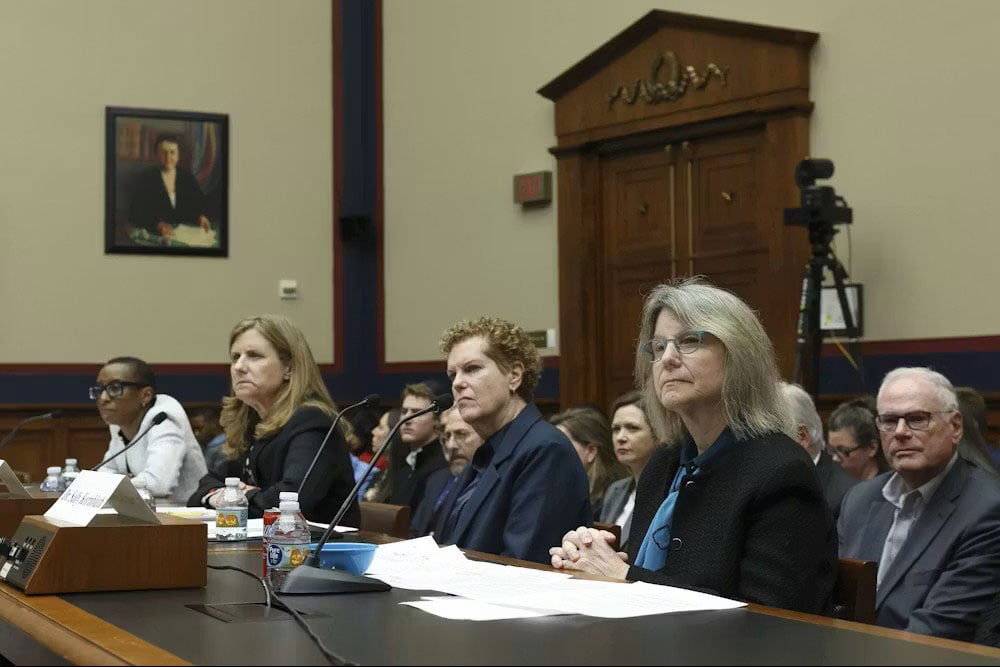
This kind of neutral approach was on display in December 2023, when Republican Congresswoman Elise Stefanik asked several university presidents during a House of Representatives committee hearing if “calling for the genocide of Jews” would violate their schools’ rules.
The presidents of Massachusetts Institute of Technology, Harvard University and the University of Pennsylvania all answered vaguely, with hesitation.
“If the speech turns into conduct it can be harassment, yes,” said Elizabeth Magill, then president of University of Pennsylvania. “It is a context-dependent decision, Congresswoman,” she continued.
Hedging, evading and speaking in platitudes has become the order of the day for university leaders, who are facing political and financial pressure under the Trump administration. Their communication style seems scripted by lawyers and communications officials, who are tasked with trying to keep universities out of trouble.
My scholarship on language and rhetoric suggests that how people speak – not just what they say – matters. This is especially true for university presidents and others in leadership positions.

Kevin Dietsch/Getty Images
Moral leadership in higher education
In 1921, Alexander Meiklejohn, then president of Amherst College, understood the importance of speaking on moral and political issues. He spoke out forcefully during a raging national controversy – namely, how the U.S. should respond to rising numbers of immigrants.
Calvin Coolidge, an Amherst grad and then vice president of the U.S., was among the political leaders who advocated for an immigration quota system favoring northern Europeans over immigrants from southern Europe or Asia.
Coolidge backed xenophobic immigration policies in 1921, then writing: “There are racial considerations too grave to be brushed aside for any sentimental reasons. Biological laws tell us that certain divergent people will not mix or blend.”
Meiklejohn opposed immigration quotas, and he publicly said in 1921 that America could either “be an Anglo-Saxon aristocracy of culture or a Democracy,” but not both.
One year after he became president, Coolidge made his choice when he signed the Immigration Act into law in 1924. This law created strict immigration quotas, dependent on people’s nationality, and barred people from Asia from entering the U.S.
College presidents oppose the Vietnam War
Decades later, university presidents like Kingman Brewster Jr. at Yale and Theodore Hesburgh at Notre Dame publicly opposed the U.S. becoming involved in the Vietnam War – without hesitation or legalistic qualifiers.
“We cannot urge students to have the courage to speak out unless we are willing to do so ourselves,” Hesburgh said in 1970.
In 1971, Brewster publicly criticized the U.S. attacks on Southeast Asia, saying the bombings showed that “America had no concern for the sanctity of human life.”
His views made headlines in The New York Times and attracted the ire of Vice President Spiro Agnew, who criticized him in several speeches.
Twenty-five years later, Howard Shapiro, at the time the president of Princeton University, praised the vocal, “moral” leadership that Brewster and Hersburgh showed.
He noted: “There was a time when great figures presided over our nation’s campuses – intellectual giants who led their faculty, students, alumni, trustees, and nation with grace, vision, and moral purpose.”
Risk management takes center stage
Current university presidents who are choosing neutral and cautious approaches to political issues have reason to watch what they say.
The Trump administration has made widespread cuts to university funding, pressured schools into deals to restore their funding, and launched investigations into several schools for civil rights violations.
Others in higher education leadership roles have seen how the presidents of Harvard and the University of Pennsylvania dramatically resigned in 2023 amid widespread criticism over their response to campus protests and reports of antisemitism.
The presidents of Columbia University and the University of Virginia also resigned in 2024 and 2025, respectively.
When university presidents do speak publicly on the Trump administration’s cuts to research funding and resulting job losses on their campuses, their language is rife with ambiguity and familiar slogans.
Princeton President Christopher Eisgruber, for example, assured Princeton’s community in a February 2026 letter that “We will sustain our commitments to excellence in teaching and research … and our other defining values.”
“As always, we will be guided by the values and principles set out in the University’s mission statement and strategic framework,” Eisgruber added.
Other prominent university and college presidents, meanwhile, write phrases like “sustaining our capacity” or make a promise to “do everything I can to ensure we continue to live by our values.”
These words sound good, but, to me at least, ultimately mean nothing.
It matters what college presidents say
It is hard to disentangle the full influence that college and university presidents have, and why what they say matters.
A 2001 survey by the American Council on Education found that “the vast majority of Americans rarely hear college presidents comment on issues of national importance, and when they do, they believe institutional needs rather than those of the students or the wider community drive such comments.”
Today, the same seems to be true.
Their choices about when and how to speak are important because, as law professor James Boyd White writes, what people say and write “helps establish an identity, or what the Greeks called an ethos – for oneself, for one’s audience, and for those one talks about.”
On college campuses and beyond, leaders’ words create “a community of people, talking to and about each other,” according to White.
That is never an easy job.
But, as Wesleyan University President Roth noted, it is always an important one, especially in a place like a university.

Austin Sarat is William Nelson Cromwell Professor of Jurisprudence and Political Science at Amherst College.



























Deborah Coffey says
Right…and choosing “neutral and cautious” approaches to political issues is exactly how a country loses its democracy…a cost that is much more huge than losing some money by way of Donald Trump’s threats. Did the “cavers” consider that colleges and universities do not thrive under authoritarian regimes? Their stance is short-sighted. Stand up, America! We’ve got to take our country back from the megalomaniac in the White House and restore its entire moral fiber.
Pogo says
The accompanying photo, how’d that happen at the intersection of the patriarchy and imperialism?
Is it possible that business is business, no matter the business?
https://www.google.com/search?q=university+executive+compensation+compared+all+executive+compensation
Here is a word to ponder and research: penury
https://www.google.com/search?q=penury
Good night, and good luck.