



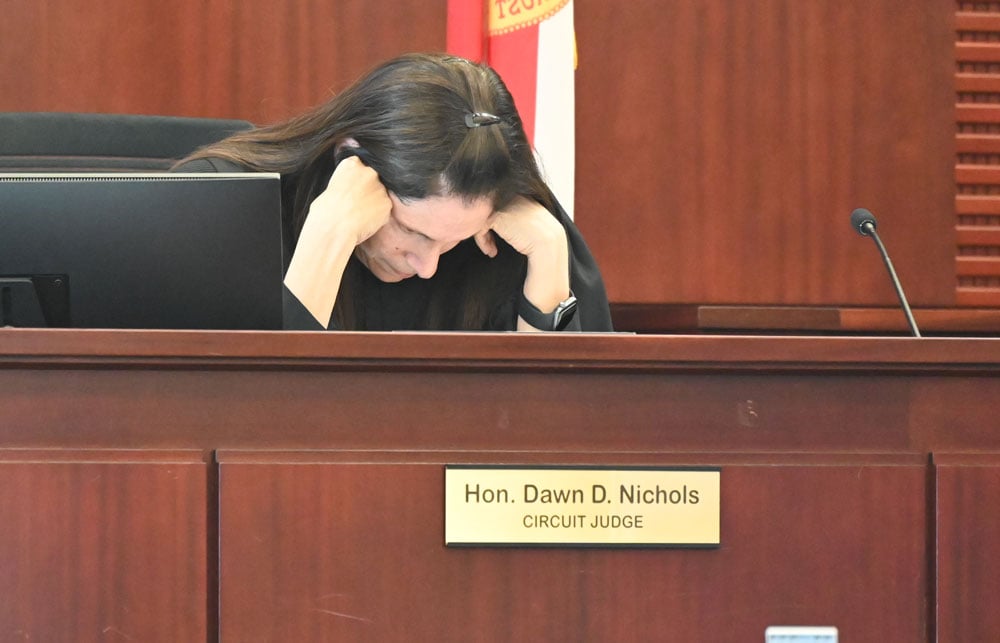
It’s never been done in recent memory in a Flagler County trial, if ever: the defendant’s opening statement was so improper that, after twice sending the jury out to address objections, the judge asked the prosecutor to take a highlighter to his 12-page statement and mark parts he could speak to the jury.
That’s what Assistant State Attorney Melissa Clark did to Kristopher Henriqson’s opening statement this afternoon: she essentially redacted all but a few lines she found permissible as the jury waited almost an hour to return after the second time it had been recessed, and after it had witnessed the prosecution’s sharp objections scuttle the first 90 seconds of Henriqson’s statement.
He had barely started to read his opening statement in his own trial on 11 charges of child rape and molestation of his pre-teen stepdaughter when he started telling the jury he was not a licensed attorney, and had chosen to represent himself. Clark objected.
Circuit Judge Dawn Nichols sent the jury out to explain to Henriqson that he doesn’t get to elicit sympathy. He’d made the choice to represent himself. He had to live with the circumstances. (She had cautioned him in pre-trials that a defendant representing himself on such grave charges could result in a life sentence without parole if Henriqson is found guilty. She did not tell him that self-representation over such high stakes had not been done in recent memory in this circuit.)
The jury returned. Less than a minute later, the judge sent it back out.
“There are so many different levels of why what you’re saying is an improper opening statement. You don’t have the ability to dictate how Miss Clark presents her case,” the judge told him, after he’d begun to complain to the jury that Clark wasn’t going to call a number of witnesses–even though he could have called any witness he wanted.
“You’re presupposing things that Ms. Clark may or may not do and witnesses she may or may not call, so it is improper, sir,” Nichols told him as he stood at the lectern. “You can’t ask the State to prove your case for you. You don’t have to prove your case. You don’t have any requirements to do anything. But you can’t then require the state to prove your case.”
Henriqson was through only the first of 12 single-spaced pages he’d written by hand, in his usual, tight-scrolled capital letters. The judge made an extraordinary request to review the rest of the opening statement. Henriqson did not object. She read.
And read, and read, her head hunched over her palms.
It was too much of a closing argument, she said. She asked Henriqson if Clark could read it, too, and “note any objections so I can rule on the record, otherwise the jury is going to be up and down for every few lines,” Nichols said. Henriqson agreed.
It had taken until just before 3 p.m. for the selection of a jury of eight men and six women, including the two alternates, even though Henriqson had decided not to ask the pool of jurors any questions. The pool of 50 had dwindled to 33 even before Clark asked them questions, as the judge’s inquiries revealed peremptory causes that called for dismissing 17 men and women, 15 of them for having themselves or their children been victims of rape or molestation.
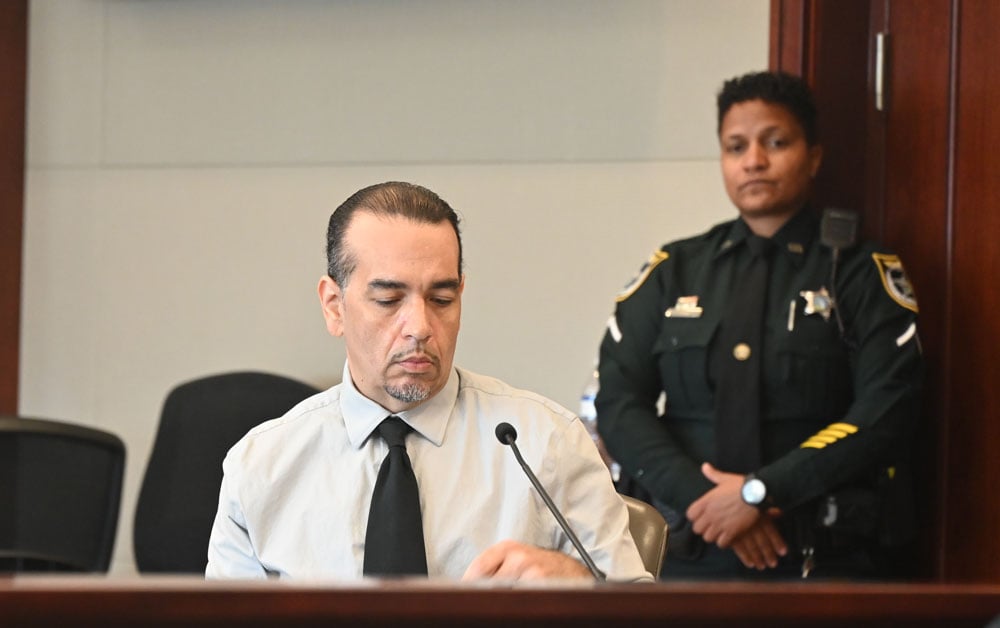
Clark found most of the pages objectionable. Henriqson was arguing that the state’s evidence was insufficient. He was bolstering his witnesses’ credentials or commending one of them for her bravery for testifying. He was calling the victim a liar, repeatedly. He was eliciting sympathy for losing his two daughters, and telling the jury about spending over a year in jail, even though he was appearing in a shirt and tie and without shackles so as not to prejudice the jury against him. He had also cut off his ponytail.
“He’s essentially testifying without being subject to cross-examination,” the judge said. “Is there anything in there to which you do not object?”
There was very little.
Clark highlighted a few parts, and after Henriqson reviewed the pages again, called on Assistant Public Defender Spencer O’Neal, his original public defender, for some help. He had agreed to keep O’Neal on standby for any questions, but O’Neal couldn’t represent him–unless Henriqson tapped out, and tapped in O’Neal for good.
Clark, a prosecutor who tends to be several moves ahead of even skilled defense attorneys, had pointedly asked the jury whether they would feel sorry for Henriqson for representing himself, whether they’d cut him breaks for doing so. “It’s possible I may be making objections during the course of the trial,” she told them. “Is it something that’s going to aggravate you because he doesn’t have a lawyer, he’s doing it himself?”
They said no. They said they would not focus on the fact that he’d chosen to defend himself, rather than on what’s happening in the trial. But in the first hour of their jury service, that’s all there was as they spent the majority of the hour in their jury room.
It was after 4 p.m. when Henriqson was ready again. The jury returned.
What would have been a 40 to 45-minute opening statement had been reduced to 35 seconds as Henriqson told the jury that there’s no DNA, no physical or medical evidence “to support any of the accusations against me,” and that the confession detectives got out of him in two phone calls he did not know they were recording were “false.” He then went back to his seat.
Clark had gone first with her opening statement. It lasted just 10 minutes and was–as she described opening statements to Henriqson and the court while the jury was out–“a roadmap” of what was ahead, rather than an argument. She said Henriqson had confessed in recorded calls to abusing his stepdaughter (he’d been tricked into believing that she had miscarried at school and that the fetus was being tested), that DNA had been collected from her chest within 24 hours of the last time he had assaulted her, and that the girl had spoken in detail of the assaults, which allegedly took place over three years, in an interview with a Child Protection Team forensic interviewer.
Clark had enumerated the witnesses she would be calling. “Each of these witnesses are going to put the pieces of this puzzle together for you,” Clark said, “and that puzzle will show you when all the pieces are together with this defendant, Kristopher Henriqson, was Avery’s* stepfather, and that he began sexually abusing her when she was just 9 years old. And this abuse went on for years, until finally Avery had enough, and she said something to a trusted adult.”
By the time Henriqson’s missteps had run out the day’s clock, Clark had time for only one witness–the Flagler County Sheriff’s Adam Gossett, the lead detective on the case, who summarized his role in the early part of the investigation. The judge then dismissed the jury until Tuesday morning.

(*) The name is a pseudonym randomly generated by AI for girls born around 2013.



























Leave a Reply