



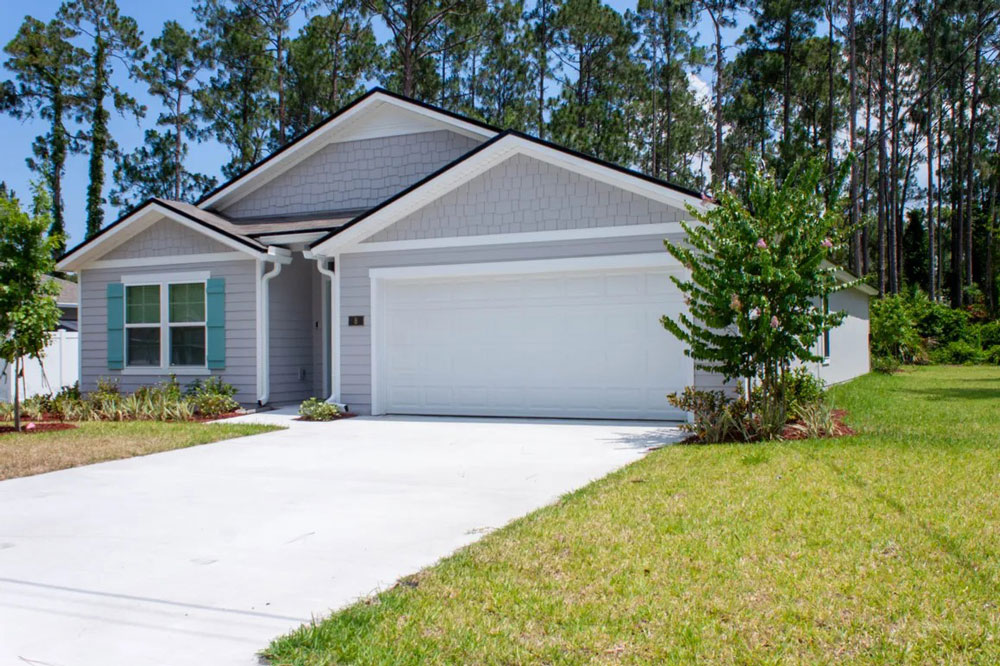
Recovery homes, once commonly known as halfway houses, have multiplied over the last 15 years. Palm Coast currently has 18 of them. Under current city code, they are technically illegal, though the city is out of compliance with state laws that protect such housing.
“Currently in our code, boarding homes, shelters, halfway houses, and rooming houses are prohibited,” City Planner Jackie Gonzalez said. That is about to change.
On Tuesday evening, the Palm Coast City Council is expected to adopt an ordinance aligning city rules with a new state law. This law requires local governments to codify the allowance of recovery houses and grants them the authority to regulate the homes according to local land development regulations. However, cities and counties cannot impose burdensome rules on recovery houses, which are typically single-family homes or duplexes in residential neighborhoods.
Starting Jan. 1, all recovery homes must register with the city and be certified through the Florida Association of Recovery Residences (FARR), according to Gonzalez.
Although the new state law does not explicitly mandate local registration, Palm Coast will require houses to prove FARR certification to obtain a city license. Existing homes will have 60 days to come into compliance with the city ordinance or face closure, Gonzalez said. (They have 60 days to show they have applied for certification, a process that may take up to nine months.)
While the state allows up to 20 residents per single-family house, Palm Coast will cap the allowance at 10—the same limit applied to short-term rentals. The city will also require that recovery homes be spaced at least 1,000 feet apart. “So that you won’t have a street with nothing but recovery homes on it,” Gonzalez said. The city cannot impose other location restrictions, such as proximity to schools or daycare centers. Additionally, a recovery home will only be allowed on one side of a duplex, not both.
“We currently have 18 homes in the City of Palm Coast: nine that are registered and nine that are not,” Gonzalez said. “NARR [National Association of Recovery Residences] had a group called Oxford House that they made a special category for that exempted them from having to apply with any agency… So those nine homes are actually Oxford Houses at this time,” and are not registered.
The new ordinance will require Oxford Houses to register, Gonzalez said. Yet Oxford Houses are federally protected under the Fair Housing Act and often litigate against local municipalities that require registration or certification, as they operate democratically without paid staff (unlike FARR certified homes).
The nine other homes in Palm Coast are already registered. The largest currently houses 14 residents; this must be reduced to comply with Palm Coast’s limit of 10. Gonzalez tracks all the houses, as well as any Narcan incidents requiring first responder intervention. Narcan is a medication used to reverse an opioid overdose and restore normal breathing.
The nine registered homes in Palm Coast are as follows: Evolve Sober Living (single-family homes on Rainbow Lane, eight beds, men only, Riviera Drive, seven beds, men only, and Zinzendorf Place, 11 beds, men only, all Level II), Foundations to Freedom (single-family house on Burning View Lane, 11 beds, men only, Level III), Palm Coast Transitions (two apartments on Brewster Lane, one single-family house on Coral Reef Court, all eight beds and men only, all Level IV) and Zen House Sober Living (Ponsettia Lane, nine beds, women only, Level II, and Panorama Drive six beds, women only, Level III. See an explanation of the four levels further down.)
“I want you to understand that recovery residences is an actual disability. It’s called substance use disorder, and it is protected” under the American with Disabilities Act and the Fair Housing Act. (The words disability and disorder are not, in fact, synonymous, and it is not legally accurate to call a substance use disorder a “disability.”) “We cannot discriminate employment or housing under those two acts from the federal government, so they have rights.” Landlord may apply to have such services provided in their houses.
“In general,” Carrie Baird, CEO of Flagler Cares, the social services coordinating agency, “we have been very pleased with the housing options that recovery residences have created for our clients—it is one of the only affordable housing options we can offer for those that qualify and we are able to provide direct financial support for initial housing costs when clients are transitioning from residential treatment or incarceration.”
Recovery homes grew out of the 12-step programs of the 1960s. They’re not called halfway houses anymore. They’re called “recovery houses,” “sober homes” or “sober living homes.” They’re non-medical group homes that help individuals make the transition from regimented treatment programs to autonomous living. The homes may be run independently, by residents themselves. Or they may be run by for-profit or non-profit companies, by staffers, depending on the “level” of home and recovery services offered.
According to a 2025 legislative analysis that accompanied the passing of Florida’s new bill, “Recovery residences started to proliferate in Florida as insurance coverage for behavioral health conditions expanded after the enactment of the Affordable Care Act in [2010] and the Mental Health Parity and Addiction Equity Act of [2008]. The opioid crisis created a demand for addiction recovery services, and the housing crash of the late 2000s made purchasing and renting homes generally more affordable. The ‘Florida model’ emerged, where after the first stages of detoxification and inpatient treatment, an individual enters intensive outpatient or day treatment services while residing in a recovery residence.”
Unlike substance abuse treatment services, which must be licensed, regulation was non-existent for recovery homes. Individuals were not protected from exploitation. A 2017 report by a Palm Beach County task force on sober-living homes found that many of the thousands of people being marketed to sober living were “being exploited and abused” for lack of oversight, especially in the private sector. That “allowed bad actors to flourish, significantly contributing to the rising death toll.”
The National Association of Recovery Residences was established in 2011. The first regulatory step in Florida was a 2015 law establishing voluntary certification through the Florida Association of Recovery Residences (FARR). There are more than 750 certified homes across the state.
There are four levels of recovery homes. Level I is peer- or democratically-run by residents who have completed their treatment and have already had a minimum of nine months of sobriety.
Level II has oversight through a house manager. Rules are set out. Residents may have to pay dues and meet milestones.
Level III homes, designed form individuals who are early in their recovery, are staffed 24 hours and provide several services, from life skill mentoring to meal preparation.
Level IV is staffed by a licensed substance-abuse treatment service provider. Residents follow treatment plans, attend counseling sessions and abide by a recovery plan.
Community residential living homes are different from recovery homes. Non-recovery community residential homes include assisted living facilities that operate in single-family homes (Palm Coast has several), foster homes, group homes for youths, and so on. There are some 90 such homes in the city, Gonzalez said. Those are limited to six residents.




















Love Your Neighbor says
As long as everyone is safe not a threat and respectful to each-other and there neighbors more power to them.
Erod says
So does this mean they can open up in HOA gated communities like Plantation Bay or any of the thousands of units being built all over Flagler County ?
Daniel Lauber says
Based solely on what this article says, Palm Coast is adopting zoning provisions that fly in the face of the Fair Housing Act and would be easily thrown out if challenged in court. To better understand what zoning approaches are legal and illegal, city leaders need to read the report the legislature commissioned which was published in 2024 entitled “Reforming State and Local Zoning for Community Residences for People with Disabilities and for Recovery Communities” which is available at grouphomes.law (it’s the Florida Report). Then they might understand that spacing distances and limits of 10 occupants are legal only when applied to being a permitted use — the Fair Housing Act requires that a reasonable accommodation must be made when certain standards are met to allow locating within a spacing distance or to house more than 10 people to ensure therapuetic and/or financial viability. In addition, the Oxford House charter is the functional equivalent of state certification and the city must treat it as such. And the city cannot have one set of zoning provisions for recovery residences and another set for community residences for people with other disabilites. From what the article reported, Palm Coast is begging for costly legal action to be taken against it.