



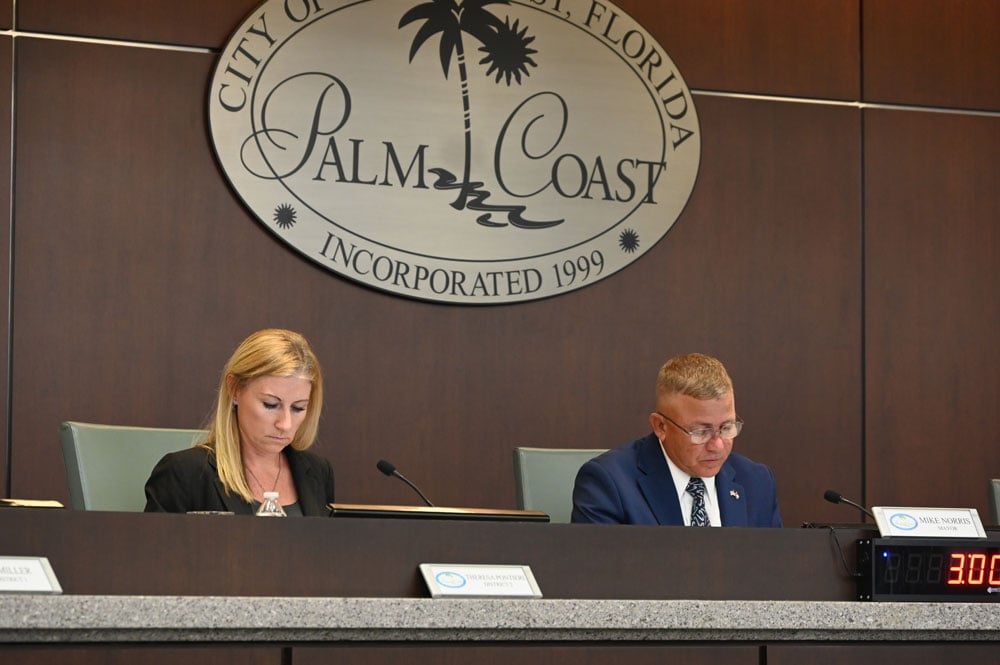
Last week Palm Coast Mayor Mike Norris proposed to his colleagues consideration of what he called an “austerity budget” in response both to potential reductions in property tax revenue due to the pending constitutional amendment significantly raising homestead exemptions, and to the slowdown in property valuations, which is also reducing revenue. The following day FlaglerLive published the mayor’s proposed resolution in full, including its disclaimer that it was a “shell” proposal for City Manager Mike McGlothlin and City Attorney Marcus Duffy to develop into a more formal resolution.
Norris at today’s council meeting criticized the publication of the proposal. “I sent them that as a shell document so we could try to mold it for our city,” he said. “We’re not trying to reinvent the wheel. And I was going through it and–do you want to do up a draft resolution. And that’s all I did. I sent that to Marcus, I said we need to pare it down, and I actually said AI doesn’t know a lot of things about our community or our systems of government. So I was just giving us something to go by. All those things on there, really, we’re already doing. It’s just putting it into guidance from the council what we want to look for. It’s just sad that [FlaglerLive] would publish an email from the mayor to the city manager and the attorney. We have Sunshine laws and stuff, but when we’re talking and just kicking back ideas and stuff, it’s just like fear mongering, and that’s not what the intent of any of that is.”
Norris’s statement is misleading. Last week, he had asked and received consensus from the council to direct Duffy to work on the resolution, which he mentioned sending to Duffy, even though several council members had reservations about agreeing to something they had not seen. Council members themselves had requested a copy of the email after the meeting. As it had become the basis of potential policy and budget discussion, FlaglerLive published it as it would any document that might serve as a foundation for policy direction.
Even Norris spoke today in terms of his document as policy direction: “I have no problem with the state, if they want to take away that [property tax revenue] in it, that’s what the residents want, that’s what the residents want,” he said. “But I do have the plan, and I’m not a person that sits back on my butt and doesn’t look forward and try to lean forward to get ahead of things. So really, [FlaglerLive] took that whole thing out of context, and he’s out in left field, so to speak.”
Norris spoke as City Council member Theresa Pontieri had begun to respond critically to the mayor’s “austerity” proposal. She was twice interrupted. What follows are Pontieri’s full remarks as she had prepared them for delivery, only a portion of which she delivered at the meeting.

I acknowledge the importance of maintaining a conservative and tightly regulated, as well as fully transparent budget. In concept, I fully support discussions on strategies that enhance our efficiency and eliminate wasteful spending. However, I must express my strong disagreement with the mayor’s proposed “austerity budget,” which, I believe, is ill-conceived, poorly written, and, frankly, legally impossible to implement.
The proposed resolution fails to recognize the practical challenges we face each year when forming a municipal budget and does not adequately address the unique needs of our community. And how could it—being written by AI? Furthermore, many of the items proposed neither make sense nor realistically present opportunities for savings. Here are just a few examples:
- It calls for the merging of finance and procurement. Procurement is already merged with finance.
- It recommends an administrative four-day work week, while at the same time, recommending those four days be ten-hour work days. I’m no math wizard, but whether we have five eight-hour work days or four 10-hour work days, our employees would still be working 40 hours a week. However, under the mayor’s proposal, we’d have one less day of being open and able to serve our residents, and our employees would be working longer—and thus likely less productive—days. I suppose those who have kids can decide whether they want to skip breakfast or skip dinner with their kids and families every Monday through Thursday, as a 7 a.m. to 6 p.m. work day, or an 8 a.m. to 7 p.m. work day (assuming we’re still allowing them to have a one-hour lunch break) doesn’t afford them the luxuries that a normal 8-to-5 work day allows. As a silver lining, I see the austerity budget does not explicitly take away their lunch hour, so I suppose we can rest easy there.
- The mayor’s budget calls for the elimination of non-mandated programs, all festivals, and all arts grants. And why wouldn’t an AI-created budget take away these things? Afterall, it’s not human. Chatbots don’t recognize how important events like our 9/11 5K are; our favorite AI buddy, Claude, has no sense of what Touch-A-Truck means to the community; and since the stories of our young authors in the Josh Crews writing program haven’t hit the internet yet, there’s simply no way Grok could know how disappointed our kids would be if we didn’t support that program.
- Next, this austerity budget calls for fixing roads using a “worst-first plus preservation” policy where we “shift budget to crack sealing and resurfacing vs. full rebuilds.” Well, mayor, we’ve been doing that. I suggested we do that my very first year in office, and we’ve been setting aside $1million each year to do just that. And we didn’t have AI nearly four years ago—I got that idea from good, old-fashioned research and reading about ways to get more infrastructure done with less money. Very vintage of me, I know.
- Moving on, apparently AI thinks saving a few bucks is worth sacrificing neighborhood safety, as this budget suggests turning streetlights off between the hours of 11 p.m. and 5 a.m. So, if you work the night shift at Wawa, I hope your bright lights work well and that no deer are feeling risky—specifically in our L Section and S Section. And to our deputies patrolling the night shift and our firefighters responding to calls at 2 a.m., I pray your coffees stay full and your eyes wide open. No streetlights for you either.
- The budget suggests a homeowner association (HOA) park takeover program. I don’t know what that is, but it sounds terrible.
- And it suggests we auction surplus vehicles from our fleet. We already do that.
- And that’s far from the only thing this austerity budget suggests that we already do:
- It says we should have a dedicated stormwater fee, which we already have.
- It says we should move to full cost-recovery pricing for our waste pickup, which we already do. And…this is my favorite…
- It calls for increasing impact fees and permit fees to 100 percent cost recovery for plan review, inspection, and infrastructure impact. Well, we’ve done that, and we’re being sued by the Homebuilders Association for it. So, apparently, either Grok, or Claude, or Chat AI didn’t get that memo either.
Finally, I must address the illegalities and impracticalities of attempting to implement this. The proposed budget lists core services that must be prioritized, and while I don’t disagree with the priorities themselves, the fact is, property taxes have nothing to do with water, sewer, road paving and solid waste. Those are completely separate funds from those we use property taxes for. Therefore, you could “austerity” the heck out of our general fund budget, and it would quite literally have zero effect on those services.
Additionally, while we as council give policy direction to staff as to how staff prioritizes city funds, including property taxes, the city manager and our directors have day-to-day spending authority, which you—mayor—voted to increase the threshold limits for rather unequivocally. In other words, city operations, like days of the week we are open and how many director-level positions we have, are not within this council’s purview. Those operational decisions sit with our city manager.
To summarize, I find this proposal to be impractical, not legally enforceable, and out of touch—not just with reality, but also with the specific needs of Palm Coast. This is a lazy attempt to substitute the use of AI for the hard work it takes to thoughtfully formulate a good budget, and quite frankly, it’s not worth the AI data center energy wasted to produce it.
As we move forward, it is crucial that we take a realistic approach, ensuring that our budget reflects the realities of governing while effectively serving our residents. I welcome the opportunity to engage in meaningful discussions with pinpointed strategies and solutions, rather than general ideas that look good on paper but are not workable in reality. This approach will lead to a budget that is both responsible and tailored to the specific needs of Palm Coast.
For these reasons, I will not be supporting this resolution. I fully support taking a hard look at our budget, making tough decisions as to where we have to cut back, trim down, spend less, and be more efficient. And I’ll be looking for ways to do this while maintaining the quality of life our residents have come to enjoy. But this…is not the answer.



























Anna Jones says
The county has bring your child to work day. They have free food trucks, bouncy houses, and they even brought in the helicopter for them to play in. Wouldn’t wanna take that away now would we? Don’t forget all those catered lunches either.
Clueless says
You move here two years ago and decide to run for office because you didn’t do your due diligence when you picked out your house and didn’t figure out that there’s an airport nearby.
To close that airport would cost the taxpayers millions of dollars in grant money to repay.
You must be some sort of tyrant to shit on the employees.
Anna Jones says
None of this is true.
celia says
Clueless stop the conspiracies…neither Anna of any of the over 1000 affected residents that signed the PeaceforPalmCoast petition want to close the airport. We want the flight training schools properly regulated so they are not a danger and nuisance for Palmcoasters. Your words show some type of special interest involved with them and also a defensive attitude to the overspending with staff. Why our taxpayers children that sustain county staff and elected can have the same luxuries afforded? THINK. Did we the taxpayers ever approve the expense?
GetItRight says
That is Flagler County. This article is about the City of Palm Coast. Different entities, governing boards, budgets and employees.
celia says
Anna is correct as the county spend our Palmcoasters taxes like is other peoples $$ and here https://flaglerlive.com/flagler-deficits/?unapproved=3702942&moderation-hash=3f6d65ad85a9bc72f3a9cbef75848fbd#comment-3702942 first thing will do is to cut our services if the bill passes! So no different than the city. Good point Anna in what they have us fund! Like Real estate purchases over 3 millions spent…and not for conservation.
Layla says
The saddest thing here about our voters is they do not know the difference between the City and County governments, and then they decide they are bright enough to run for office. I am embarrassed for you, for all of us. Some things never change. We need to return to teaching government in all grades here.
The same people run for office over and over again, bringing more lack of skills and ignorance. Qualified people will not run for office here. Until we fix that, we are all screwed.
Just a Rolling Stone says
Why anyone would vote for you makes me believe there is no hope for humanity.
That’s your answer to a budget cut?
What is your plan, your policy your political agenda?
Oh, that’s right you don’t have one.
Just an FYI-
Im sending pizza and donuts to the so they can balance their budget…..
Geeez
Franky says
Mayor Mikes schtick is starting to get old. Wasn’t he harping against data centers? But, “watch AI give me a city budget!”
Let’s be honest, the mayors race had awful choices. He seemed like the best choice despite a serious question of whether he could “hold it together” for, what alcoholics call, a moment of clarity. Those moments have been fleeting. The guy is all over the place, mostly, of insanity.
This AI fiasco is utterly embarrassing. This guy just downloaded the City’s budget in Chat and prompted it to “cut the budget by 30%”. Was “lazy public financial budgeting” an upper level class in his “Masters of Human Resources” program? I mean, who gets a masters of Human Resources degree anyway? And who would talk to people like he does if they actually went to a credible institution for this ridiculous graduate degree?
Look, he’s completely unprepared for every meeting. He has no idea what he’s talking about when it comes to the governance of the city. However, this could all be due to his need for that next cigarette.
It’s been a few months, something tells me he’ll be back to playing victim again soon. He needs the attention.
Meanwhile, can the serious council members get a plan together for what’s coming? Give AI mike a coloring book and some crayons to keep him busy on the dais while they do so.
Just a Rolling Stone says
Exactly this by far the worst person ever to be elected as Mayor. He will go down in history as the worst ever.
He is unprofessional, crude and rude.
It’s sad that my tax dollars pays for this guy.
See you at the next election.
Why I reject says
[Comment withheld. You’re using multiple handles to make it appear as if you are different commenters, in violation of our policy. Please choose one handle and stick to it, without trolling fellow commenters in your handle. You’re welcome to resubmit as long as you comply with our comment policy. Thank you.–FL]
Leila says
I am not alone in wishing Ms. Pontieri was returning to the Council. We can all see what an absolute disaster as well as embarrassment this Mayor is. Elections have consequences and we are in dire need of a competent mayor at a time when we don’t have one.
Layla says
Watching the same people comment and complain here is frustrating. It is a cesspool of ignorance. Large numbers here have no idea of the differences in city and county government, nor do they care. We need to return to teaching government at all levels to our children. Until we do, prepare to see the same people running for office and the same people bitching about how terrible they are.
Our mayor is a joke. We struggle over and over again among the uninformed and policies which belong to the state and federal governments, the biggest examples of why local control is better. We are about to give up that local control to the state. Will any even notice the loss of freedom?