



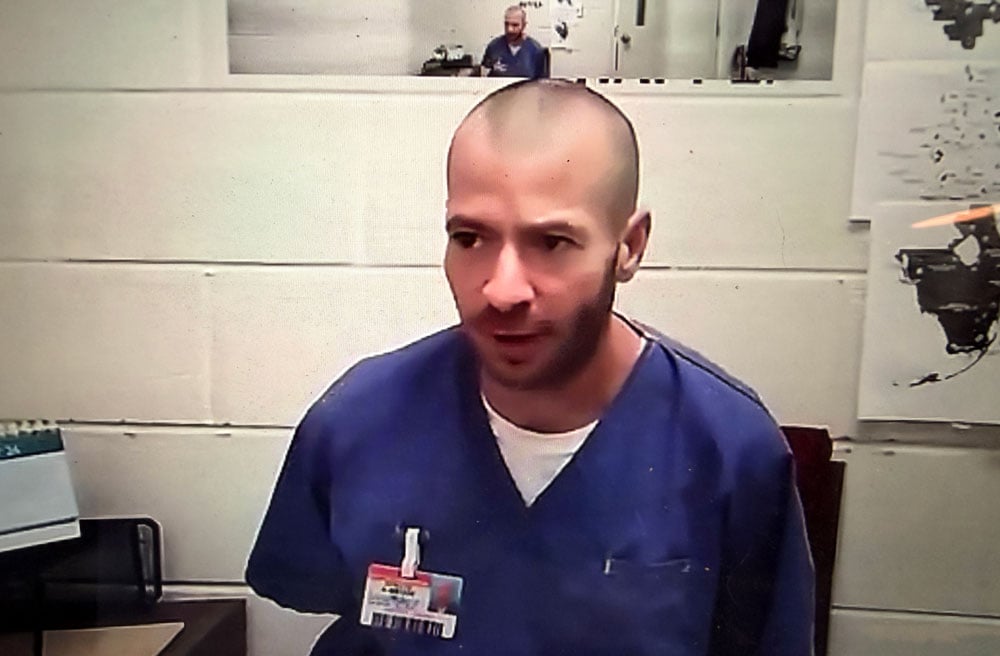
David J. Pettit is a 41-year-old former resident of Daytona North in Bunnell who three months ago was arrested for the third time for violating an injunction for protection against domestic violence. The injunction has been in effect since 2022 and protects a woman and her minor children from what had been harrowing encounters with Pettit.
Pettit was twice before convicted for violating the injunction, serving a brief jail term in Volusia County then seven months in state prison, a term that ended in March 2025. After his February arrest for the third violation he pleaded no contest to the third-degree felony before Circuit Judge Dawn Nichols on April 22, was sentenced to three years in prison, and was incarcerated at a prison in isolated Malone in the Panhandle, just south of the border with Alabama.
On Tuesday, he was back in court–by a remote connection–to argue a rare motion: retracting a plea after the sentence. He had nothing against his attorney, Assistant Public Defender Melissa MacNicol. He just wanted the judge to know that he wasn’t in his right mind when he pleaded–that he was “incompetent to proceed.”
“My case is complicated. There’s details I can’t talk about and it makes me say stupid crap,” Pettit told Nichols. That was the least of it.
Before his last arrest, his mother had alerted authorities that he had just gotten out of the hospital after four days there, one of his latest Baker Acts, and that he suffered from schizophrenia. She told them that he was back in the Mondex, where he wasn’t supposed to be, and wanted sheriff’s deputies to conduct a welfare check on him to ensure his safety.
By then he had already violated the injunction, so when deputies found him, they took him to jail.
What has unfolded since illustrates the little extent to which mental illness gets in the way of criminal prosecutions no matter how absurdly an individual behaves, no matter how outlandishly he speaks, no matter how paranoid and violent his past behavior.
The injunction had resulted from a series of violent altercations starting five years ago with the mother of his then-infant son, when he punched her repeatedly and said he would not stop until she agreed to shoot him. She escaped with her child out a window, according to her petition to the court for an injunction. He had previously fired a gun in the same room where his baby was sleeping after hallucinating that people were in the attic, according to his partner at the time, and started stalking her and destroying property. He’s been Baker Acted numerous times.
His February case shows no attempt to establish his competency to stand trial, though the bar for establishing competency is very low. The alternative is incarceration in a state hospital for psychiatric treatment until the individual is “restored” enough to proceed with trial or additional proceedings–as was the case, for example, with Joseph Bova, the man eventually convicted and sentenced to life in prison for shooting to death a night clerk at the Mobil convenience store on State Road100 in Palm Coast in 2013. Bova suffered from schizophrenia. The shooting was random. He was deemed incompetent for years, then tried more than nine years later, though to a lay person, his competence was as suspect then as it had always been.
As was Pettit’s as he tried to make his case to the judge on Tuesday.
“I lied under oath to protect government secrets,” Pettit told the judge. He sounded lucid enough: his sentences were largely grammatical and logical. The thoughts they were conveying were not.
“I went through a very thorough plea colloquy with you, and asked you if you suffered from any mental health issues,” the judge told him. “We went through it very thoroughly. I wanted to make sure you understood everything you indicated you understood.”
Pettit didn’t seem to be listening to her.
“The NSA are trying to do something right now,” he said, referring to the National Security Agency, the government’s spying and surveillance arm abroad, or mostly abroad. “My crime involves technology from the government that I can’t even speak about, because it’s real technology. It would just be easier to get me out of this mess through this.”
The judge just wanted to know how he believed he was incompetent at the time of the plea. But she and Pettit were on different planets. Pettit continued to talk NSA and fantasy claims. The judge kept trying to bring him back to earth, or at least to Malone.
“This is not whether or not you believe that you’re telling me all of this stuff now. It’s whether or not you were confident at the time that you entered your plea, so that’s what you have to convince me of,” the judge told him.
“I’m not guilty of the crime. I can prove this in the court of law with the governor testifying for me, and that’s a promise, that’s not insanity talk, that’s a promise,” Pettit said, claiming entrapment. “It’s been four and a half years that I started hearing things, and I found out about so much [about] the atmosphere, how to communicate from a distance. I started communicating. It was the NSA that says I communicate with people from a distance. I found out all these things about technology. I got famous.” He said he started communicating with celebrities, and that “we have vision out the eyes over three 50 million Americans.”
“I’m not here to relitigate your underlying case,” Nichols said, her patience wearing thin. But she was still ensuring that the legal process followed its course to not open the door to an appeal. “We are here solely to determine your motion to withdraw a plea, and you’ve not given me anything that would indicate that the plea should be withdrawn.” He had talked over her so many times that at one point he had to have his mic silenced, if only briefly. When he was back on, he assured the judge that he was getting his medication.
The judge then had Assistant State Attorney Tara Libby play two phone calls between Pettit and his mother, calls recorded at the jail the day before the plea, and the day of the plea. He’d said nothing about his competence in the alls, only that at one point he felt pressured to plead out from being told that he had schizophrenia, and that the plea was the best way out. That was not his claim Tuesday.
The following day, he told his mother that all told, he’d be in prison two years and four months, once his credit for time served and time for good behavior are counted. “You were very lucid, and you were very coherent,” the judge told him.
“Just relax, keep in touch with me,” he told his mother in the phone call. “I’m going to be fine, I’m going to be fine, everything will be fine.”
The judge denied his motion. Pettit is scheduled to be released on Feb. 6, 2029, not counting “gaintime.” Nothing suggests “everything will be fine.”




























Pogo says
A pardon (and promotion, including a PhD certificate of attendance, from Trump University) from Trump, and that boy could be in charge of all Diet Coke for the big beautiful golden ballroom.
Laurel says
Catch 22?