• Skip to primary navigation
  • Skip to main content
  • Skip to primary sidebar
MENUMENU
MENUMENU
  • Home
  • About
    • Contact Us
    • FlaglerLive Board of Directors
    • Comment Policy
    • Mission Statement
    • Our Values
    • Privacy Policy
  • Live Calendar
  • Submit Obituary
  • Submit an Event
  • Support FlaglerLive
  • Advertise on FlaglerLive (386) 503-3808
  • Search Results

FlaglerLive

No Bull, no Fluff, No Smudges

MENUMENU
  • Flagler
    • Flagler County Commission
    • Beverly Beach
    • Flagler History
    • Mondex/Daytona North
    • The Hammock
    • Tourist Development Council
    • Marineland
  • Palm Coast
    • Palm Coast City Council
    • Palm Coast Crime
  • Bunnell
    • Bunnell City Commission
    • Bunnell Crime
  • Flagler Beach
    • Flagler Beach City Commission
    • Flagler Beach Crime
  • Cops/Courts
    • Circuit & County Court
    • Florida Supreme Court
    • Federal Courts
    • Flagler 911
    • Fire House
    • Flagler County Sheriff
    • Flagler Jail Bookings
    • Traffic Accidents
  • Rights & Liberties
    • First Amendment
    • Second Amendment
    • Third Amendment
    • Fourth Amendment
    • Fifth Amendment
    • Sixth Amendment
    • Seventh Amendment
    • Eighth Amendment
    • 14th Amendment
    • Sunshine Law
    • Religion & Beliefs
    • Privacy
    • Civil Rights
    • Human Rights
    • Immigration
    • Labor Rights
  • Schools
    • Adult Education
    • Belle Terre Elementary
    • Buddy Taylor Middle
    • Bunnell Elementary
    • Charter Schools
    • Daytona State College
    • Flagler County School Board
    • Flagler Palm Coast High School
    • Higher Education
    • Imagine School
    • Indian Trails Middle
    • Matanzas High School
    • Old Kings Elementary
    • Rymfire Elementary
    • Stetson University
    • Wadsworth Elementary
    • University of Florida/Florida State
  • Economy
    • Jobs & Unemployment
    • Business & Economy
    • Development & Sprawl
    • Leisure & Tourism
    • Local Business
    • Local Media
    • Real Estate & Development
    • Taxes
    • Sponsored Content
  • Commentary
    • The Conversation
    • Pierre Tristam
    • Diane Roberts
    • Guest Columns
    • Byblos
    • Editor's Blog
  • Culture
    • African American Cultural Society
    • Arts in Palm Coast & Flagler
    • Books
    • City Repertory Theatre
    • Flagler Auditorium
    • Flagler Playhouse
    • Special Events
  • Elections 2026
    • Amendments and Referendums
    • Presidential Election
    • Campaign Finance
    • City Elections
    • Congressional
    • Constitutionals
    • Courts
    • Governor
    • Polls
    • Voting Rights
  • Florida
    • Federal Politics
    • Florida History
    • Florida Legislature
    • Florida Legislature
    • Ron DeSantis
  • Health & Society
    • Flagler County Health Department
    • Ask the Doctor Column
    • Health Care
    • Health Care Business
    • Covid-19
    • Children and Families
    • Medicaid and Medicare
    • Mental Health
    • Poverty
    • Violence
  • All Else
    • Daily Briefing
    • Americana
    • Obituaries
    • News Briefs
    • Weather and Climate
    • Wildlife

The Persian Gulf’s Vulnerable Desalination Plants

March 10, 2026 | FlaglerLive | 3 Comments

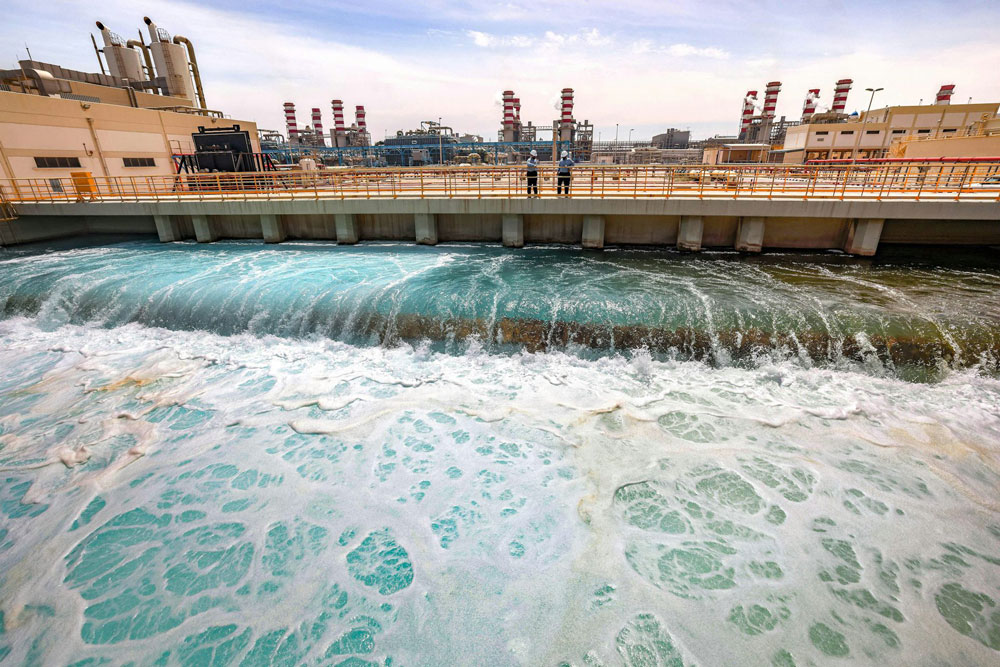
The Ras al-Khair water desalination plant in eastern Saudi Arabia is just one of many along the Persian Gulf coast.
The Ras al-Khair water desalination plant in eastern Saudi Arabia is just one of many along the Persian Gulf coast. (Fayez Nureldine/AFP via Getty Images)

By Michael Christopher Low

Saudi Arabia, the United Arab Emirates and neighboring countries in the Persian Gulf region use the fossil fuels under their desert lands not only to make money, but also to make drinking water. The petroleum they produce powers more than 400 desalination plants, which turn seawater into drinkable water.

In the war that began on Feb. 28, 2026, with U.S. and Israeli attacks on Iran, retaliatory attacks from Iranian forces have hit oil refineries and natural gas plants and disrupted tourism and aviation. Those attacks all hurt Gulf nations’ economies and their hard-won reputations for safety and stability.

But Iranian strikes have also already hit close to a key desalination plant in Dubai. Iranian strikes on March 2 on Dubai’s Jebel Ali port hit about 12 miles (20 kilometers) away from a massive complex with 43 desalination units that are key to the city’s production of more than 160 billion gallons of water each year.

And there has already been damage to the UAE’s Fujairah F1 power and water plant and at Kuwait’s Doha West plant. In both cases, the damage seems to have stemmed from attacks on nearby ports or from falling debris from drone interceptions.

Three people walk through a massive space with many large pipes and valves.
The internal workings of desalination plants can be massive and very complex.
Fayez Nureldine/AFP via Getty Images

Saltwater kingdoms

The region’s monarchies are often described as petro-states, but they have also become what I call saltwater kingdoms, global superpowers in the production of human-made fresh water drawn from the sea. Desalination is part of the reason there are golf courses, fountains, water parks and even indoor ski slopes with manufactured snow.

All together, eight of the 10 largest desalination plants in the world are in the Arabian Peninsula. Israel’s two Sorek plants round out the list.

The countries of the Arabian Peninsula have about 60% of global water-desalination capacity. And plants close to Iran, around the Persian Gulf and the Arabian Sea, produce more than 30% of the world’s desalinated water.

Roughly 100 million people in the Gulf region rely on desalination plants for their water. Without them, almost nobody would be able to live in Kuwait, Qatar and the UAE – or much of Saudi Arabia, including its capital, Riyadh.

Under a massive roof, skiers slide down snow-covered slopes while others sit in a chairlift.
A massive indoor ski area in Dubai is just one of the ways Gulf nations use desalinated water.
Karim Sahib/AFP via Getty Images

Sabotage of water supplies

CIA worries about attacks on Gulf region desalination plants date back to the 1980s. During Saddam Hussein’s 1990 invasion of Kuwait, those worries became real.

After coalition forces began bombing Iraqi positions in January 1991, part of Iraqi troops’ response was to release millions of barrels of crude oil into the Persian Gulf. As the massive oil slick drifted south, U.S. and Saudi officials feared it was meant to sabotage desalination systems.

Workers installed protective booms to shield intake valves at major plants, especially the one that supplies much of Riyadh’s water. In Kuwait, Iraqi sabotage damaged or destroyed much of the country’s desalination capacity.

Kuwaiti authorities also turned to Turkey and Saudi Arabia to supply some 750 water tankers and 200 trucks to import an 18-ton emergency supply of bottled water. U.S.-supplied generators and mobile desalination units provided additional temporary relief, though the full recovery took years.

A beach with black oil on it and large buildings in the background.
Oil washes up on a Persian Gulf beach near a Saudi desalination plant in late January 1991.
Chris Lefkow/AFP via Getty Images

More recent threats

Fears of attacks on desalination plants resurfaced after Yemen’s Houthi movement launched drones and missiles at Saudi facilities at Al-Shuqaiq in 2019 and 2022 – though they did no lasting damage.

Iran’s weapons are far more numerous and sophisticated than the Houthis’, though, so if it attacked desalination plants, the damage could be significant.

There is an irony here: Iran’s capital city of Tehran has a water shortage crisis so serious that in 2025 the government reportedly considered relocating the drought-stricken capital to the coast. But Iran is less vulnerable to attacks on desalination, because its water supply relies instead on dams and wells.

Whatever else the war may be about, water could well become a major factor in the violence and leave lasting political scars. And if either side were to intentionally attack water sources or desalination plants, it would clearly be a human-rights violation.

Michael Christopher Low is Associate Professor of History and Director of the Middle East Center at the University of Utah.


The Conversation arose out of deep-seated concerns for the fading quality of our public discourse and recognition of the vital role that academic experts could play in the public arena. Information has always been essential to democracy. It’s a societal good, like clean water. But many now find it difficult to put their trust in the media and experts who have spent years researching a topic. Instead, they listen to those who have the loudest voices. Those uninformed views are amplified by social media networks that reward those who spark outrage instead of insight or thoughtful discussion. The Conversation seeks to be part of the solution to this problem, to raise up the voices of true experts and to make their knowledge available to everyone. The Conversation publishes nightly at 9 p.m. on FlaglerLive.
See the Full Conversation Archives
Support FlaglerLive
The political climate—nationally and right here in Flagler County—is at war with fearless reporting. Your support is FlaglerLive's best armor. After 16 years, you know FlaglerLive won’t be intimidated. We dig. We don’t sanitize to pander or please. We report reality, no matter who it upsets. Even you. Imagine Flagler County without that kind of local coverage. Stand with us, and help us hold the line. There’s no paywall—but it’s not free. become a champion of enlightening journalism. Any amount helps. FlaglerLive is a 501(c)(3) non-profit news organization, and donations are tax deductible.
You may donate openly or anonymously.
We like Zeffy (no fees), but if you prefer to use PayPal, click here.
If you prefer the Ben Franklin way, we're at: P.O. Box 354263, Palm Coast, FL 32135.
 

Reader Interactions

Comments

  1. JimboXYZ says

    March 10, 2026 at 11:47 pm

    In typical Iranian regime fashion, they aren’t able to get thru the dome, resorting to their terrorist ways to target what isn’t protected under the dome.

    1
    Reply
    • Samuel L. Bronkowitz says

      March 11, 2026 at 4:10 pm

      Interesting. Since you were in the military, what kind of approach do you think they should have taken?

      1
      Reply
  2. PaulT says

    March 11, 2026 at 1:38 pm

    Middle East water wars aren’t new. Fresh water has been fought over for millennnia, Israel and Jordan have been squabbling over water for many years. And it’s not like the Florida – Georgia disputes about Apalachee River oysters, in the Middle East it’s life or death.
    In the 1980’s the desal water in Saudi’s Eastern Region wasn’t potable, it was decidedly brackish but OK for irrigation and domestic use. For something drinkable, you’d need to take your (plastic) jerricans out to a ‘sweetwater plant’ to buy some precious drinking water.
    .Water wars are a horrifying prospect, Iran claims that targeting of a desalination plant in Bahrain was reprisal for a US strike on the desal plant on Iran’s Qeshm Island. The US denies this just as they denied striking a girls school in southern Iran.
    Now the Israeli press is reporting that the Emirates have also carried out strikes on Iran’s freshwater infrastructure as a warning, truly a dive down a slippery slope.
    Whoever attacks fresh water supplies is guilty of a crime against humanity, a war crimes. Drinking water isn’t a strategic target, it’s a human right.

    2
    Reply

Leave a Reply Cancel reply

Your email address will not be published. Required fields are marked *

This site uses Akismet to reduce spam. Learn how your comment data is processed.

  • Conner Bosch law attorneys lawyers offices palm coast flagler county
  • grand living realty
  • politis matovina attorneys for justice personal injury law auto truck accidents

Primary Sidebar

  • grand living realty
  • politis matovina attorneys for justice personal injury law auto truck accidents

Recent Comments

  • Mark on Flagler Beach Leaders Revisit 30 Years of Paid Parking Talk Amid Growing Resentment Toward Palm Coast and County
  • Ed P on The Daily Cartoon and Live Briefing: Thursday, April 2, 2026
  • Deborah Coffey on US, Israel and Iran All Think God Is On Their Side
  • Dennis C Rathsam on The Daily Cartoon and Live Briefing: Friday, April 3, 2026
  • Skibum on US, Israel and Iran All Think God Is On Their Side
  • Skibum on The Daily Cartoon and Live Briefing: Thursday, April 2, 2026
  • TR on Flagler Beach Approves Millions In New Debt For Sewer Upgrades Without Clear Resident Cost
  • John Stove on Flagler Beach Leaders Revisit 30 Years of Paid Parking Talk Amid Growing Resentment Toward Palm Coast and County
  • Deborah Coffey on Palm Coast Releases ‘Popular’ 20-Page Annual Financial Report
  • paid parking my keester on Flagler Beach Leaders Revisit 30 Years of Paid Parking Talk Amid Growing Resentment Toward Palm Coast and County
  • Roseyinflorida on Flagler Beach Leaders Revisit 30 Years of Paid Parking Talk Amid Growing Resentment Toward Palm Coast and County
  • Wendy K. Bentzley on Target Shopping Center Expansion and Large U-Haul Storage Facility Off Whiteview Are Approved
  • JimboXYZ on Flagler Beach Leaders Revisit 30 Years of Paid Parking Talk Amid Growing Resentment Toward Palm Coast and County
  • Momma Mia on Flagler Beach Leaders Revisit 30 Years of Paid Parking Talk Amid Growing Resentment Toward Palm Coast and County
  • Skibum on Trump Fires Pam Bondi, Ending Combative Tenure as Attorney General
  • Skibum on Appeals Court Will Decide if Flagler Beach Shopping Center Can Legally Ban Coastal Family Church Services

Log in