



To include your event in the Briefing and Live Calendar, please fill out this form.
Weather: Sunny and hot, with a high near 97. Heat index values as high as 111. Calm wind becoming southeast 5 to 8 mph in the afternoon.
Thursday Night: Mostly clear, with a low around 77. Southwest wind 5 to 9 mph, with gusts as high as 16 mph.
- Daily weather briefing from the National Weather Service in Jacksonville here.
- Drought conditions here. (What is the Keetch-Byram drought index?).
- Check today’s tides in Daytona Beach (a few minutes off from Flagler Beach) here.
- Tropical cyclone activity here, and even more details here.
Today at a Glance:

Drug Court convenes before Circuit Judge Dawn Nichols at 10 a.m. in Courtroom 401 at the Flagler County courthouse, Kim C. Hammond Justice Center 1769 E Moody Blvd, Bldg 1, Bunnell. Drug Court is open to the public. See the Drug Court handbook here and the participation agreement here.
Northeast Florida Regional Council Board of Directors Meeting, 10 a.m. at 40 East Adams Street, Suite 320, Jacksonville. The council spans Flagler, Baker, Clay, Duval, Putnam, Nassau, and St. Johns counties, and includes 25 municipalities. It includes several county and city representatives from Flagler County, among them First Vice President Andy Dance, a Flagler County commissioner, and Palm Coast City Council member Charles Gambaro. See the full list here. The council focuses on economic development, emergency preparedness, policy and planning and resiliency. It offers access to state and federal programs benefiting all counties, technical assistance through paid service agreements, and project-specific support via grant application and implementation. Zoom Link: https://nefrc-org.zoom.us/j/87499770491 Meeting ID: 874 9977 0491 See meeting materials here.
Flagler Beach United Methodist Church Food Pantry: Flagler Beach United Methodist Church‘s food pantry is open today from 9:30 a.m. to noon at 1500 S. Daytona Ave, Flagler Beach. The church’s mission is to provide nourishment and support in a welcoming, respectful environment. To find us, please turn at the corner of 15 Street and S. Daytona Ave, pull into the grass parking area and enter the green door.
The Flagler Beach City Commission meets at 5:30 p.m. at City Hall, 105 South 2nd Street in Flagler Beach. Watch the meeting at the city’s YouTube channel here. Access meeting agenda and materials here. See a list of commission members and their email addresses here.
Model Yacht Club Races at the Pond in Palm Coast’s Central Park, from noon to 2 p.m. in Central Park in Town Center, 975 Central Ave. Join Bill Wells, Bob Rupp and other members of the Palm Coast Model Yacht Club, watch them race or join the races with your own model yacht. No dues to join the club, which meets at the pond in Central Park every Thursday.
The Palm Coast Democratic Club holds its monthly business meeting at noon at the Flagler Democratic Party Headquarters in City Marketplace, 160 Cypress Point Parkway, Suite C214, Palm Coast. This gathering is open to the public at no charge. No advance arrangements are necessary. Call (386) 283-4883 for best directions or (561)-235-2065 for more information. For further information, please contact Palm Coast Democratic Club’s President Donna Harkins at (561) 235-2065, visit our website at http://palmcoastdemocraticclub.org/ or Facebook at https://www.facebook.com/groups/palmcoastdemclub/permalink
Notably: Back when the worst the government would do to you was kick you out of the civil service for not paying your grocery bill (and when grocers called Teddy Roosevelt a czar). From the New York Times’s front page, June 6, 1908: “Асcording to a message brought from President Roosevelt to the National Wholesale Grocers’ Association, in final session today, by John A. Green, Secretary of the National Retailers’ Association, failure to pay grocers’ bills will be considered sufficient ground for dismissing a man from the Government service. Mr. Green gave out the information in an address upon the relation of retailer and jobber and the difficulty they experienced in collecting bills. Commendation of this act of President Roosevelt was made by Charles H. Treat, United States Treasurer, who said: “Many people say that the President is a Czar, and he may be in a small way, but he believes himself to be a servant of the people, and will take up the smallest matter that he believes will benefit the merchants and consumers of the land.” The convention made a formal appeal for the amendment of the Sherman anti-trust law, and opposed the parcels post.”

The Live Calendar is a compendium of local and regional political, civic and cultural events. You can input your own calendar events directly onto the site as you wish them to appear (pending approval of course). To include your event in the Live Calendar, please fill out this form.
[MEC id=”163848″]
For the full calendar, go here.


In general, he never questioned Johnson at all. Ask Latimer why he was willing to work so hard, and he replies first, “I guess I didn’t know there was any other way to do it. He was the only guy I had worked for. And he keeps the pressure on you all the time.…” But Latimer himself knows this is only part of the explanation, and he soon goes on. For Gene Latimer—sixty-five years old at the time he spoke, sitting alone in a little apartment in a little town in Texas, a tiny Irish elf with sad eyes that often spill over with tears as he describes his life as an employee of Lyndon Johnson, so that he periodically excuses himself and goes into the bathroom to wash them off—understands, even if he was unable to cure, his own psychological dependence on Johnson: to listen to him talk is to hear a man who is fully aware that during his sixteenth year, he surrendered—for life—his own personality to a stronger personality. To listen to him talk is to hear a man who is fully aware that he has been used as a tool. Once, during the long days he spent with the author in his little apartment—difficult days for both men—he said: “He never talked to me too much, because with someone like me, all he wanted was to keep me busy. When he saw me: ‘Where’s your [stenographer’s] book? I want you to take this down.’ When he saw me, he just wanted to know what orders he could give me.” But the awareness is accompanied by acceptance, not resentment. Johnson called him “Son”; he called Johnson “Chief.” Asked if he ever called Johnson by his first name, he replied, shocked: “I would never have dreamed of calling him by his first name. He was The Chief!” Lyndon Johnson had found a man who liked taking orders as much as he liked giving them. Gene Latimer speaks of Lyndon Johnson with idolatry. “I don’t think he’s ever been scared in his life.” And he talks of him with fear. “He can be mean. He can make people cry. He can make you feel so bad that you could go out and shoot yourself.” And he talks of him with a feeling deeper than idolatry or fear. “I had such tremendous respect for the man,” he says. “I don’t know any other man I had such respect for. And, hell, you just had faith—hell, he could talk you into anything and make you feel it was right, and absolutely necessary and proper. He can make you cry, he can make you laugh—he can do anything. And if you like him, then he puts things on such a personal basis, you know. You felt like I belong to him, and he belongs to me. Whatever you do, you do it for him” He did a lot for him. Gene Latimer would work for Lyndon Johnson for the next thirty-five years, as “his slave—his totally willing slave.” This term of service would not, however, be continuous. In 1939 began the first in a series of many nervous breakdowns; Latimer spent a substantial portion of his life recuperating from them—and from recurrent, severe, bouts of alcoholism. He understood their cause. “The work broke me,” he says. But as soon as he recuperated, he would always return to the same work. Because the work was for Lyndon Johnson.
–From Robert Caro’s The Years of Lyndon Johnson: The Path to Power (1982).


























Dennis C Rathsam says
Roosevelt, is one of the faces on Mt Rushmore….He will welcome TRUMP,s profile to the Mount
Pierre Tristam says
Even a racist and a jingo like TR would have considered Trump no more estimable than a tick on a Kenyan rhino’s rear.
Skibum says
That nightmarish delusion on your part will NEVER happen… not in a million years!
Laurel says
Oh My God, Dennis! No, Roosevelt would not welcome Trump!
Teddy Roosevelt was the original founder of our National Parks system. Trump sells lumber out of our parks and wants to drill for oil in our parks. He flat out doesn’t give a rip about the flora and fauna, (which you do care about) and the American people.
There is a pristine Albanian island, publicly owned by the people of Albania, that Ivonka Trump and Jared Kushner want to develop for their own profit, against the will of the people.
No, the Trump name would not come out of Teddy’s mouth in a pleasant way!
Laurel says
No, Dennis, I don’t think so.
Teddy Roosevelt was a naturalist, and was the founder of our National Parks system.
Trump is pushing taking lumber out of our National Forests, and from National lands. He also wants to drill for oil in our parks. He doesn’t give a rip about the land or the wildlife, which you do care about.
Ivonka Trump and and Jared Kushner want to develop a pristine island, for their personal profit, that belongs to the Albanian people, who consider it as their publicly owned national treasure.
No, I don’t think the name Trump would sit well with Teddy.
Bob says
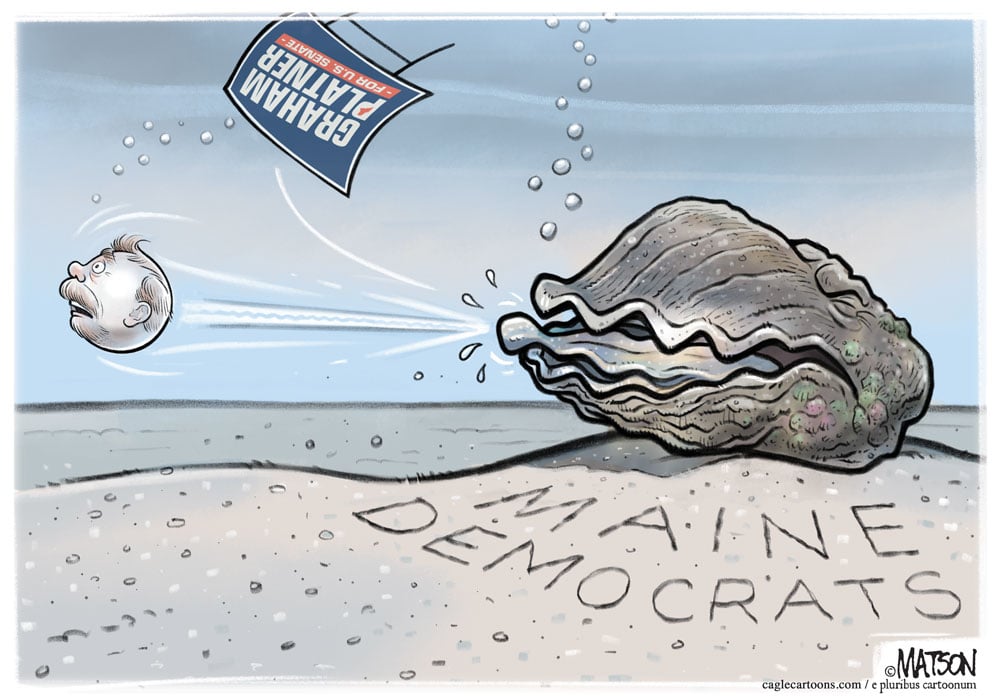
Can’t believe an almost negative democratic cartoon Took them a long time to do the right thing. Guy was a real sleaze ball
FlaglerLive says
Yeah. Imagine how long it’s taking for the pussy-grabbing rapist in the White House who was just ordered to fork over $5 million to one of his victims. Yeah, the one you voted for Bob and whose ass is your double-sighted faith’s gourmet to this day.
Sherry says
Right On Flaglerlive and Pierre for these two comments!
It’s beyond belief that even the Maga brainwashed are so delusional and hypocritical that they condemn an “Accused” Sexual Assaulter/Rapist. . . but, voted for trump, who is a “GUILTY Sexual Assaulter/Rapist”. . . who owes his victim over FIVE MILLION DOLLARS! SMH.
Shairy says says
Only the lowest of the low spits in the eyes of its guest.
Sherry says
Everybody Now. . . To the Tune of Rawhide. . . sing out. . . “Trollin’ Trollin’ Trollin”. . . “Keep Maga Lies a Rollin'” LOL! LOL! LOL! Getting to ya, huh jake! LOL! LOL! LOL!
Laurel says
Childish comment.
Bob says
What a sick response. Sounds like your the real man the dems are looking for
Laurel says
Okay, first I post my response and I get the notification that I cannot post a duplicate comment and it disappears. No notice of moderation. So I rewrite the entire comment, posted it, and now I have two comments.
Anyway, the second comment is more accurate.