



To include your event in the Briefing and Live Calendar, please fill out this form.
Weather: Areas of fog in the morning. Mostly sunny. Highs in the upper 70s. Light and variable winds, becoming northeast around 5 mph in the afternoon. Sunday Night: Mostly clear in the evening, then becoming partly cloudy. Patchy fog after midnight. Lows in the mid 50s.
- Daily weather briefing from the National Weather Service in Jacksonville here.
- Drought conditions here. (What is the Keetch-Byram drought index?).
- Check today’s tides in Daytona Beach (a few minutes off from Flagler Beach) here.
- Tropical cyclone activity here, and even more details here.
Today at a Glance:



Palm Coast Farmers’ Market at European Village: The city’s only farmers’ market is open every Sunday from noon to 4 p.m. at European Village, 101 Palm Harbor Pkwy, Palm Coast. With fruit, veggies, other goodies and live music. For Vendor Information email [email protected]
Rotary’s Fantasy Lights Festival in Palm Coast’s Town Center: Nightly from 6 to 9 p.m. at Palm Coast’s Central Park, with 57 lighted displays you can enjoy with a leisurely stroll around the pond in the park. Admission to Fantasy Lights is free, but donations to support Rotary’s service work are gladly accepted. Holiday music will pipe through the speaker system throughout the park, Santa’s Village, which has several elf houses for the kids to explore, will be open, with Santa’s Merry Train Ride nightly (weather permitting), and Santa will be there every Sunday night until Christmas, plus snow on weekends! On certain nights, live musical performances will be held on the stage.
Grace Community Food Pantry, 245 Education Way, Bunnell, drive-thru open today from noon to 3 p.m. The food pantry is organized by Pastor Charles Silano and Grace Community Food Pantry, a Disaster Relief Agency in Flagler County. Feeding Northeast Florida helps local children and families, seniors and active and retired military members who struggle to put food on the table. Working with local grocery stores, manufacturers, and farms we rescue high-quality food that would normally be wasted and transform it into meals for those in need. The Flagler County School District provides space for much of the food pantry storage and operations. Call 386-586-2653 to help, volunteer or donate.
Notably: Whether he’s writing about John Dewey, Camille Paglia, The New Yorker, Kazuro Ishiguro, the state of the American university, New York intellectuals, the nazified Paul de Man, the semi-fascist Charles Murray, Thomas Pynchon, Henry James or porn (not in the same context, unfortunately for James), you can be sure that Louis Menand will always be interesting in a calm, non0ideological, non-abrasive, very New Yorkerish way. He can be too calm, too austere making him at times implicitly sententious the way more overt polemicists are more honestly sententious. But Menand prefers to use politeness as a balcony, setting himself above the fray. He writes frequently for The New Yorker, which mirrors his aesthetics. He has an unsurprisingly interesting piece in the current issue, “Is the Dictionary Done For?” The opening: “Once, every middle-class home had a piano and a dictionary. The purpose of the piano was to be able to listen to music before phonographs were available and affordable. Later on, it was to torture young persons by insisting that they learn to do something few people do well. The purpose of the dictionary was to settle intra-family disputes over the spelling of words like “camaraderie” and “sesquipedalian,” or over the correct pronunciation of “puttee.” (Dad wasn’t always right!) Also, it was sometimes useful for doing homework or playing Scrabble.” He goes on to describe the diminishing stature of the physical dictionary now that online services are everywhere. Who needs to get up from the chair to check on a word? (Which reminds me of an unexpected line in a 1960 letter by Joh Updike: “… I have never had much ability at looking things up in dictionaries.”) But these are the lines that arrested me: “Britannica has been losing market share since 1993, when Microsoft released its digital encyclopedia, Encarta. Fatsis quotes a Britannica editor comparing Wikipedia, disparagingly, to a public rest room—a comparison that’s not entirely wrong. It’s not the most elegant website, but everyone uses it. Britannica stopped printing its physical volumes in 2012.” A comparison that’s not entirely wrong? Only a New Yorker writer too comfortable in his digs would say something like that, even though it’s qualified with the following sentence. I happen to fin the following sentence factually wrong, though elegance is not a matter of fact. The paragraph is also incomplete: Britannica did not just go out of business. Wikipedia drove it out of business because it was more accurate, and more useful, and more accessible, and free. This is not conjecture. I am relying on a 20-year-old article in the journal Nature, when Nature itself investigated the accuracy of Britannica against Wikipedia. That was 20 years ago, mind you, when Wikipedia was just 4 years old, and when it had just under 4 million entries (the English version alone now has 7.1 million, all its versions have a combined 66 million articles The 2010 Britannica’s 32 volumes had 100,000 entries.) The Nature investigation found that inaccuracies were more frequent in Wikipedia still, but barely: “Nature’s investigation suggests that Britannica’s advantage may not be great, at least when it comes to science entries. In the study, entries were chosen from the websites of Wikipedia and Encyclopaedia Britannica on a broad range of scientific disciplines and sent to a relevant expert for peer review. Each reviewer examined the entry on a single subject from the two encyclopaedias; they were not told which article came from which encyclopaedia. A total of 42 usable reviews were returned out of 50 sent out, and were then examined by Nature’s news team. Only eight serious errors, such as misinterpretations of important concepts, were detected in the pairs of articles reviewed, four from each encyclopaedia. But reviewers also found many factual errors, omissions or misleading statements: 162 and 123 in Wikipedia and Britannica, respectively.” Michael Twidale, an information scientist at the University of Illinois, said this: “People will find it shocking to see how many errors there are in Britannica. Print encyclopaedias are often set up as the gold standards of information quality against which the failings of faster or cheaper resources can be compared. These findings remind us that we have an 18-carat standard, not a 24-carat one.” That was 20 years ago. I am not mourning Britannica. I happily contribute monthly to Wikipedia. It’s the least I can do for one of the resources I tap more often than Louis XV tapped his Parc-aux-Cerfs.

The Live Calendar is a compendium of local and regional political, civic and cultural events. You can input your own calendar events directly onto the site as you wish them to appear (pending approval of course). To include your event in the Live Calendar, please fill out this form.
January 2026
Flagler Beach Farmers Market

Coffee With Flagler Beach Commission Chair Scott Spradley

Grace Community Food Pantry on Education Way

Gamble Jam at Gamble Rogers Memorial State Recreation Area

Stetson University Concert Choir in Concert with Orlando Philharmonic
ESL Bible Studies for Intermediate and Advanced Students
Grace Community Food Pantry on Education Way

Palm Coast Farmers’ Market at European Village
Stetson University Concert Choir in Concert with Orlando Philharmonic

Al-Anon Family Groups

Temple Beth Shalom Blessing of the Pets

Nar-Anon Family Group
Palm Coast Charter Review Committee Meeting
Bunnell City Commission Meeting
For the full calendar, go here.


I am Philip Roth. I had reason recently to read for the first time the Wikipedia entry discussing my novel “The Human Stain.” The entry contains a serious misstatement that I would like to ask to have removed. This item entered Wikipedia not from the world of truthfulness but from the babble of literary gossip—there is no truth in it at all. […] My novel “The Human Stain” was described in the entry as “allegedly inspired by the life of the writer Anatole Broyard.” (The precise language has since been altered by Wikipedia’s collaborative editing, but this falsity still stands.) This alleged allegation is in no way substantiated by fact. “The Human Stain” was inspired, rather, by an unhappy event in the life of my late friend Melvin Tumin, professor of sociology at Princeton for some thirty years. […] As with the distinguished academic career of the main character of “The Human Stain,” Mel’s career, having extended for over forty years as a scholar and a teacher, was besmirched overnight because of his having purportedly debased two black students he’d never laid eyes on by calling them “spooks.” To the best of my knowledge, no event even remotely like this one blighted Broyard’s long, successful career at the highest reaches of the world of literary journalism.
–From an Open Letter to Wikipedia by Philip Roth, The New York Times, Sept. 7, 2012.




















Bo Peep says
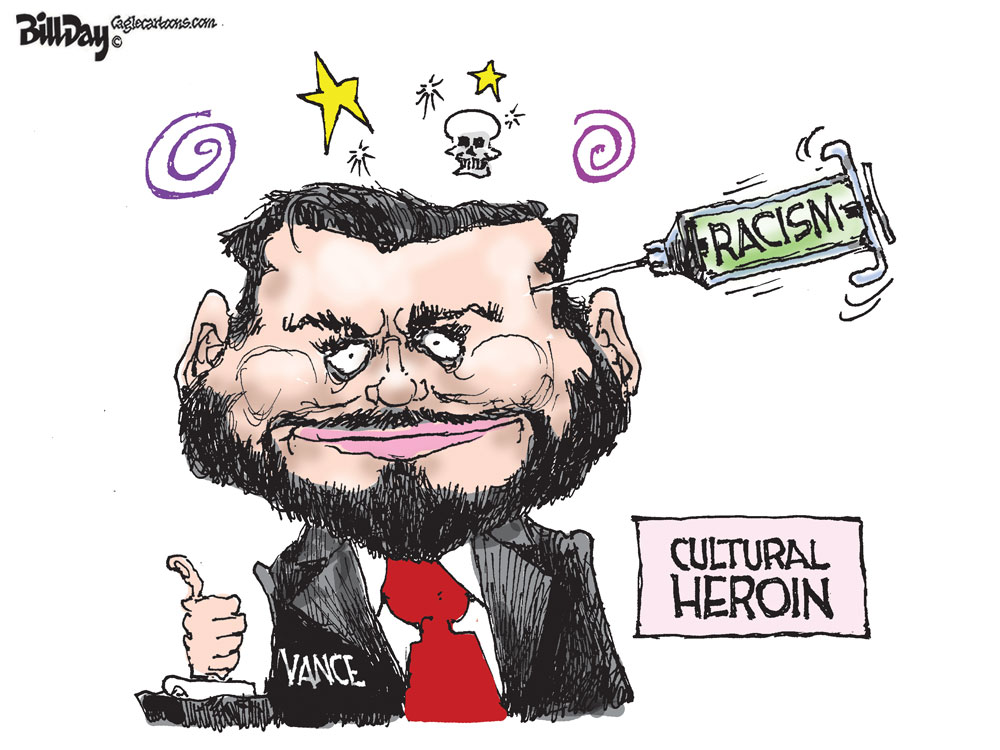
WRT today’s cartoon. Silly liberals often confuse bigotry with racism. Muslims are not a race.
Skibum says
Hmmm, so let’s see if we can clarify your subtle message, shall we? Did you mean Trump, Vance and his maga sycophants are not racists, they’re just bigots? Or, not bigots, they’re just racist?
Curious observers would like to know how you define their behavior.
Pogo says
@P.T.
Checks out; and passes a smell test too. Well said and well done.
Dennis C Rathsam says
Not nice to pick on the the next President, Dem,s sing that same ole song…. How bout your 401 K?
Laurel says
The cartoon should show the arm of the Heritage Foundation giving Vance the brain inoculation. Indoctrination Inoculation.