


By Gregory P. Magarian
The president announces an aggressive, controversial policy. Large groups of protesters take to the streets. Government agents open fire and kill protesters.
All of these events, familiar from Minneapolis in 2026, also played out at Ohio’s Kent State University in 1970. In my academic writing about the First Amendment, I have described Kent State as a key moment when the government silenced free speech.
In Minneapolis, free speech has weathered the crisis better, as seen in the protests themselves, the public’s responses – and even the protest songs the two events inspired.
Protests and shootings, then and now
In 1970, President Richard Nixon announced he had expanded the Vietnam War by bombing Cambodia. Student anti-war protests, already fervent, intensified.
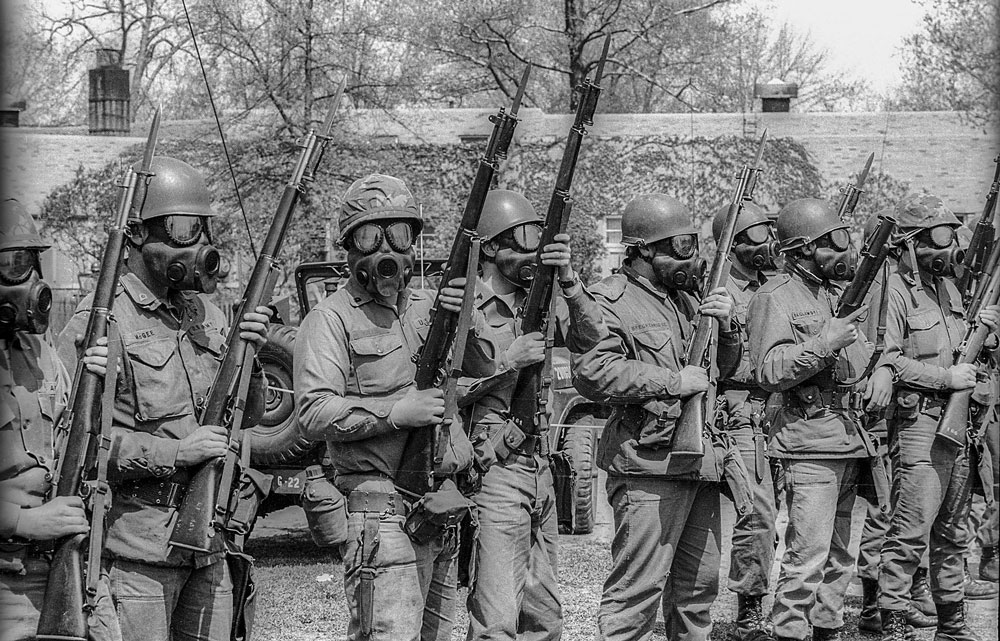
In Ohio, Gov. James Rhodes deployed the National Guard to quell protests at Kent State University. Monday, May 4, saw a large midday protest on the main campus commons. Students exercised their First Amendment rights by chanting and shouting at the Guard troops, who dispersed protesters with tear gas before regrouping on a nearby hill.
With the nearest remaining protesters 20 yards from the Guard troops and most more than 60 yards away, 28 guardsmen inexplicably fired on students, killing four students and wounding nine others.
After the killings, the government sought to shift blame to the slain students. Nixon stated: “When dissent turns to violence, it invites tragedy.”
Minneapolis in 2026 presents vivid parallels.
As part of a sweeping campaign to deport undocumented immigrants, President Donald Trump in early January 2026 deployed armed U.S. Immigration and Customs Enforcement and Customs and Border Protection agents to Minneapolis.
Many residents protested, exercising their First Amendment rights by using smartphones and whistles to record and call out what they saw as ICE and CBP abuses. On Jan. 7, 2026, an ICE agent shot and killed activist Renee Good in her car. On Jan. 24, two CBP agents shot and killed protester Alex Pretti on the street.
The government sought to blame Good and Pretti for their own killings.
Different public reactions
After Kent State, amid bitter conservative opposition to student protesters, most Americans blamed the fallen students for their deaths. When students in New York City protested the Kent State shootings, construction workers attacked and beat the students in what became known as the “hard hat riot.” Afterward, Nixon hosted construction union leaders at the White House, where they gave him an honorary hard hat.

Roberto Schmidt/AFP via Getty Images
In contrast, most Americans believe the Trump administration has used excessive force in Minneapolis. Majorities both oppose the federal agents’ actions against protesters and approve of protesting and recording the agents.
The public response to Minneapolis has made a difference. The Trump administration has announced an end to its immigration crackdown in the Twin Cities. Trump has backed off attacks on Good and Pretti. Congressional opposition to ICE funding has grown. Overall public support for Trump and his policies has fallen.
Free speech in protests, recordings and songs
What has caused people to view the killings in Minneapolis so differently from Kent State? One big factor, I believe, is how free speech has shaped the public response.
The Minneapolis protests themselves have sent the public a more focused message than what emerged from the student protests against the Vietnam War.
Anti-war protests in 1970 targeted military action on the other side of the world. Organizers had to plan and coordinate through in-person meetings and word of mouth. Student protesters needed the institutional news media to convey their views to the public.
In contrast, the anti-ICE protests in Minneapolis target government action at the protesters’ doorsteps. Organizers can use local networks and social media to plan, coordinate and communicate directly with the public. The protests have succeeded in deepening public opposition to ICE.
In addition, the American people have witnessed the Minneapolis shootings.
Kent State produced a famous photograph of a surviving student’s anguish but only hazy, chaotic video of the shootings.
In contrast, widely circulated video evidence showed the Minneapolis killings in horrifying detail. Within days of each shooting, news organizations had compiled detailed visual timelines, often based on recordings by protesters and observers, that sharply contradicted government accounts of what happened to Good and Pretti.
Finally, consider two popular protest songs that emerged from Kent State and Minneapolis: Crosby, Stills, Nash & Young’s “Ohio” and Bruce Springsteen’s “Streets of Minneapolis.”
Crosby, Stills, Nash & Young recorded, pressed and released “Ohio” with remarkable speed for 1970. The vinyl single reached record stores and radio stations on June 4, a month after the Kent State shootings. The song peaked at No. 14 on the Billboard chart two months later.
Neil Young’s lyrics described the Kent State events in mythic terms, warning of “tin soldiers” and telling young Americans: “We’re finally on our own.” Young did not describe the shootings in detail. The song does not name Kent State, the National Guard or the fallen students. Instead, it presents the events as symbolic of a broader generational conflict over the Vietnam War.
Springsteen released “Streets of Minneapolis” on Jan. 28, 2026 – just four days after CBP agents killed Pretti. Two days later, the song topped streaming charts worldwide.
The internet and social media let Springsteen document Minneapolis, almost in real time, for a mass audience. Springsteen’s lyrics balance symbolism with specificity, naming not just “King Trump” but also victims Pretti and Good, key Trump officials Stephen Miller and Kristi Noem, main Minneapolis artery Nicollet Avenue, and the protesters’ “whistles and phones,” before fading on a chant of “ICE out!”
Critics offer compelling arguments that 21st-century mass communication degrades social relationships, elections and culture. In Minneapolis, disinformation has muddied crucial facts about the protests and killings.
At the same time, Minneapolis has shown how networked communication can promote free speech. Through focused protests, recordings of government action, and viral popular culture, today’s public can get fuller, clearer information to help critically assess government actions.

Gregory P. Magarian is Thomas and Karole Green Professor of Law at Washington University in St. Louis.























Ed P says
Having grown up in Cleveland/Parma Ohio ( 35 miles from campus) in the 50s and 60s, being politically unaware, my perception of the Kent State shootings was a tad different.
First, over 15 million American men received 2S college, 1Y or 4F draft deferments. Some even fled to Canada. 24 million men were eligible for the draft between 1964 and 1973, but only 2.2 million were drafted. Some actually enlisted. Imagine that.
During that same period, joining the national guard effectively made you exempt from being drafted into active duty, referred to as a safe haven.
The point is, I believe nobody on campus was supportive of the Vietnam conflict.
I can’t remember what I felt when I learned of the event. No sorrow, no sympathy.
You can close your eyes to prevent seeing the reality of war. Sooner or later you have to sleep. You can plug your ears to stop the sounds. But you can’t stop breathing. The smells imprinted on one’s brain are for ever. The smells.
58,281 KIA 153,372 WIA. 150.332 more not requiring hospitalization. 2.7 million deployed – 1-1.6 million fought in combat.
Most were loathed by my generation when returning home.
Still rings hollow to me today.
Not sorry.
PaulT says
Draft deferments weren’t limited to ‘anti-war draft dodging students’.
Donald Trump aka President bone spurs also avoided the draft and had very little respect for those who were drafted suggesting ‘they.weren’t smart enough to avoid the draft’. Later he told Howard Stern that avoiding STD’s from his many girlfriends was his personal Vietnam.
That’s not innuendo by the way though I’m loath to provide a link to the video of Trump’s admission because it’s kind of raunchy!
DaleL says
Mr. Trump wasn’t the only recent president to avoid Vietnam for “health” reasons. Mr. Biden was a high school football player and a teenage lifeguard. He received four student deferments. Following an April 1968 physical exam, he was deferred because of his asthma as a teenager. Mr. Clinton avoided Vietnam with student deferments. Draft deferments were common among the children of wealthy (Caucasian) families.
I avoided Vietnam first by student deferment. I lost that when I missed one quarter of college while transferring from Michigan State to Iowa State at the end of 1969. After a physical, I was reclassified 1-A, “prime meat”. However, on December 1, 1969, just after my physical and before I filed my planned appeal to my reclassification, Nixon’s second draft lottery was held. I WON with a number of 273.
It was crazy times back then. I remember in my dorm at Michigan State some of my male classmates sweating out grades for fear of losing their draft deferment. In December 1969, some draftees were going to the Marines. Men were volunteering for the Air Force and Navy to avoid being put into the Army or Marines.
Samuel L. Bronkowitz says
https://en.wikipedia.org/wiki/Myth_of_the_spat-on_Vietnam_veteran
Ed P says
I agree with you that the spitting on returning vets was very limited and more of a an urban legend than truth. Know why?
Because the spitters would have received beatings of their lives, …it was a much different time.
Al says
The statement of go figure about enlisting shows all I need to know about the commentor. Those of us that showed up for our country really appreciated the way the Nam vets were respected. That was the beginning of the political divide. Us who served and those that ran from service. When I meet people who criticize the military I not only befriend them I completely write them out of my life regardless of how long I’ve known them. May the liberals rot in hell where they belong. When you go please take the illegals with you.
DaleL says
Mr. Trump is definitely not a Liberal. John Kerry is a Liberal. Mr. Kerry won a Silver Star, a Bronze Star, and three Purple Hearts in Vietnam. Mr. Trump had “bone spurs”. Do you think Mr. Kerry should “rot in hell” or Mr. Trump?
Laurel says
Al: Your life must be simple, black and white with no in between.
The Vietnam War was not that simple, and the divisiveness was not as you have described. We did not believe in the war, and many young men went begrudgingly. The protesters were not about hate, they were about it being unnecessarily put upon our youth, for reasons not clear, or believable, to us.
Many, not all, but many missed the war by lottery. The best man at our wedding, and my husband’s best friend, went. He was the recipient of two Purple Hearts and a Silver Star. He received the Silver Star 30 years later as the Vietnam War was not considered a war, but a “police action.” He was also a Fire Fighter. He died in 2008 from acute leukemia, the cause was believed to be Agent Orange. Between the Vietnam Vets, on motorcycles, closing the roads ahead of the funeral procession, and the fire trucks that followed, it was the most amazing funeral procession I have seen in my life. We miss him terribly!
Be careful of whom you wish to rot in hell, or be removed.
Pogo says
As stated
https://www.google.com/search?q=vietnam+veterans+day
Those who cannot remember the past are condemned to repeat it; only the dead have seen the end of war.
https://www.google.com/search?q=George+Santayana