



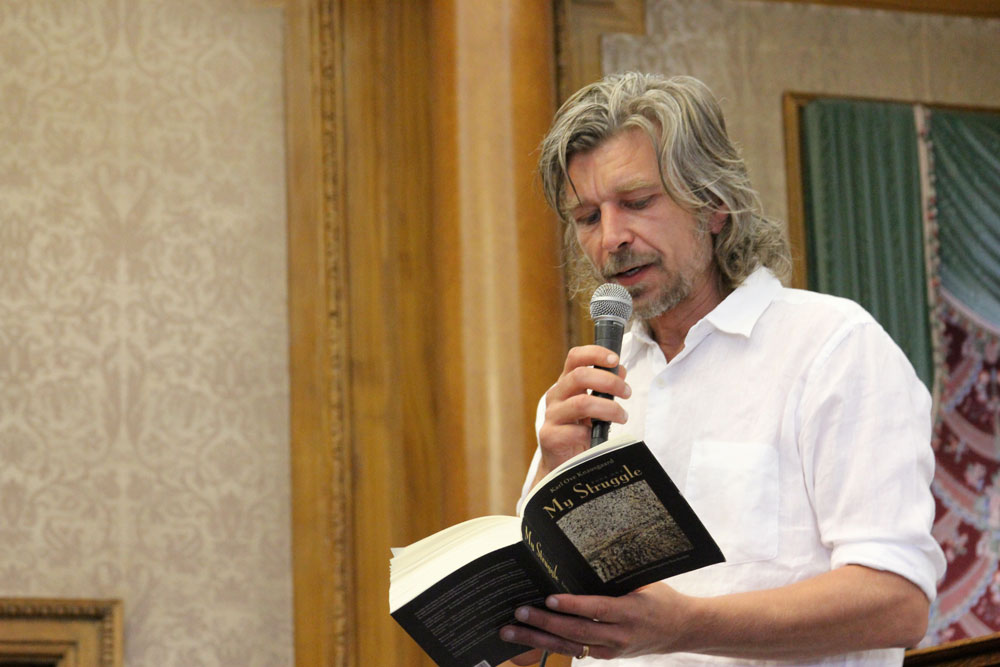
Karl Ove Knausgaard is the Norwegian writer who between 2009 and 2011 published the six volumes of My Struggle, the autofiction that seemed to be 99 percent auto and 1 percent fiction, and that in Norway was titled Min Kamp, an intentional echo of Hitler’s Mein Kampf, German for “my struggle” and universal for abominable.
 Knausgaard’s Struggle has its abominable moments, but in a more aesthetic sense. He can be painfully boring, with run-on ideas that go nowhere, like the 400-page incoherence on Hitler he inserted in the middle of Book Six as an apologia for the title, or his mini-essays on philosophy, literature, art, and least convincingly, religion, all shoved in his fictional Struggle by this “king of approximation,” as he calls himself with dead-eyed accuracy in Book One.
His style is flat, remarkably humorless most of the time, his insights or observations so simplistic as to make you wonder whether anyone edited the books: “Freedom is destruction plus movement,” we read in Book One. “What would it have been like to live in a world where everything was made from the power of your hands, the wind, or the water?” he asks in Book Two. “What would it have been like to live in a world where the American Indians still lived their lives in peace? Where that life was an actual possibility? Where Africa was unconquered? Where darkness came with the sunset and light with the sunrise?” What would it have been like had My Struggle not been written?
I’m glad we’re denied that knowledge, because for all his books’ flaws, Knausgaard is mostly bewitching. Page-turner is not a cliché with him. I remember the exhilaration of Book One, largely about “the sons leaving home to bury their father,” a violent, neglectful father who’d abandoned his children for alcoholism. The first 150 pages have the hypnotic momentum of Don DeLillo’s opening pages to Underworld–some of the best pages in American literature–as they chronicle 17-year-old Karl Ove’s minute-by-minute odyssey for beer, hiding beer, hoping to get laid (she brushes him off) and getting to a New Year’s Eve party. His father was a living terror who humiliated him at every turn. It all fuses with the narrative of present-day, adult Karl Ove dealing with his father’s death amid the self-inflicted filth of a drunk. Yet Knausgaard’s art makes this man who “destroyed everything” come alive on the page amid that suicidal filth, and you almost understand when Knausgaard writes at the end: “I had written the book for Dad.”
Knausgaard ennobles the ordinary, an ordinary we all recognize, an ordinary we can’t put our finger on, or wouldn’t want to, for fear of realizing how ordinary it is, how ordinary we are. Balzac famously put the “finger of God” on his characters, a supernatural copout that enabled many a cheap deus ex machina–that device so favored by 19th century novelists to get themselves out of their own plot prisons. Knausgaard puts his finger on us, at times molesting our sensibilities to the point of squirms. He’s more unfiltered than “The Office”’s Michael Scott but unlike Scott, he’s self-aware to the point of parody, making an art of self-loathing:
And it was okay, I had my small pleasures too, it wasn’t that, and I could endure any amount of loneliness and humiliation, I was a bottomless pit, just bring it on, there were days when I could think, I receive, I am a well, I am the well of the failed, the wretched, the pitiful, the pathetic, the embarrassing, the cheerless, and the ignominious. Come on! Piss on me! Shit on me too if you want! I receive! I endure! I am endurance itself! I have never been in any doubt that this is what girls I have tried my luck with have seen in my eyes. Too much desire, too little hope.
Now we know why the original title he wanted for My Struggle was The Dog. We recoil at the shock, we sometimes laugh at the obvious (“A depressed Norwegian,” he told a New York Times photographer when asked what kind of guy he was during a 2015 trip across the country, “nothing to write home about”). But we can’t stop reading because we recognize the familiar and the unsaid, except when he throws phrases at us like “the duality of the nature of otherness.” It is as if Dostoevsky’s Underground Man is our next-door neighbor, chatting with us over the hedge with a beer in one hand and a cigarette in the other. He makes the ordinary beautiful, the existential bearable, the unbearable being the joy of it, if you get to survive it. That’s Knausgaard.
It is impossible to review “My Struggle” as a single work in the traditional sense, and that’s not my intention here. At best I’m trying to give you a general idea about him as he seems headed for a Nobel, assuming his liver and lungs cooperate. He’s still in his prime despite an alarming Charlie Sheen-like capacity for booze and smoke.
Trying Knausgaard suggests commitment, though dipping in and out of My Struggle at random, if you have access to a good online library, is good enough to start, especially as entire sections would have been eliminated had he had his own Max Perkins. But the gems in these 3,691 pages are also copious: “You can spend twenty pages describing a trip to the bathroom and hold your readers spellbound,” a character tells the Knausgaard of Book Two.
I read My Struggle in sequence over two years, but they don’t have to be read that way. Each volume’s subtitle title is a fair guide to what you’re in for: “A Death in the Family” for Book One, “A Man In Love” for Book Two, where he invasively, at times heedlessly deconstructs his marriage to his second wife, her manic depression included. Book Three takes him back to his early childhood and his father’s terrors.
Quality weakens significantly with Book Four. It’s his late adolescence after graduating high school. He gets a teaching stint in one of the remotest and northernmost villages in the world, on Norway’s western shoulder (“I had the feeling I was walking on the edge of the world. That it wasn’t possible to go any farther. One more step and I was gone.”) He hints of an illicit relationship with 13-year-old Andrea, one of his students: “Was I in love with Andrea? Was I in love? No, no, no. But I was drawn to her in my thoughts.” You’re never sure it stopped at thoughts. Knausgaard is lost at the end of the world, and so is the reader. So tedious. As good as Book Three was, I found Book Four a bit of a chore.
The series then becomes self-referential, because Knausgaard was writing it even as the first volumes were being published. So we get one-sided reflections on the fallout of his intrusions on his family’s privacy, his uncle’s and two wives’ especially. The uncle never forgave him for the brutal portrayal of Knausgaard’s father and either threatened or filed suit. Wife Number One found out in My Struggle, which has its commonalities with gossip sheets, that he’d cheated on her with Wife Number Two. We’re made uncomfortable voyeurs to Wife Number Two’s mental health struggles, which make his seem petty, then to her reaction to seeing her struggles turned into a literary forensic exercise for the world to read. He wrote the 550 pages of Book Five, a jumble of confessions about his search for a literary voice, in eight weeks. It shows.
The series sold half a million copies in Norway, a nation of 10 million people, making it by ratio one of the most-read (or at least most bought) books of the young century in Norway. It’s been translated into more than a dozen languages. I was happy to close the sixth volume. By far the longest at 1,156 pages, it was deadened by the unreadable 400 pages on Hitler and an equally interminable analysis of the poet and Holocaust survivor Paul Celan, all this in an alleged book of fiction.
Like Philip Roth in 2012, Knausgaard in 2011 told an interviewer he’d stop writing after My Struggle. Roth stuck to the pledge, a form of suicide. He died in 2018. Knausgaard did not. He wrote a four-volume seasons quartet, a sort of encyclopedia of small things to explain the world to his children. “I’ve wanted to look at everything in the same manner, whether it’s high or low, ugly, bad, good, beautiful,” he told a Paris Review interviewer. “A beer bottle receives the same attention as the concept of love—as much space and as much care. I’m interested in the idea of looking at things without hierarchy, in the world as it is before we start categorizing it.”
In Autumn, he writes a 504-word essay on toilet bowls. You won’t learn anything new: “That it is wide at the top and narrow at the base is because its purpose, first and foremost, is to conduct our waste matter away from the body and out of the house as effectively as possible.” Or: “That it is made of solid porcelain, which is characterized by its smooth and hard surface, and that the interior of this surface is irrigated with water, is so that nothing should stick to it.” I paid $13.99 for that in 2018. But he ends the piece with this: “That is how the toilet bowl functions, this swan of the bath chamber.” That made it worth the price. (The italics are mine. This tribute to toilets is the most poetic you’ll read in an oeuvre overflowing with scatological fixations.)
He wrote a couple of other nonfiction books, then got back to fiction. And how. Between 2020 and 2025, he published six of seven planned novels in the “Morning Star” series, where he creates a dialectic between the mysterious and the rational. Each is a brick of pages. Four have been translated into American. I’ve only read the first. I’ll report on it in two weeks, but haven’t had the courage yet to spring for volume two of this new struggle. Kanausgaard can induce a fear of commitment, however rewarding the jump.

Pierre Tristam is the editor of FlaglerLive. Reach him by email here.



























Leave a Reply