



By Mireille Rebeiz and Josiane Yazbeck
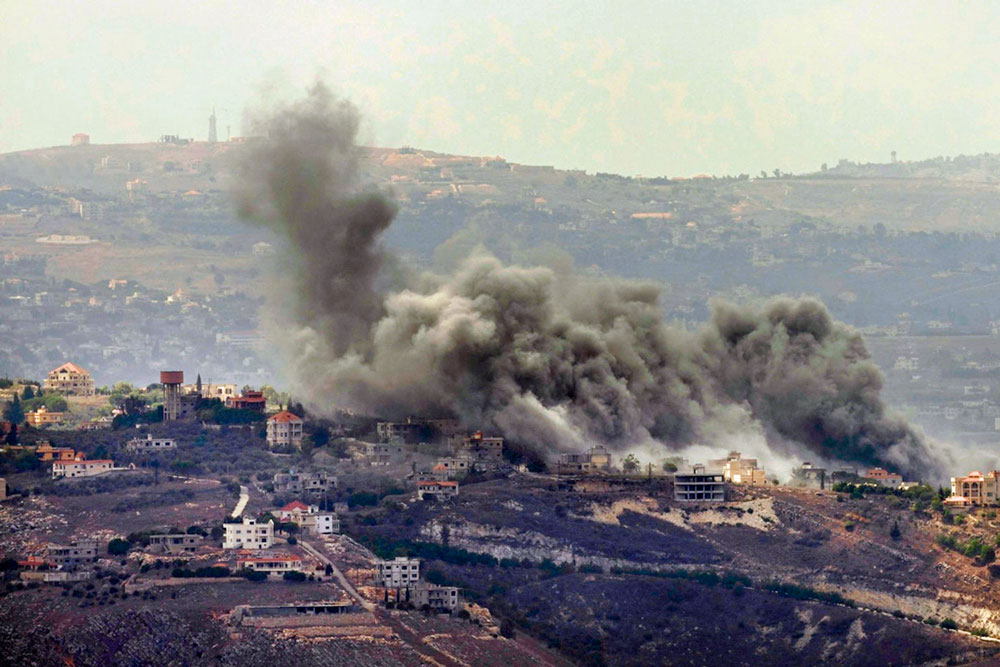
More than a year after a ceasefire nominally ended active fighting, much of southern Lebanon bears the ecological scars of war. Avocado orchards are gone and beehives destroyed. So, too, are the livelihoods they supported. Meanwhile, fields and forests have disappeared under the intense fire caused by white phosphorus shelling. Shrapnel and unexploded bombs, however, remain.
Such grim realities are a window into the massive ecological destruction brought to Lebanon as a result of the 2024 war between Hezbollah and Israel. The number of Israeli airstrikes from October to November of that year ranked among the highest globally in the 21st century.
The conflict proved disastrous for human life, with more than 4,000 people killed, more than 17,000 injured, and 1.2 million civilians displaced internally. But a relatively uncovered aspect of the destruction was the significant effects to the environment.
Farmlands, olive groves, and pine forests were extensively burned by Israel’s airstrikes. Water resources were polluted. Pipelines and waste management were partially or completely destroyed. And the extensive dropping of ordnance and debris left a widespread trail of toxic dust and hazardous chemicals.
The damage to the Lebanon’s environment will have long-term consequences for the country’s agriculture and economy, and on its people’s mobility.
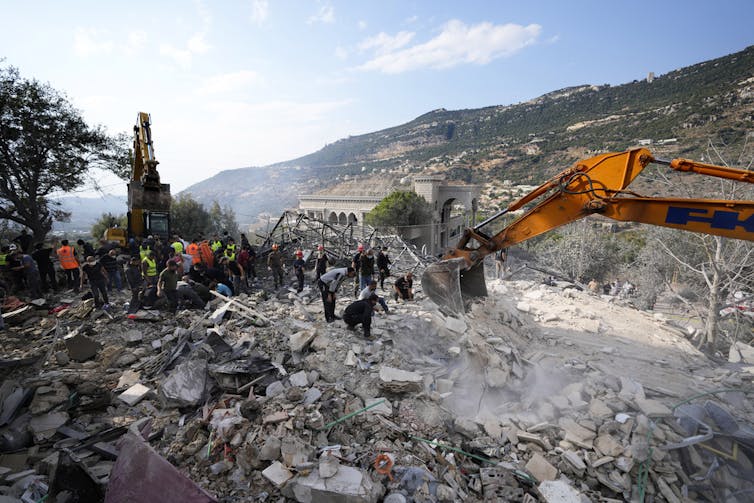
Repairing the damage would involve a multi-year reconstruction project costing an estimated US$11 to $14 billion, according to one World Bank assessment.
As experts in Middle East studies and environmental law, we believe that this destruction also indicates a grave breach of international environmental law and raises the question of whether Israel committed war crimes in Lebanon by deliberately targeting natural resources and engaging in environmental warfare.
Environmental destruction in Lebanon
During the latest war — the sixth such Israeli invasion of Lebanon since 1978 — Lebanon lost around 1,910 hectares of prime farmland, 47,000 olive trees and around 1,200 hectares of oak forests, according to Lebanese state figures.
According to Amnesty International, Israel used white phosphorus, a highly reactive chemical that burns at extremely high temperatures when exposed to air. While international humanitarian law does not necessarily ban its use for military necessity, it clearly dictates that white phosphorus must never be used against civilians.
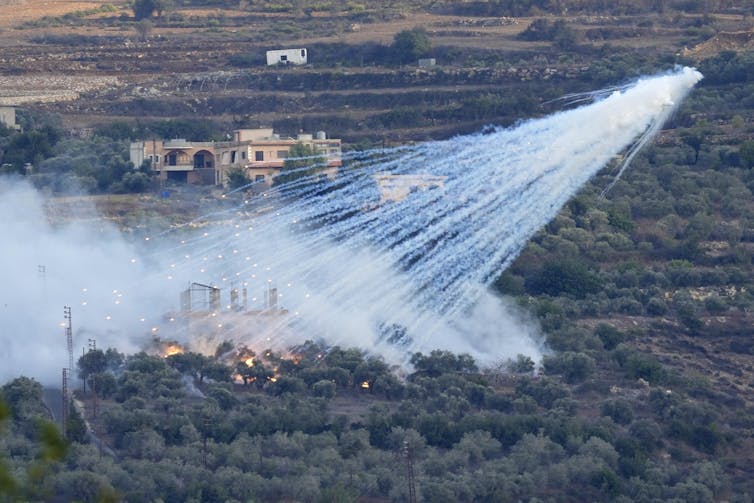
AP Photo / Hussein Malla, File
Data collected by Amnesty International’s Citizen Evidence Lab suggests that Israel deliberately used this incendiary substance in densely populated villages in southern Lebanon to push the civilians out and make their lands unusable. Many civilians were killed, and several had long-term injuries, such as respiratory damages and severe burns.
As to the environment, white phosphorus destroyed fruit, vegetable and olive harvests, burned agricultural lands and left them polluted. White phosphorus also ignited large-scale fires that ravaged oak and pine forests and devastated wildlife. Natural habitats were destroyed, pushing animals whose species are already under stress, such as striped hyenas, golden jackals, and Egyptian mongoose, into residential areas, putting them at risk of being killed.
In the course of the conflict Israel also used cluster munitions, which are widely banned by international law. A cluster bomb consists of several smaller bombs that explode at different times to cover wider areas. But some of these cluster munitions do not explode on impact, thus threatening civilians’ lives and targeting civilians indiscriminately.
Due to these various chemicals and munitions, Lebanon’s soil and water have been contaminated with heavy metals, military scrap, and unexploded bombs.
To be sure, underlying conditions that preceded Israel’s bombing campaign likely worsened the extent of the resulting environmental damage. For example, there are no clear domestic laws in Lebanon banning asbestos, and data indicates the country continued importing the toxic substance well into the early 2000s, well after it had been banned in most other countries.
Several urban and industrial sites were heavily bombed during the 2024 war, especially in south Beirut and Tyre, a major city in southern Lebanon. There is little doubt that the resulting debris contains high levels of asbestos and other toxic substances, which were released with the destruction of buildings, pipelines, paints, roofs, tiles and other old structures.
Environmental protection in armed conflict
Current international humanitarian law provides limited environmental protection during armed conflict. Article 8(2)(b)(iv) of the Rome Statute qualifies a war crime as any attack launched “in the knowledge that such attack will cause widespread, long-term and severe damage to the natural environment which would be clearly excessive in relation to the concrete and direct overall military advantage anticipated.” The cumulative nature of these criteria — being widespread, long term and severe — establishes a high bar for proving a war crime of this nature.
AP Photo / Hassan Ammar
Additional legal frameworks include the 1976 ENMOD Convention prohibiting environmental modification techniques for military purposes and Protocol I to the Geneva Conventions that prohibits methods of warfare intended or expected to cause widespread, long-term and severe environmental damage.
In Feb. 2024, International Criminal Court Prosecutor Karim Khan announced a policy initiative prioritizing environmental crimes within the existing Rome Statute framework.
Further, a growing international movement is pushing to recognize “ecocide,” defined as the mass destruction of ecosystems, as a fifth international crime alongside genocide, crimes against humanity, war crimes, and the crime of aggression. If adopted, this legal framework would significantly lower the threshold for prosecuting environmental destruction during armed conflict.
Even so, the documented environmental impacts in Lebanon already raise substantive questions regarding the application of international humanitarian law and the legal requirement that military commanders weigh anticipated civilian and environmental harm against expected military gains before launching an attack.
The actions of Israel and other countries in recent years, however, have more broadly raised questions over the viability of international law and institutions’ ability to hold those accused to account.
Moving forward
Although Israel and Lebanon agreed to an internationally supervised ceasefire in Nov. 2024, it has largely been a truce in name only, with continued Israeli strikes targeting southern Lebanon and Beirut since then. Meanwhile, though Lebanon remains committed to the terms of the ceasefire, including the disarmament of Hezbollah, the armed Shiite movement has refused to entirely give up its arms.
Under U.S patronage, negotiations between Lebanon and Israel continue today, with discussions of a land border agreement and the return of Lebanese hostages. But, the negotiations so far have stuck largely to political issues with no mention of environmental damages.
In fact, the question of environmental reparations is not without precedent. Since 2006, the United Nations General Assembly has adopted 19 consecutive resolutions on the Jiyeh oil spill, caused by the Israeli bombing of fuel storage tanks during the July 2006 war. The destruction released up to 30,000 tons of oil into the Mediterranean, contaminating 170 kilometers of Lebanese coastline. The U.N. secretary-general assessed damages at US$856.4 million, and the assembly has repeatedly called upon Israel to assume responsibility for prompt and adequate compensation — calls that have gone unanswered for nearly two decades.
For the Lebanese people, particularly those who experienced firsthand environmental destruction, the question of Israel’s alleged environmental crimes is not merely an intellectual exercise. Rather, many environmental groups inside and outside Lebanon argue that addressing such issues is necessary to ensure the promotion of human rights in the region and equitable access to unpolluted farmland, water and forests.

Mireille Rebeiz is Chair of Middle East Studies at Dickinson College. Josiane Yazbeck is a Lecturer at the Université La Sagesse.



























Greg says
Bottom line is, quit tossing bombs into Israel and the issue most likely will go away.
Pogo says
@First world professional students and academic careerists
… making elegant cocktail party small talk.
Speaking of flouting
https://www.google.com/search?q=list+jihadist+patron+country+by+gdp
Where in the world is Bashar al-Assad(?) — what’s that little rascal, and his lovely wife, been up to lately?
What are the names of the assistant managers who keep track of the payroll for Ali Khomeini’s all-you-can-eat blood buffet and Hezbollah tunic and ski mask franchise(s)?
What is the body count from the street cleaners in Iran?
Always,
Curious in Floriduh
EC: File