


By Mireille Rebeiz
A chorus of hawkish Israeli politicians is urging the country’s military to intensify its weekslong ground and air campaign against Hezbollah and pave the way for a more permanent presence in the country’s south.
On April 5, 18 Israeli lawmakers pressed the government of Prime Minister Benjamin Netanyahu to occupy and fully control southern Lebanon up to the Litani River and “evacuate” the Lebanese population there. It followed an earlier call from Israel’s Finance Minister Bezalel Yoel Smotrich, a powerful, extremist voice in the ruling coalition for the outright annexation of southern Lebanon.
Alongside such voices, Israel’s campaign shows no signs of slowing down. That’s despite a two-week ceasefire announced by President Donald Trump on April 7 that paused the U.S. and Israel’s war in Iran and that, according to mediators, was meant to apply to Lebanon as well.
Those calling for a enlarged Israel that includes parts of Lebanon tend to shroud their ideology in religious rhetoric. Yet the view is hardly isolated to the hawkish, religious far-right. It is also nothing new. As a scholar who specializes in Middle East studies, I believe that the policy of occupying and annexing south Lebanon up to the Litani River has long held influence among parts of the Israeli government and dates back to influential Zionist leaders – secular and religious alike – before Israeli independence in 1948.
History suggests were that goal to be pursued in the course of Israel’s military campaign now, however, it would only destabilize Lebanon further, encourage regional turmoil and do little to guarantee Israel’s safety.
Early Zionism and south Lebanon
In 1918, David Ben-Gurion – an early Zionist leader and widely regarded as Israel’s founding father – argued that Israel’s natural borders included parts of modern-day Syria, Egypt, the Arabian Gulf, and should also extend north to the Litani River in southern Lebanon. Lying 20 miles north of Lebanon’s southern border, the river is about 108 miles long and serves as Lebanon’s main source of water.
This position was reaffirmed again in 1919 when a delegation of the Zionist Organization, led by Chaim Weizmann, presented the case of a Jewish homeland in Palestine at the Paris Peace Conference that concluded World War I. The organization argued that such a state should start from the southern city of Saida and include the Litani River.
Instead, Great Britain and France were granted control of administering the formerly Ottoman-ruled land of Greater Syria and Palestine, which were put under an international legal charter called the mandate system.
Lebanon’s current borders date back to Sept. 1, 1920, when the French mandate recognized the nation’s territory stretching south to the cities of Saida and Tyre and below the Litani River to the boundaries of British-administered Mandatory Palestine.
AP Photo/Francois Mori
Land borders dispute since 1948
The creation of the state of Israel in 1948, which led to the mass displacement of over 750,000 Palestinians and a subsequent Arab-Israeli war in 1948, led to a further shifting of borders in the region. In Lebanon, Israel occupied and annexed seven southern villages.
In 1949, under the aegis of the United Nations, Israel and Lebanon agreed to an Armistice Demarcation Line based on the 1923 Palestine-Lebanon boundaries set by the French and British colonial powers.
Though not a mutual agreement on statehood, the armistice was nonetheless a recognition of land borders. While never officially revoked, the armistice was, in practice, superseded by a borders shift during the Six Day War in 1967. That’s when Israel stopped recognizing all armistice agreements it had signed in 1949, including with Lebanon, even though the country wasn’t a party to the 1967 war.
In 1978, following a series of attacks organized by Palestinian fighters from Lebanese soil, Israel invaded Lebanon and occupied its south in what was known as Operation Litani. Israeli troops withdrew more than two decades later on May 25, 2000.
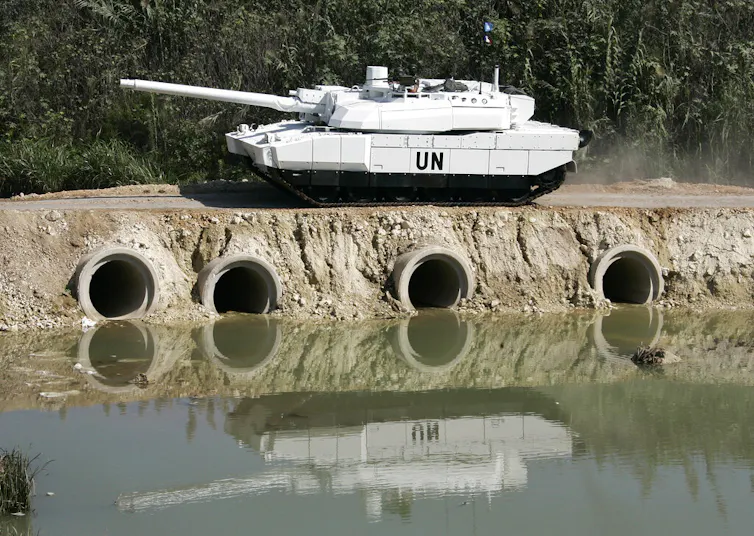
Thereafter, the U.N. established the Blue Line – a so-called withdrawal line to separate the two countries, absent mutually recognized borders – and put in the buffer zone a U.N. peacekeeping mission.
War for natural resources
But the border question was never settled, and the discovery of the Leviathan field in 2010 – the largest natural gas reservoir in the Mediterranean Sea – added a wrinkle in the form of a potential maritime dispute.
In October 2022, Israel and Lebanon signed a U.S.-brokered maritime border agreement, a move some analysts interpreted as the beginning of normalizing relations between the two countries.
However, the long-running land dispute has never been settled.
For the most part, the vocal far-right in Israel calling for expansion of the country’s border to the Litani River dress their claims in religious language – and what it might mean for security for Israel’s northern residents. But extending to the Litani would also provide a potential new source of water for a country with limited natural water sources and growing demand.
Lebanon’s fragile sovereignty
The lack of resolved borders and Israel’s periodic incursions into southern Lebanon have predictably meant that Lebanon has struggled to assert sovereignty over its own territory.
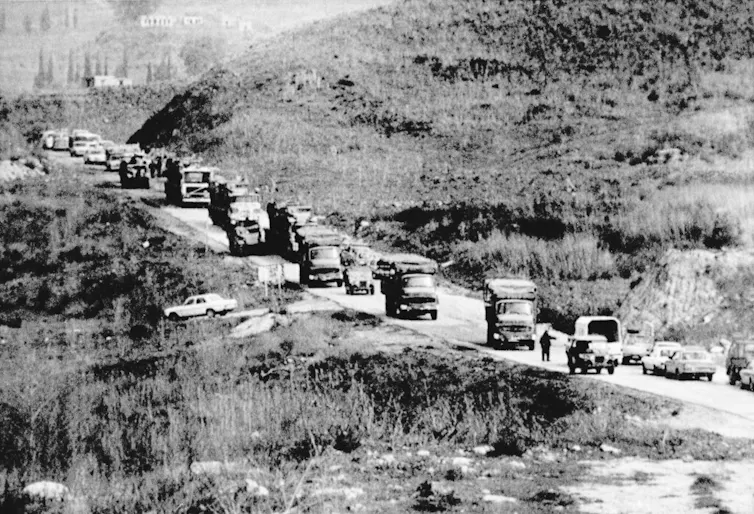
The 1985 birth of Hezbollah, the Iranian-backed Shiite militia, following repeated Israeli invasions and amid the Lebanese civil war, only compounded matters.
AP Photo/Shedid
Since then, Hezbollah has dominated the military scene inside Lebanon and repeatedly battled with Israel.
Tit-for-tat Hezbollah-Israel fighting following the Oct. 7, 2023, attacks escalated into a full-scale war in September 2024 in which over 3,000 Lebanese civilians were killed, 14,000 injured, and more than 1.2 million residents were displaced.
On Nov. 27, 2024, Israel and Hezbollah agreed to a ceasefire. However, this agreement was beset by mutual violations, including hundreds on the Israeli side.
It was finally derailed by the U.S. and Israeli war in Iran, Hezbollah’s subsequent retaliation, and Israel’s invasion.
Facing the magnitude of the war and the real threat of Israeli occupation, Lebanon banned Hezbollah’s military actions on its soil and expelled the Iranian ambassador from its territory.
But those moves have not satisfied those in Israel intent on full occupation of southern Lebanon.
The security risks of new Lebanon occupation
Including the current operation, Israel has invaded Lebanon seven times in the past 50 years.
Any potential plans for another long-term occupation would face many of the same risks as past endeavors – to both Lebanese and Israeli safety.
For one, Israel’s targeting and displacement of the Shiite community in southern Lebanon is likely to create friction among Lebanon’s various religious sects.
It could also degenerate into another wave of violence outside Lebanon. The internal destabilization of Lebanon has rarely been contained within the country, and in the past it has spread to neighboring countries – something that Israel’s northern residents and security officials are all too aware of.
Second, following yearslong conflict in Gaza, operations in Syria and now war with Iran, Israel’s military may be too stretched to achieve full occupation, even if that were the plan. Addressing the Israeli security cabinet, Lt. Gen. Eyal Zamir said the “IDF is on the verge of collapse.”
There is also a sizable Israeli opposition to war in Lebanon and war fatigue within Israeli society.
Neither of those things may be enough to stop a long-term Israeli presence in south Lebanon, but it may help explain the ongoing narrative shifts from Israeli officials that in recent weeks have gone from creating a buffer zone in south Lebanon to full-scale occupation and control up to the Litani River.
There is no doubt that the fate of Hezbollah depends largely on the longer-term settlement of the Iran war and its effect on the associated operation in Lebanon’s south.
But Israel faces headwinds not favorable to full occupation: dwindling international support, internal tensions, entanglements in war across the region and potential violence inside Lebanon. Moreover, history shows that it is a risky endeavor – with high potential to backfire.

Mireille Rebeiz is Chair of Middle East Studies at Dickinson College.




























Sherry says
Anybody Surprised?