


By Stephen Mattingly
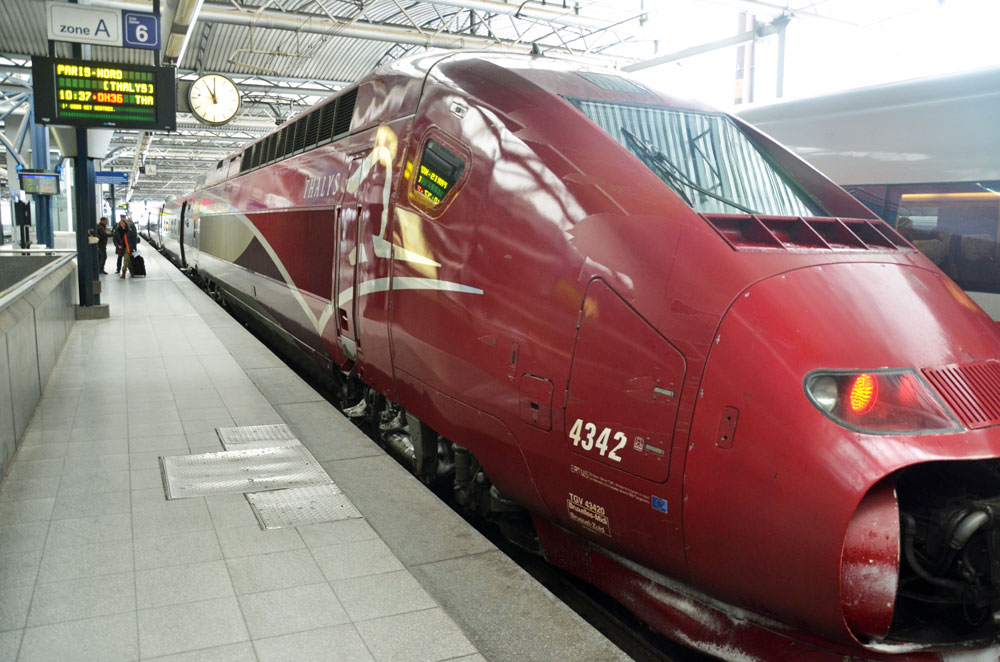
High-speed rail systems are found all over the globe. Japan’s bullet train began operating in 1964. China will have 31,000 miles (50,000 kilometers) of high-speed track by the end of 2025. The fastest train in Europe goes almost 200 mph (320 kph). Yet high-speed rail remains absent from most of the U.S.
Stephen Mattingly, a civil engineering professor at the University of Texas at Arlington, explains why high-speed rail projects in much of the country so often go off track.
The Conversation has collaborated with SciLine to bring you highlights from the discussion, edited for brevity and clarity.
How is high-speed rail different from conventional trains?
Stephen Mattingly: With conventional rail, we’re usually looking at speeds of less than 80 mph (129 kph). Higher-speed rail is somewhere between 90, maybe up to 125 mph (144 to 201 kph). And high-speed rail is 150 mph (241 kph) or faster. There’s also a difference in the infrastructure for these different rail lines.
Is there anything in the U.S. that’s considered high-speed rail?
Mattingly: The Acela train operates in the Northeast Corridor and serves Boston, New York City, Philadelphia, Baltimore and Washington, D.C. In some parts of the corridor, the Acela runs on infrastructure that accommodates the train’s maximum 150 mph (241 kph) speed.
Why has the U.S. been slow to adopt this?
Mattingly: Except for some in the northeastern U.S., not many cities have enough travel between them and are at the correct distance to support an investment in high-speed rail, because it’s not necessarily going to take a huge number of cars off the road. Trains are not a replacement for auto travel; they compete more directly with air.
High-speed rail competes best with air when the trip is between one-and-a-half to three hours. Within that range, a train’s door-to-door travel time is typically faster than air. That’s because of the additional security time required for air travel: sitting around in the airport, the time it takes to load and unload and all of that.
For longer distances – more than three hours – the train’s travel time starts to get noncompetitive with air. That’s because for every three or four hours of high-speed rail travel, air travel only takes one hour.
Go lower than that – a trip of less than an hour-and-a-half – and cars become the more attractive choice.
That said, what are the advantages of high-speed rail?
Mattingly: First, the environmental benefit is an advantage. High-speed rail has lower carbon emissions than air travel, especially on a per passenger basis. You can load more people onto a train than most planes.
Then, of course, its speed makes it a viable way to commute when compared with conventional rail. Our current Amtrak system, outside the Northeast Corridor, is really a leisure travel mode, as opposed to business travel mode.
What large-scale projects are in the works here in the U.S.?
Mattingly: Some higher-speed rail is in Florida, and Brightline, a private train company, is proposing to improve the existing line with more of a high-speed capability. There’s also a proposed line in Texas to run between Dallas and Houston.
The Texas project has a lot of challenges with eminent domain, which is the right of government to take private property for public use after providing compensation. A federal grant to help fund the line was recently terminated, and a strategic partner pulled out of the project. With delays, costs inevitably begin to increase.
California’s high-speed rail project for its Central Valley actually has about 120 miles (193 kilometers) of track laid down. And it’s working on slowly building that out. There are some other proposals in the Pacific Northwest, but those are more ideas than projects at this point.
When these systems are proposed, they’re often positioned as a replacement for auto travel. But I’m incredibly skeptical that auto travel will significantly decrease with a new public transit mode that deposits you within a larger metropolitan destination, which may not even have the public transportation to take you to your final destination.
Regional networks of high-speed rail could connect more exurban or rural areas to hub airports and enhance economic development in these regions. In this case, a public high-speed rail system could receive public money, just like the federal government has done with the interstate highway system and all the other road investments that we’ve made over the past century and longer.
But I’m not sure that high-speed rail will be a solution for congested freeways between cities for any place outside of the Northeast Corridor.
What is your central message about high-speed rail?
Mattingly: I love high-speed rail as a technology. For specific applications, it’s beneficial, especially from an environmental perspective. But the country has to be very careful in its choices on where those public investments in high-speed rail would actually make sense and be worthwhile investments. So I’m hesitant to make large investments without really understanding what the outcomes are.

Stephen Mattingly is Professor of Civil Engineering at the University of Texas at Arlington. SciLine is a free service based at the American Association for the Advancement of Science, a nonprofit that helps journalists include scientific evidence and experts in their news stories.

























MITCH says
Look at the High-Speed Rail in California – They cannot be built without fleecing the American TAXPAYER.
Bo Peep says
Yeah California’s high speed rail was approved in 2008 with a proposed cost of 33 Billion and a completion date of 2020. The cost has risen to 128 Billion and they haven’t put down any track yet. Yet you think fiscal conservatives are one of if not the nation’s biggest problem because they are not socialists.
Nephew of Uncle Sam says
“California’s high-speed rail project for its Central Valley actually has about 120 miles (193 kilometers) of track laid down. And it’s working on slowly building that out.”
Guess Bo Peep couldn’t put the orange Kool-Aid down to read the story.
Damien says
Where is the train? Zero locomotives? and how useless is the little bit of track without it? Total Boondoggle made Gavin rich. This shit show more than anything else makes California democrats look like what they really are, in it for themselves.
Mark says
Here’s an idea. Update and invest in local municipal airports and provide services that enhance the travel experience. Should we as a country see that one billion dollars per mile will cost California over a half of a trillion dollars . For what ? So we can have trains to nowhere with troubles of their own created by tracks themselves. Shorten the process to fly smaller planes in local markets to feed the large airports. That is woth investments.
Ray W. says
Hello Mark. Thank you.
This is the point posed by Aura Aero, the fledging French commuter aircraft manufacturer that chose Daytona’s airport grounds over Flagler’s airport grounds to construct a factory to build 19-passenger electric short-range (900 mile) commuter aircraft for the North American market.
The factory is now open; it is assembling electric two-seat acrobatic aircraft, with the commuter plane continuing under development. It’s release date remains on-track for 2030.
The idea is that comparatively inexpensive short-range electric aircraft will disrupt the giant airport hubs of today. Will it work? I don’t know, but changes are coming.
Inexpensive commuter planes with low operating costs might persuade an enterprising young entrepreneur to open a regional airline at Flagler’s airport to fly twice weekly to Mobile without going through Atlanta. To Charleston twice a week without going through Atlanta. Gambling junkets to the Bahamas or South Florida every day. Return the next day. To (insert small city within 600 air miles here) … and on and on.
Innovation! Ingenuity! American research needs to be fostered. A French company is doing here what American companies could be doing here. Not one more wasted penny of taxpayer funds for dying fossil fuel industries. Look forward, not backwards.
Pogo says
Automaker
… a self-manufacturing loan shark.
R.S. says
It’s a problem inherent in capitalism and private enterprise. The superrich could build such public transport but don’t give a darned about the little people, who–to the rich–are expendable as victims of private-enterprise healthcare. And having been leeched by the superrich, the public worries about each dime it loses to programs that would indeed benefit them. What a land of the blind leading the blinded!
Sherry says
“Public Transportation” should be thought of like national highways, water and electricity. . . it’s a necessity, not a capitalists wet dream. If the oligarchs owned high speed rail systems and “LOBBIED” (bribed) Congress like the oil barons and auto manufacturers do, every part of our country would be linked by modern high speed rail.
We could live in the countryside and commute easily to city centers. But “NO”. . . we now live in a corrupt society who is experiencing the greed of the downside of capitalism. To Hell with the working people!
BTW. . . Unlike the BS spouted by Fox. . . There are wonderful high speed rail systems that are a boon to communitors in California. I actually live here and use them all the time:
BART officials said Tuesday that based on data from their January 2026 Monthly Ridership Snapshot, there were nearly 4.6 million paid exits, which is a 10.7% increase compared with January 2025. Average weekday ridership reached 182,487 trips, and several weekdays topped 200,000 trips. The busiest day was Jan. 28, with 207,343 trips, according to the transit agency.
Ridership also spiked during major events. On Jan. 17, large crowds used BART to attend the Bob Weir public memorial in San Francisco’s Civic Center and a TWICE K-pop concert at the Oakland Arena. BART ran longer trains to handle the demand, agency officials said.
BART’s report also noted changes in how people are paying. Use of Tap and Ride — which allows riders to pay with contactless bank cards or mobile wallets — rose 15.5% in January compared with December. About 14% of all trips were taken using Tap and Ride. Clipper START, which offers a 50% discount for low-income riders, increased 32.6% year over year, transit officials said.
Ed P says
Sherry,
There are currently no high speed rail systems operating in California.
High speed rail requires 125-150 mph.
BART is a heavy rail rapid transit system operating at a max speed of 70-80 mph but averages 35 mph. Hardly high speed.
Sausalito doesn’t have its own train station or any direct passenger rail service.
Amtrak Acela is the only limited high speed rail in USA. Runs northeast corridor between Boston and DC.
Shark says
They cant get up enough speed with trumps clean coal !!!
Mothersworry says
There is no profitable passenger service anywhere. It is all subsidized by tax’s that we the taxpayer will be hit with.
Nephew of Uncle Sam says
Just like your interstates, intrastates, intracoastals, freeways, expressways, routes, streets, lanes, avenues……
Mothersworry says
Actually a road tax, fuel tax are paid by trucking companies to help the feds take care of the highways. The railroads pay no tax.
RobdaSlob says
It was during Carter’s administration that the airlines were deregulated. Which is very ironic because Carter presented himself as a strong environmentalist and for the working man. And the reality is it is cheaper and more environmentally friendly to move the masses by train. This bothered many in DOT who understood that nuance.
Deregulation of aviation opened up flying to the masses, but in order to support it, it drove DOT funding to build up airports and and by default away from other infrastructure projects.
Now US societal norms are to fly. And not just fly but an expectation of first class and a desire to be in a private jet. Even in this opinion piece the author makes a case for longer distance being better on an airplane. However, for the last 20 years I have travelled to Europe 2-3 times a year. I never rent a car and once in Europe I move by train. I will say their system is not what it was 20 years ago (I used to set my watch by the German train system but not so much anymore). But it does work. And this from a guy with 38 years in aerospace. However, I fear the journey to get the US there will certainly not occur in my lifetime.
Sherry says
OMG! I stand corrected. . . Maga says my comment regarding the reliable, FAST, public transportation system here in CA that is invaluable in helping thousand get to work every day and seniors who no longer drive should be completely disregarded. . . because those systems technically are not “high speed”!
My fu@#$%^ point exactly. . . Public transportation should be available, convenient, much better for the environment ,cheap and “high speed” where reasonable! The US should come into the 21 century. . . trump’s coal craziness should help with that!
Florida, with their massive “retired” population. . . many who still drive when should not be. . . should be a leader in “public transportation”. Too bad almost all decisions are n based on the “profit motive” instead of the “people/planet motive”!
Ed P says
Sherry,
Just for the sake of clarification.
High speed rail is supposed to be for Speed and Convenience. Offering rapid inter -city travel designed to replace or compete with air travel for medium distance journeys.
It is not a commuter rail used to get to work or the super market.
Due to the cost of construction it will always be a super premium priced service in the United States compared to what you describe to be a public passenger train for commuters.
In fact, a high speed rail ticket is more than discount air fare and rarely faster.
Do we need it? Amtracks Acela carries 8-9,000 passengers daily.
Really. Over 50 million people live along their corridor.
Even low budget, poorly consumer rated, Spirit airlines, flys to 700 markets and moves 10 times as many people annually for less. And it doesn’t cost taxpayers a dime.
Hence high speed rail could be viewed a boondoggle in the US.
FYI