


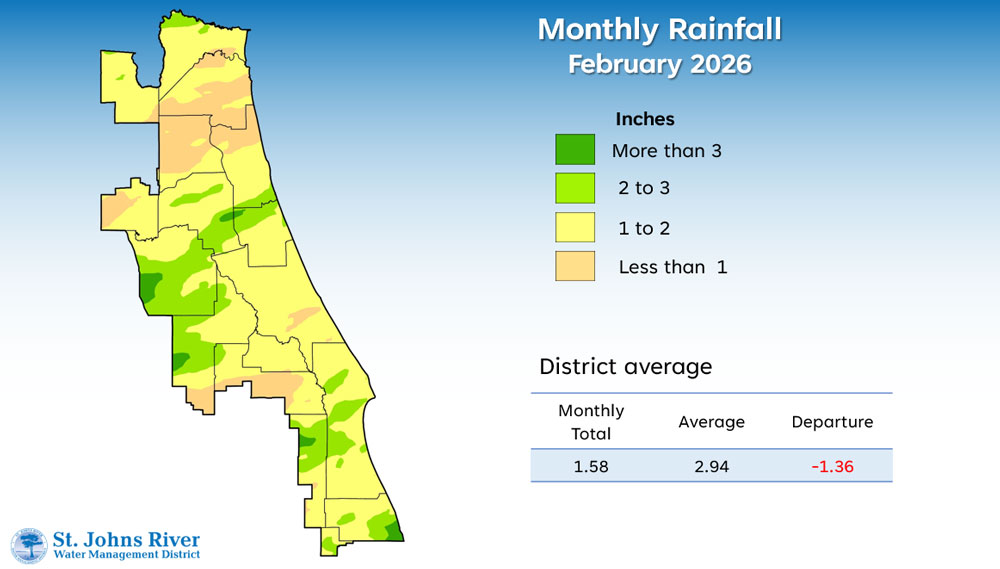
The St. Johns River Water Management District’s (District) latest hydrologic conditions report shows continued dry conditions across much of the region, following four consecutive months of below-average rainfall. Rainfall totals in February were below normal across all 18 counties within the District, with 10 counties receiving less than half of their typical monthly rainfall.
Over the past 12 months, 16 counties recorded rainfall totals below their long-term averages, including five counties that are more than 13 inches below normal. As a result, groundwater and surface water indicators across the District continue to trend lower. Most aquifer levels declined during February, and the majority of the Upper Floridan Aquifer is currently below the normal range, with areas of low groundwater levels expanding in northern and western counties. Very low levels are also being observed in parts of several central counties.
These conditions align with broader statewide drought indicators. As of last week, the entire state of Florida was classified at a minimum of Moderate Drought, with several counties in the central portion of the District falling within that category and portions of northern and southern counties experiencing severe to extreme drought conditions according to the U.S. Drought Monitor.
A full report outlining February’s hydrologic conditions was presented at the District’s Governing Board meeting. Highlights include:
Rainfall:
- Districtwide rainfall averaged 1.58 inches, 1.36 inches below the monthly average.
- Monthly averages ranged from 2.44 inches in Marion County to 0.78 inches in Bradford County.
- Annual rainfall across the District was 43.98 inches, 7.03 inches below the long-term average.
- Rainfall distribution on an annual scale has been higher in Volusia, northern Brevard and portions of Seminole and Orange counties, while areas to the west and the northwest have received below 35 inches.
- Volusia and Seminole counties were the only counties that remained above normal rainfall for the year. Of the 16 counties that recorded below-average annual rainfall, eight were below their averages by 11 inches, including Baker and Bradford counties, which were more than 16 inches below their annual averages.
Groundwater
- Water levels in the Upper Floridan aquifer primarily recorded decreases, reflecting drier conditions.
- Districtwide groundwater levels, expressed as a single index, were in the 11th percentile for February, which is just within the low range.
Spring flows
- Silver Springs recorded a monthly mean flow of 476 cubic feet per second (cfs), or 308 million gallons per day (mgd), a decrease of 12 cfs from December. Remaining in the low range for this time of year.
- In Volusia County, the Blue Spring station reported flows to be in the normal range.
- Rock Springs had a monthly mean flow of 58 cfs (37 mgd), which is in the normal range.
- Wekiwa Springs recorded a monthly mean flow of 63 cfs (41 mgd), continuing to be in the normal range.
For further insights into rainfall totals and other hydrologic data, visit www.sjrwmd.com. For more information about the Phase I Moderate Water Shortage, visit www.sjrwmd.com/


























FedUp says
The population boom in Florida will ultimately deplete the aquifer, and each local elected official will have to address our water crisis by relying on desalination, which will be very costly to taxpayers. But that’s the price paid to open up Florida to those who wish to run away from the problems they’ve caused in their own state by voting for the same failed policies that got them there in the first place.
burn that oil baby burn it says
I think this is more due to a combination of effects from La Nina and climate change as a whole. Keep in mind the Floridian aquifer spans several states outside of Floriduh (100,000 sq miles); it’s not just under our feet here.
Jim says
You may well be right. However, regardless of the cause, the continued expansion of Florida which is directly the result of our governor and state legislature is hurling us towards chronic water shortages (reminds me of California – that commie state). When we pass the critical point where we just can’t provide enough water, some alternative (desalinization or pipelines of something else) will have to be implemented. It’ll cost money and we’ll all pay for it.
The government is supposed to act in the best interests of it’s citizens. Doesn’t appear that’s the path we’re on to me! Wonder how many of our “leaders” will stand up and accept responsibility?