



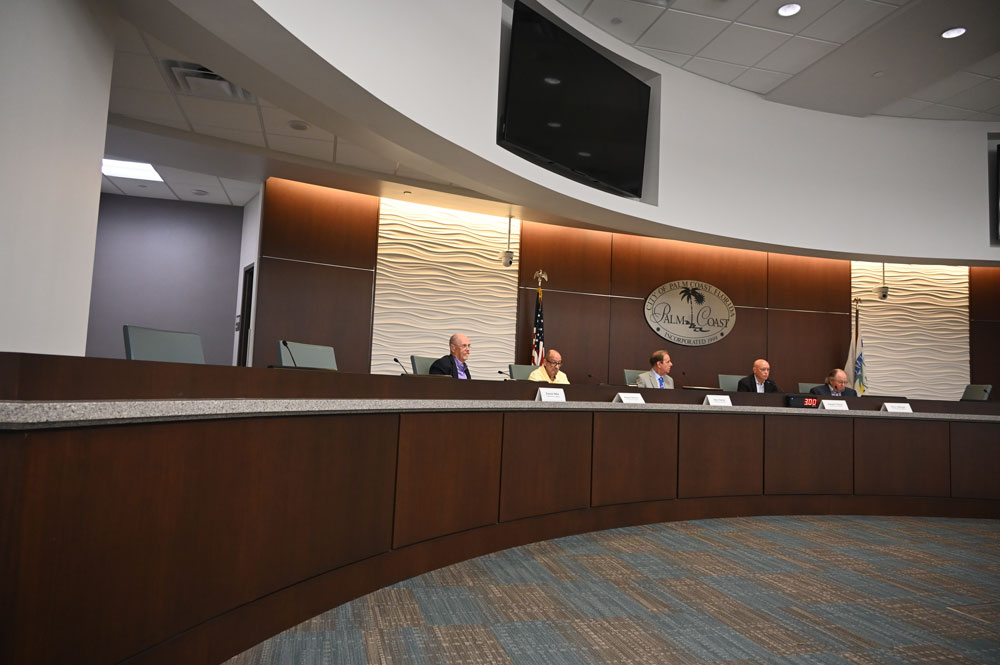
As Palm Coast’s Charter Review Committee continues to meet bi-weekly as it did last night, and before audiences that can be counted on one hand, its proposed revisions are taking shape well ahead of a March 1 deadline: the committee expects to be done next month. The council will then decide what, if any, proposals make it onto next November’s ballot.
The council may edit, delete, rewrite or accept in whole the committee’s proposals. The committee itself may meet only one or two more times, likely in January. Here’s what it’s come up with.
The committee will not propose changes to the form of government: no transforming the mayor into a “strong mayor”–that is, a mayor-city manager. “If you get a mayor that does not have the skill set, the city could quickly go backwards, really quick,” Perry Mitrano, one of the five committee members, said. “All the mayors that I’ve watched since I’ve been here in 2004,” he said of Jon Netts, Melissa Holland, David Alfin and Mike Norris, “quite frankly, great people, but not managers. Pretty evident. So having a professional answer to the city council and a mayor who is a figurehead of the city, it makes more sense.”
The committee will not propose increasing the council’s membership to seven, or change the requirement that there be four council members elected at large–that is, by all eligible voters across the city–but who represent the district where they live. Both those provisions may change with the next census in 2030, the committee suggests.
But it will recommend sharply reducing the requirements to qualify for election to the council.
Currently, a candidate may qualify by gathering petitions equivalent to 1 percent of the number of voters in the district, or 165 to 200 petitions for council members, 700 petitions for the mayor’s office. The numbers increase as the population increases. Alternately, the candidate may pay a qualifying fee of 10 percent of the office’s salary plus a 1 percent assessment. The previous council gave itself a 151 percent pay raise, supposedly to encourage more candidates to run. But the qualifying fee for a council seat rose to $2,867 and $3,573 for the mayoral seat.
The Charter Review Committee is proposing a flat requirement of 100 signatures regardless of district or population, or a $100 qualifying fee. The signatures no longer need to be gathered exclusively from the candidate’s district. They may be gathered from qualified voters of any district in the city. For the mayoral seat, the requirement would be 400 petitions or $400.
“Let’s make it simple. Let’s make it affordable,” Charter Committee member Michael Martin said.
Other candidate requirements will remain. The charter currently requires elected members to live in their district at least 45 weeks of the year. That requirement would be removed, as it is difficult to police. The committee is proposing that candidates must have lived in the district for at least a year before qualifying for the seat, even though for Donald O’Brien, who chairs the committee, it’s also a difficult provision to enforce. The candidate would have to attest to living in the district for a year when filing for election.
To Chantal Preuninger, an alternate committee member who’s attended every meeting, the residency requirement should mirror a prohibition on attending meetings remotely. She’s been intent on limiting or eliminating council members’ remote meeting attendance. But she’s running against a council trend–and proposal–to ensure that remote participation is not quashed, especially as technology now makes it possible–either for council members or members of the public.
The charter currently calls for a limit of two successive terms for the same seat. Theoretically, a candidate could move to a different district and serve a third successive term on the council, but from a different district. That has never happened, though Netts was in his second term as council member when he was elected mayor.
“I don’t think that we should allow anyone to run more than two times no matter how we do it,” Mitrano said. So the proposal would be to tighten the language on council seats, preventing a council member from serving more than two terms regardless, but not prevent a council member from running for mayor even after serving two terms as a council member (or vice versa). “Remember, we’re trying to incentivize people to run for office, not dissuade them,” Mitrano said.
But health benefits, provided to council members and the mayor since the 2022 raise, would be withdrawn. “I don’t see that it’s a necessary thing,” Martin said. “I think that it’s, again, a public service, you’re supposed to make some sacrifices for public service. It’s not supposed to be something that enriches you.” The presumption that the 2022 raise and health benefits would attract younger and better candidates “hasn’t happened,” Martin said. There was no suggestion to reduce the salary–only to limit future salary increases.
Committee member Patrick Miller said there will be “an uproar” by council members when they get the proposal to remove health benefits. He proposed instead to earmark the benefit to the individual in office, not to family members of that individual.
The committee previously clarified the language controlling council and mayoral appointments in case of vacancies, expanding the requirements of special elections and narrowing the window of council appointments. It set the residency radius for a city manager not at the city’s boundaries, but at 50 miles, and set a baseline of education requirements. The firing of a city manager would need a super-majority of the council’s vote (at least 4-1). There would be clarifying language about redistricting, which takes place every 10 years. The committee has yet to nail down a provision on what limit, if any, should apply to the council’s authority to borrow money against the general fund. A $15 million limit is in place now, as is a three-year limit on long-term leases the city may enter into. The council last year tried to eliminate both limits in a referendum. The referendum failed.
The charter would also include a preamble and a citizens’ bill of rights. The committee may yet make further recommendations in the one or two meetings it will hold.
City Attorney Marcus Duffy had started Monday’s meeting with answers to questions the committee had asked a few meetings ago.
Council members levying fines against the mayor or a council member for misbehavior? Not recommended.
“We generally advise against fining anyone on a charter violation because what you’re dealing there is due process rights,” Duffy said. That requires hearings, avenues of appeal, more hearings, and a drawn out process. “In my research, I’ve not found any cities or municipalities that currently do that. Usually what happens is you have a censure. That’s the most common thing that happens when you feel like someone has violated a charter.”
A council member challenging a council vote on claims that it violates the charter? “That’s what you have a city attorney for,” Duffy said. So while a council member or the mayor may raise a question about the validity of a vote, it may not–should not–go beyond that once the city attorney has weighed in. In any case, a wise attorney weighs in before a vote, ensuring that any votes taken are in line with the charter.
The question was prompted by Mayor Mike Norris claiming for most of the year that Council member Charles Gambaro was improperly appointed. Norris eventually sued and lost. He’s been less fixated on Gambaro’s presence since Gambaro decided to run for a congressional seat, ensuring his term ends in less than a year.


























Janet Sullivan says
Very informative. Thank you.