


Maybe if members of the Florida House of Representatives were present at the Day of Celebration last Friday at Palm Coast United Methodist Church, they’d have walked away convinced that sitting on a bill to build the Florida Museum of Black History in St. Augustine, as they have for the last two years, is no longer tenable. They’d have been so moved, so inspired by the commitment and purpose behind the project that further delaying the museum would have started to look like mendacity.
Sen. Tom Leek had been invited to the Day of Celebration–a production of Dwyer and Knight, the Flagler Beach law firm, and Howard Holley’s Evolve Communications Group–but didn’t make it. Leek anyway did his job: he sponsored the Senate bill to get the museum going, and got it unanimously passed by three committees and the full Senate. Like last year, its House companion has languished.
Holley, who’s served on the task force and could mathematically say that he cast the deciding vote in a 5-4 decision that located the future museum in St. Johns County, doesn’t understand the House’s apathy. “All of our legislators are behind it. But they don’t control what gets heard in committee. That’s determined by the speaker and his team,” Holley said. “So I don’t have an answer to that. When I talk to people who talk to the speaker, he says, Well, I thought that was already decided.”
Yet all it needs is one committee hearing and it could still get a vote on the floor of the House. “When the task force was formed, every House member voted for it except for one person. So this isn’t an issue in the House,” Holley said.
Bringing awareness to the Florida Museum of Black History and honoring its volunteers and future mission was just one of the centerpieces of the Day of Celebration.
Others were the all-woman organization known as SIS, or Seeking Insights for Solutions, a nonprofit whose focus has been to unearth the Black history of Flagler Beach, some of it as grim as the “No N— After Sunset” sign that many of its intended targets remember stuck to a pylon near the old Moody Bridge. Also honored was the late Jim Guines, who served on the Flagler County School Board for a decade and founded the African American Mentor Program.
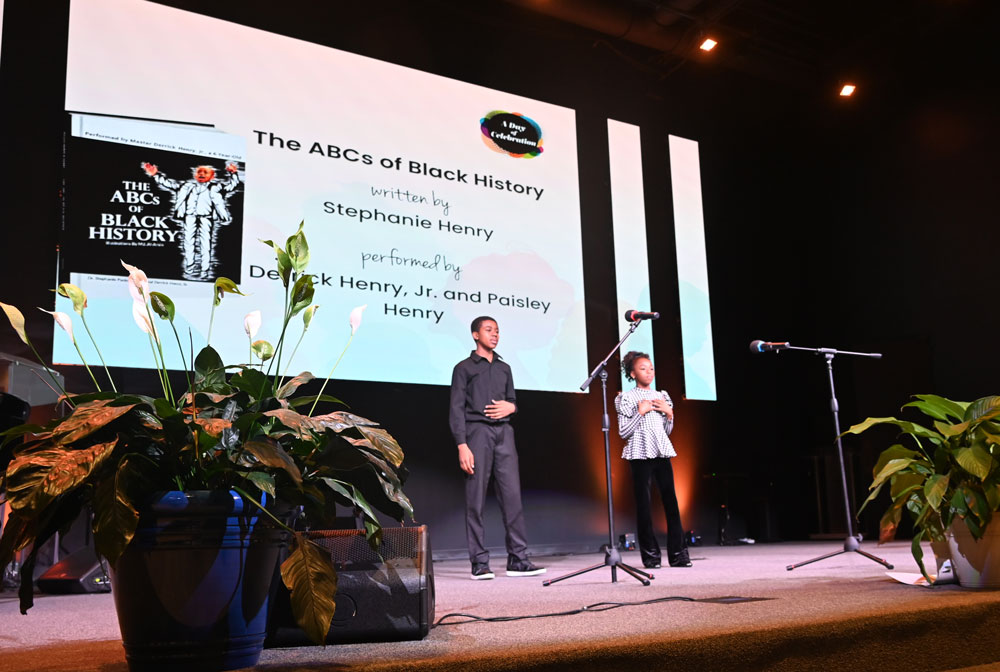
It all started with a pair of kids who almost stole the show: fifth-grader Derrick Henry Jr. and his sister, fourth-grader Paisley Henry, children of Bethune-Cookman University’s Dr. Stephanie Henry, the Dean of First Year Experience, and Derrick Henry, Daytona Beach’s mayor. Derrick Jr. and Paisley performed “The ABCs of Black History,” a romp through Black history that’s in turn lyrical, disturbing, joyful, bracing and touching. Their mother wrote the piece some years ago when she found that whatever was offered her son to mark Black History Month just didn’t cut it.
“G is for the GPS that Harriet Tubman did not need… L is for the letter written in Birmingham Jail. Martin’s body was incarcerated, yet his mind was free…. N is for NAACP, O is for the Obamas who serve our country with dignity. P is for the potential that we all have to be great. And U is for our question, why? Why? Why is there so much hate?”
Derrick Jr. has performed the five-minute routine from memory dozens of times. Paisley just started, but both were flawlessly in sync and brought the audience of some 140 to their feet and lingered in their memory, so that when West Augustine Mayor Greg White took the mic 20 minutes later, he was still thinking about it. “That alphabet from A to Z was phenomenal. Phenomenal. A for Awesome,” he said, though moments earlier the Henrys had left: they had to get to school.
Emceed by Jay Scherr, the program started at 7:30 a.m., bringing together some elected and other officials, among them Superintendent LaShakia Moore, who has her own stage presence though she was not among the morning’s speakers. Asked how, as an education leader, she is contending with Florida government’s and the state Board of Education’s silencing and whitewashing of Black history in the last few years, Moore said: “For me, sitting here as the superintendent, my focus is really just helping our staff focus on the areas that we can continue to teach, and then in other areas and other means, people in our community to take up advocacy for those other things, and so in my role as superintendent, I don’t focus as much on what can’t be done, but what can be still done.”
That, in effect, is behind the Day of Celebration, Marc Dwyer, its co-founder and owner of Dwyer and Knight, said. He wants people who turned up that day and others “to really feel good that there are people unseen behind the scenes that are doing very good work in the community,” he said. Always one of Flagler County’s best-dressed men, he wore that morning a Kenyan scarf as if woven into his suit like a burst of African colors. “It’s really important for us to remember that when we see part of the news cycle, we would tend to think that the country is going down and everything is in chaos. And that’s not really the case. It’s a lot of good people doing good things in communities all around America every day. And we want to make sure people recognize that, understand that, and hopefully are inspired by that, to themselves, get involved and do things positively for the community.”
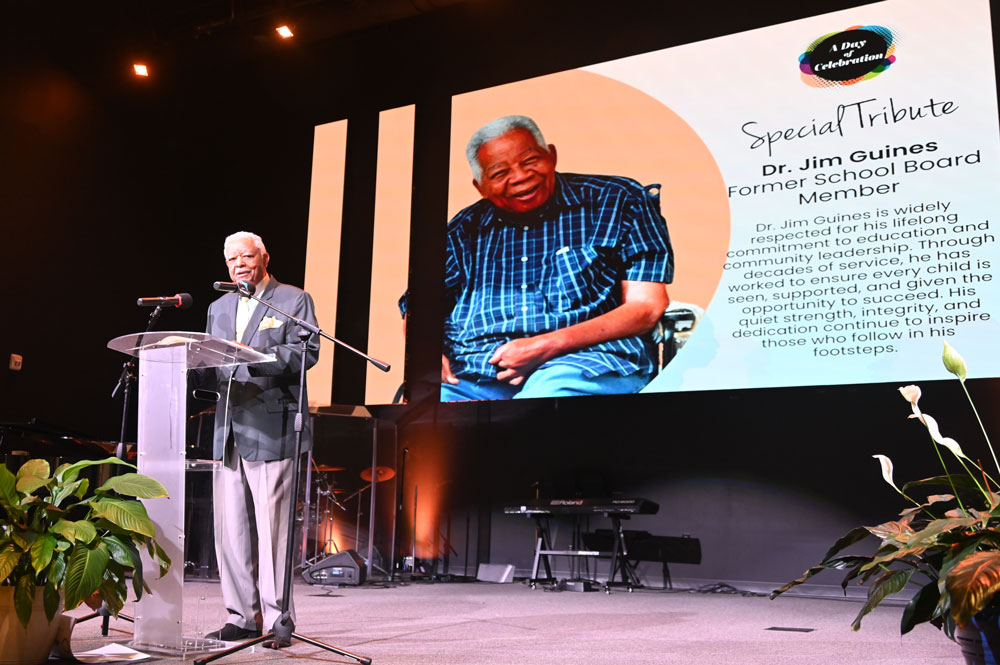
One of those people in Flagler County has long been John Winston, a hero to many and a lifeline to many more in his role as the co-founder of the African American Mentor Program. Speaking to a reporter before taking the stage, Winston remembered how when he’d just moved to Palm Coast, a hand tapped his shoulder at the grocery store and a man he’d never seen before asked him if he was ready to be a champion to other young men. It was Guines, recruiting.
“So he pulled me over and he said, ‘Sir, I don’t know you,’” Winston recalled Guines telling him, “but I got a feeling you’re a good human being, and I’m trying to develop a unique program, never before done in the history of Flagler County, that I think can make a difference in young students’ lives.’”
Next they were in Guines’s kitchen, planning it all out. That was in 2003 when Bill Delbrugge was the maverick superintendent who greenlighted pioneering programs first and worried about costs and consequences later. The mentoring program has now served 3,300 students and it’s still going. Winston repeated a version of the story when he took the stage, standing below a picture of a smiling Guines.
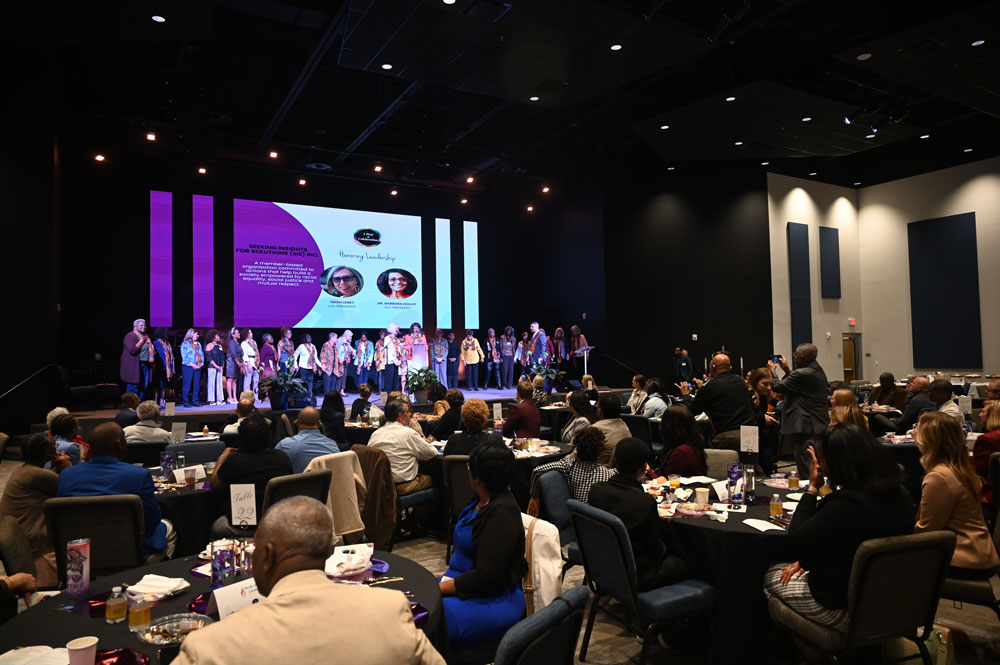
He had followed the tribute to the women of Seeking Insights for Solutions, which had included a brief video of their ongoing work. Several of the women, including co-presidents Trish Lenet and Barbara Holley, had appeared before the Flagler Beach City Commission the night before to bring the same awareness to the city, and to make a startling, subtle accusation: not a single item in the Flagler Beach Museum relates to the city’s Black history. Lenet said she’s been trying to track down the infamous sign that stood in the Intracoastal, and had heard that a photograph of it had once been in the museum’s possession, but has so far been unsuccessful.
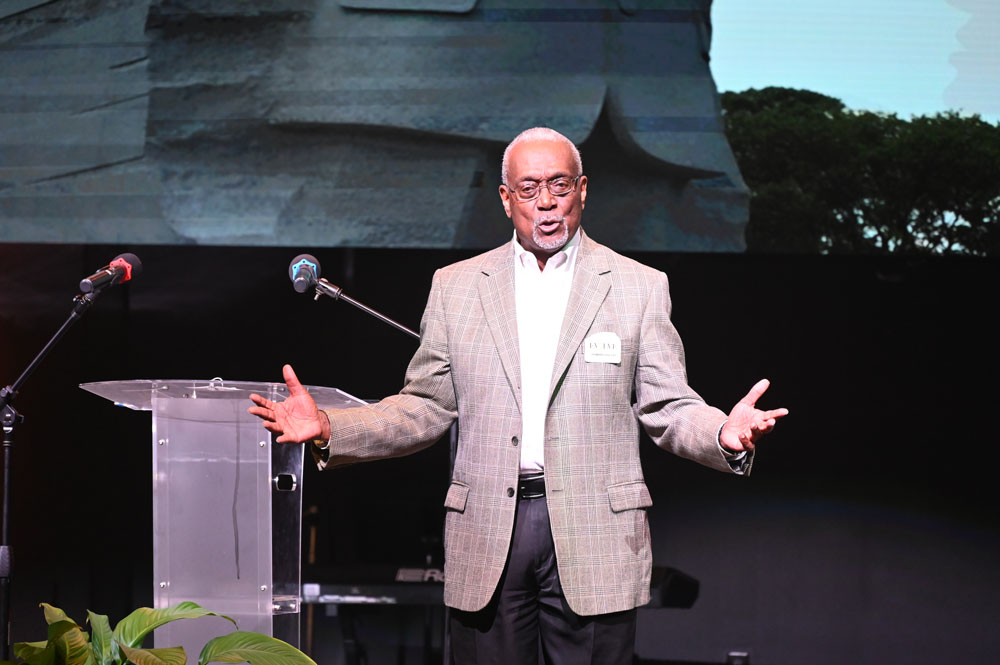
Holley led the segment on the Museum of Black History with a theme framed by the commemorative centennial of Black history–Dr. Carter G. Woodson, celebrated and often controversial author of The Mis-Education of the Negro, founded the commemoration in 1926–and the importance of living Black history. He illustrated that theme with the story of the “burning bus,” the literal incineration of a bus carrying 54 people to Tallahassee in 2024 to advocate for the Museum of Black History. Unlike the shooting and burning of civil rights buses, this one had been an accident, no one was hurt, and all 54 continued by other means to Tallahassee.
“This is a piece of the history,” Holley said, describing the event as a trio of miracles–nobody was hurt, nobody turned tail, and “they brought the smoke” to Tallahassee, winning the creation of the task force. The museum, if and when the legislature decides to fund it, will be a complex of over 100,000 square feet on its own campus, including a 40,000-square-foot museum, a 40,000 square-foot performing arts center, and a 20,000-square-foot event and education building.
“This is a statewide museum that will have a huge impact,” Holley said. “We have to have a sense of urgency. A sense of urgency. As John Winston said, say something. Let people know that we want this to move forward.”
The event closed with the singing of “Lift Every Voice and Sing,” the Black National Anthem.


























Leave a Reply