• Skip to primary navigation
  • Skip to main content
  • Skip to primary sidebar
MENUMENU
MENUMENU
  • Home
  • About
    • Contact Us
    • FlaglerLive Board of Directors
    • Comment Policy
    • Mission Statement
    • Our Values
    • Privacy Policy
  • Live Calendar
  • Submit Obituary
  • Submit an Event
  • Support FlaglerLive
  • Advertise on FlaglerLive (386) 503-3808
  • Search Results

FlaglerLive

No Bull, no Fluff, No Smudges

MENUMENU
  • Flagler
    • Flagler County Commission
    • Beverly Beach
    • Flagler History
    • Mondex/Daytona North
    • The Hammock
    • Tourist Development Council
    • Marineland
  • Palm Coast
    • Palm Coast City Council
    • Palm Coast Crime
  • Bunnell
    • Bunnell City Commission
    • Bunnell Crime
  • Flagler Beach
    • Flagler Beach City Commission
    • Flagler Beach Crime
  • Cops/Courts
    • Circuit & County Court
    • Florida Supreme Court
    • Federal Courts
    • Flagler 911
    • Fire House
    • Flagler County Sheriff
    • Flagler Jail Bookings
    • Traffic Accidents
  • Rights & Liberties
    • First Amendment
    • Second Amendment
    • Third Amendment
    • Fourth Amendment
    • Fifth Amendment
    • Sixth Amendment
    • Seventh Amendment
    • Eighth Amendment
    • 14th Amendment
    • Sunshine Law
    • Religion & Beliefs
    • Privacy
    • Civil Rights
    • Human Rights
    • Immigration
    • Labor Rights
  • Schools
    • Adult Education
    • Belle Terre Elementary
    • Buddy Taylor Middle
    • Bunnell Elementary
    • Charter Schools
    • Daytona State College
    • Flagler County School Board
    • Flagler Palm Coast High School
    • Higher Education
    • Imagine School
    • Indian Trails Middle
    • Matanzas High School
    • Old Kings Elementary
    • Rymfire Elementary
    • Stetson University
    • Wadsworth Elementary
    • University of Florida/Florida State
  • Economy
    • Jobs & Unemployment
    • Business & Economy
    • Development & Sprawl
    • Leisure & Tourism
    • Local Business
    • Local Media
    • Real Estate & Development
    • Taxes
    • Sponsored Content
  • Commentary
    • The Conversation
    • Pierre Tristam
    • Diane Roberts
    • Guest Columns
    • Byblos
    • Editor's Blog
  • Culture
    • African American Cultural Society
    • Arts in Palm Coast & Flagler
    • Books
    • City Repertory Theatre
    • Flagler Auditorium
    • Flagler Playhouse
    • Special Events
  • Elections 2026
    • Amendments and Referendums
    • Presidential Election
    • Campaign Finance
    • City Elections
    • Congressional
    • Constitutionals
    • Courts
    • Governor
    • Polls
    • Voting Rights
  • Florida
    • Federal Politics
    • Florida History
    • Florida Legislature
    • Florida Legislature
    • Ron DeSantis
  • Health & Society
    • Flagler County Health Department
    • Ask the Doctor Column
    • Health Care
    • Health Care Business
    • Covid-19
    • Children and Families
    • Medicaid and Medicare
    • Mental Health
    • Poverty
    • Violence
  • All Else
    • Daily Briefing
    • Americana
    • Obituaries
    • News Briefs
    • Weather and Climate
    • Wildlife

Martin Luther King Was For Universal Basic Income

February 27, 2026 | FlaglerLive | 2 Comments

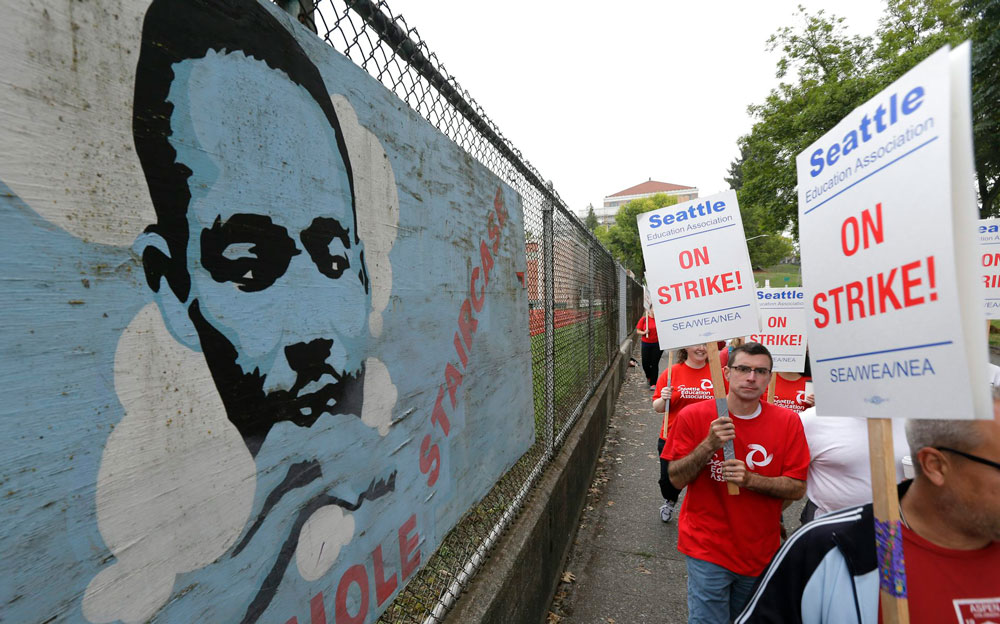
Martin Luther King Jr. became involved not just in fights over racial equality but also economic hardship.
Martin Luther King Jr. became involved not just in fights over racial equality but also economic hardship. (Ted S. Warren/AP)

By Tarah Williams and Andrew Bloeser

Each year on the holiday that bears his name, Martin Luther King Jr. is remembered for his immense contributions to the struggle for racial equality. What is less often remembered but equally important is that King saw the fight for racial equality as deeply intertwined with economic justice.

To address inequality – and out of growing concern for how automation might displace workers – King became an early advocate for universal basic income. Under universal basic income, the government provides direct cash payments to all citizens to help them afford life’s expenses.

In recent years, more than a dozen U.S. cities have run universal basic income programs, often smaller or pilot programs that have offered guaranteed basic incomes to select groups of needy residents. As political scientists, we have followed these experiments closely.

One of us recently co-authored a study which found that universal basic income is generally popular. In two out of three surveys analyzed, majorities of white Americans supported a universal basic income proposal. Support is particularly high among those with low incomes.

King’s intuition was that white people with lower incomes would support this type of policy because they could also benefit from it. In 1967, King argued, “It seems to me that the Civil Rights Movement must now begin to organize for the guaranteed annual income … which I believe will go a long, long way toward dealing with the Negro’s economic problem and the economic problem with many other poor people confronting our nation.”

But there is one notable group that does not support universal basic income: those with higher levels of racial resentment. Racial resentment is a scale that social scientists have used to describe and measure anti-Black prejudice since the 1980s.

Notably, in our research, whites with higher levels of racial resentment and higher incomes are especially inclined to oppose universal basic income. As King well knew, this segment of Americans can create powerful opposition.

Economic self-interest can trump resentment

At the same time, the results of the study also suggest that coalition building is possible, even among the racially resentful.

Economic status matters. Racially resentful whites with lower incomes tend to be supportive of universal basic income. In short, self-interest seems to trump racial resentment. This is consistent with King’s idea of how an economic coalition could be built and pave the way toward racial progress.
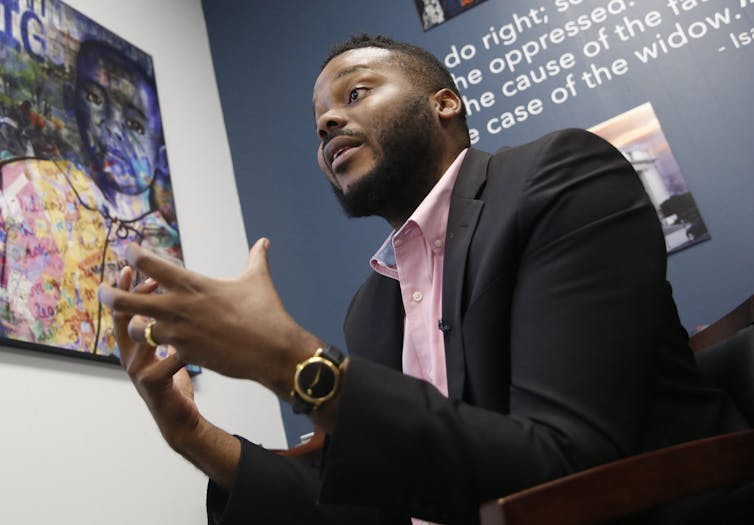
Michael Tubbs, the mayor of Stockton, Calif., gestures with his hands while making a point.
As mayor of Stockton, Calif., Michael Tubbs ran a pioneering program that provided a basic income to a limited number of residents.
Rich Pedroncelli/AP

Income is not the only thing that shapes attitudes, however. Some of the strongest supporters of universal basic income are those who have higher incomes but low levels of racial resentment. This suggests an opportunity to build coalitions across economic lines, something King believed was necessary. “The rich must not ignore the poor,” he argued in his Nobel Peace Prize lecture, “because both rich and poor are tied in a single garment of destiny.” Our data shows that this is possible.

This approach to coalition building is also suggested by our earlier research. Using American National Election Studies surveys from 2004-2016, we found that for white Americans, racial resentment predicted lower support for social welfare policies. But we also found that economic position mattered, too.

Economic need can unite white Americans in support of more generous welfare policies, including among some who are racially prejudiced. At a minimum, this suggests that racial resentment does not necessarily prevent white Americans from supporting policies that would also benefit Black Americans.

Building lasting coalitions

During his career as an activist in the 1950s and 1960s, King struggled with building long-term, multiracial coalitions. He understood that many forms of racial prejudice could undermine his work. He therefore sought strategies that could forge alliances across lines of difference. He helped build coalitions of poor and working-class Americans, including those who are white. He was not so naive as to think that shared economic progress would eliminate racial prejudice, but he saw it as a place to start.
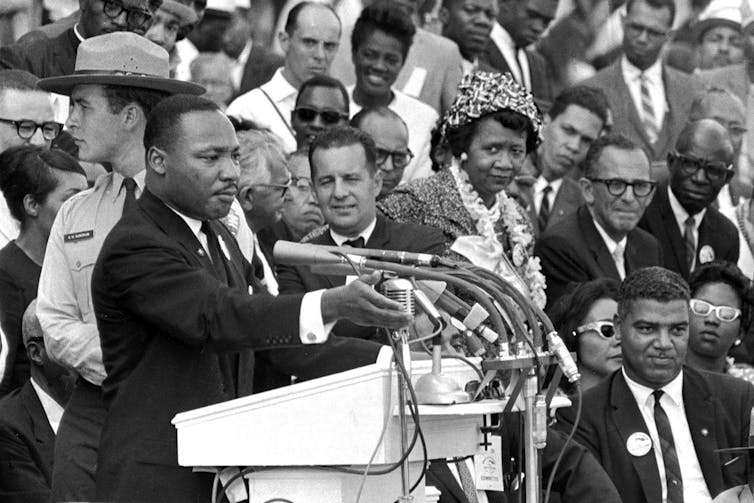
Martin Luther King Jr. speaks before a crowd at the 1963 March on Washington.
Martin Luther King Jr. believed Americans of different racial backgrounds could coalesce around shared economic interests.
AP

Currently, the nation faces an affordability crisis, and artificial intelligence poses new threats to jobs. These factors have increased calls for universal basic income.

Racial prejudice continues to fuel opposition to universal basic income, as well as other forms of social welfare. But our research suggests that this is not insurmountable.

As King knew, progress toward economic equality is not inevitable. But, as his legacy reminds us, progress does remain possible through organizing around shared interests.

Tarah Williams is Assistant Professor of Political Science at Allegheny College. Andrew Bloeser is Associate Professor of Political Science and Director of the Center for Political Participation at Allegheny College.


The Conversation arose out of deep-seated concerns for the fading quality of our public discourse and recognition of the vital role that academic experts could play in the public arena. Information has always been essential to democracy. It’s a societal good, like clean water. But many now find it difficult to put their trust in the media and experts who have spent years researching a topic. Instead, they listen to those who have the loudest voices. Those uninformed views are amplified by social media networks that reward those who spark outrage instead of insight or thoughtful discussion. The Conversation seeks to be part of the solution to this problem, to raise up the voices of true experts and to make their knowledge available to everyone. The Conversation publishes nightly at 9 p.m. on FlaglerLive.
See the Full Conversation Archives
Support FlaglerLive
The political climate—nationally and right here in Flagler County—is at war with fearless reporting. Your support is FlaglerLive's best armor. After 16 years, you know FlaglerLive won’t be intimidated. We dig. We don’t sanitize to pander or please. We report reality, no matter who it upsets. Even you. Imagine Flagler County without that kind of local coverage. Stand with us, and help us hold the line. There’s no paywall—but it’s not free. become a champion of enlightening journalism. Any amount helps. FlaglerLive is a 501(c)(3) non-profit news organization, and donations are tax deductible.
You may donate openly or anonymously.
We like Zeffy (no fees), but if you prefer to use PayPal, click here.
If you prefer the Ben Franklin way, we're at: P.O. Box 354263, Palm Coast, FL 32135.
 

Reader Interactions

Comments

  1. Kola says

    February 28, 2026 at 8:26 am

    “The government provides direct cash payments.” What a novel concept. A culture of welfare is born. These ideas have destroyed the “work ethic” of our country.

    2
    Reply
  2. Tom says

    March 2, 2026 at 10:46 am

    MLK (and his handler Stanley Levison) was in favor of rape and murder as well. Disgusting creature, “civil rights” was and remains terrorism against Americans. Fitting that every “MLK Blvd” and “MLK highschool” is a violent, litter-strewn blight. Truly his legacy.

    Reply

Leave a Reply Cancel reply

Your email address will not be published. Required fields are marked *

This site uses Akismet to reduce spam. Learn how your comment data is processed.

  • Conner Bosch law attorneys lawyers offices palm coast flagler county
  • grand living realty
  • politis matovina attorneys for justice personal injury law auto truck accidents

Primary Sidebar

  • grand living realty
  • politis matovina attorneys for justice personal injury law auto truck accidents

Recent Comments

  • Mark on Flagler Beach Leaders Revisit 30 Years of Paid Parking Talk Amid Growing Resentment Toward Palm Coast and County
  • Ed P on The Daily Cartoon and Live Briefing: Thursday, April 2, 2026
  • Deborah Coffey on US, Israel and Iran All Think God Is On Their Side
  • Dennis C Rathsam on The Daily Cartoon and Live Briefing: Friday, April 3, 2026
  • Skibum on US, Israel and Iran All Think God Is On Their Side
  • Skibum on The Daily Cartoon and Live Briefing: Thursday, April 2, 2026
  • TR on Flagler Beach Approves Millions In New Debt For Sewer Upgrades Without Clear Resident Cost
  • John Stove on Flagler Beach Leaders Revisit 30 Years of Paid Parking Talk Amid Growing Resentment Toward Palm Coast and County
  • Deborah Coffey on Palm Coast Releases ‘Popular’ 20-Page Annual Financial Report
  • paid parking my keester on Flagler Beach Leaders Revisit 30 Years of Paid Parking Talk Amid Growing Resentment Toward Palm Coast and County
  • Roseyinflorida on Flagler Beach Leaders Revisit 30 Years of Paid Parking Talk Amid Growing Resentment Toward Palm Coast and County
  • Wendy K. Bentzley on Target Shopping Center Expansion and Large U-Haul Storage Facility Off Whiteview Are Approved
  • JimboXYZ on Flagler Beach Leaders Revisit 30 Years of Paid Parking Talk Amid Growing Resentment Toward Palm Coast and County
  • Momma Mia on Flagler Beach Leaders Revisit 30 Years of Paid Parking Talk Amid Growing Resentment Toward Palm Coast and County
  • Skibum on Trump Fires Pam Bondi, Ending Combative Tenure as Attorney General
  • Skibum on Appeals Court Will Decide if Flagler Beach Shopping Center Can Legally Ban Coastal Family Church Services

Log in