


By Nicole M. Bennett
When an Immigration and Customs Enforcement agent shot and killed Renee Nicole Good in south Minneapolis on Jan. 7, 2026, what happened next looked familiar, at least on the surface. Within hours, cellphone footage spread online and eyewitness accounts contradicted official statements, while video analysts slowed the clip down frame by frame to answer a basic question: Did she pose the threat federal officials claimed?
What’s changed since Minneapolis became a global reference point for bystander video in 2020 in the wake of George Floyd’s murder is how thoroughly camera systems, especially smartphones, are now entangled with the wider surveillance ecosystem.
I am a researcher who studies the intersection of data governance, digital technologies and the U.S. federal government. The hard truth for anyone filming law enforcement today is that the same technologies that can hold the state accountable can also make ordinary people more visible to the state.
Recording is often protected speech. But recording, and especially sharing, creates data that can be searched, linked, purchased and reused.
Video can challenge power. It can also attract it.
Targeting the watchers
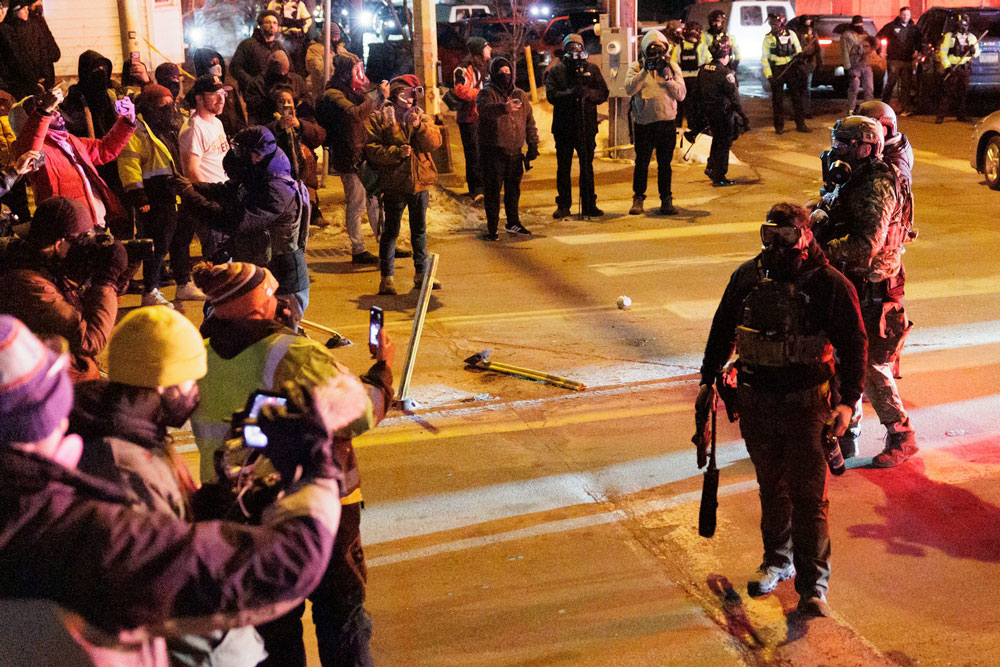
Documentation can be the difference between an official narrative and an evidence-based public record. Courts in much of the U.S. have recognized a First Amendment right to record police in public while they perform official duties, subject to reasonable restrictions. For example, you can’t physically interfere with police.

AP Photo/Adam Gray
However, that right is uneven across jurisdictions and vulnerable in practice, especially when police claim someone is interfering, or when state laws impose distances people must maintain from law enforcement actions – practices that chill filming.
While the legal landscape of recording law enforcement is important to understand, your safety is also a major consideration. In the days after Good’s killing, Minneapolis saw other viral clips documenting immigration enforcement and protests, along with agents’ forceful engagement with people near those scenes, including photographers.
It’s difficult to know how many people have been targeted by agents for recording. In Illinois in late 2025, the U.S. Press Freedom Tracker, operated by advocacy group Freedom of the Press Foundation, documented multiple incidents in which journalists covering ICE-facility protests reported being shot with crowd-control munitions or tackled and arrested while filming.
These incidents underscore that documentation isn’t risk-free. There is an additional layer of safety beyond the physical to take into account: your increased risk of digital exposure. The legal right to record doesn’t prevent your recording from becoming data that others can use.
Both camera and tracking device
In practical terms, smartphones generate at least three kinds of digital exposure.
The first is identification risk, including through facial recognition technology. When you post footage, you may be sharing identifiable faces, tattoos, voices, license plates, school logos or even a distinctive jacket. That can enable law enforcement to identify people in your recordings through investigative tools, and online crowds to identify people and dox or harass them, or both.
That risk grows when agencies deploy facial recognition in the field. For example, ICE is using a facial recognition app called Mobile Fortify.
Facial recognition accuracy also isn’t neutral. National Institute of Standards and Technology testing has documented that the technology does not perform equally across different demographic groups, meaning the risk of misidentification is not evenly distributed across groups. For example, studies have shown lower recognition accuracy for people with darker skin color.
Second is the risk of revealing your location. Footage isn’t just images. Photos and video files often contain metadata such as timestamps and locations, and platforms also maintain additional logs. Even if you never post, your phone still emits a steady stream of location signals.
This matters because agencies can obtain location through multiple channels, often with different levels of oversight.
Agencies can request location or other data from companies through warrants or court orders, including geofence warrants that sweep up data about every device in a place during a set time window.
Agencies can also buy location data from brokers. The Federal Trade Commission has penalized firms for unlawfully selling sensitive location information.
Agencies also use specialized “area monitoring” tools: ICE purchased systems capable of tracking phones across an entire neighborhood or block over time, raising civil liberties concerns. The tools could track a phone from the time and place of a protest – for example, to a home or workplace.
There are more pathways for tracking than most people realize, and not all are constrained by the courtroom rules people picture when they think “warrant.”
The third type of potential exposure is the risk of having your phone seized. If police seize your phone, temporarily or for evidence, your exposure isn’t just the video you shot. It can include your contacts and message history, your photo roll, location history and cloud accounts synced to the device.
Civil liberties groups that publish protest safety guidance consistently recommend disabling the face and fingerprint unlocking features and using a strong passcode. Law enforcement officials can compel you to use biometrics more easily in some contexts than reveal memorized secrets.
Digital safety when recording police
This isn’t legal advice, and nothing is risk-free. But if you want to keep the accountability benefits of filming while reducing your digital exposure, here are steps you can take to address the risks.
Before you go, decide what you’re optimizing for, whether it is preserving evidence quickly or minimizing traceability, because those goals can conflict. Harden your lock screen with a long passcode, disable face and fingerprint ID, turn off message previews and reduce the risk of what you carry by logging out of sensitive accounts and removing unnecessary apps. Even consider leaving your primary phone at home if that’s realistic.
If you’re worried about having your recording deleted, plan ahead for how you’ll secure footage. You can either send it to a trusted person through an encrypted app or keep it offline until you’re safe.
While filming, keep your phone locked when possible using the camera-from-lock-screen feature and avoid livestreaming if identification risk is high, since live posts can expose your location in real time. Focus on documenting context rather than creating viral clips: Capture wide shots, key actions and clear time-and-place markers, and limit close-ups of bystanders. Assume faces are searchable, and if you can’t protect people in the moment, consider waiting to share until you can edit safely.
Afterward, back up securely and edit for privacy before posting by blurring faces, tattoos and license plates, removing metadata, and sharing a privacy-edited copy instead of the raw file. Think strategically about distribution because sometimes it’s safer to provide footage to journalists, lawyers or civil rights groups who can authenticate it without exposing everyone to mass identification. And remember the “second audience” beyond police, including employers, trolls and data brokers.
A new reality
Recording law enforcement in public is often a vital democratic check, especially when official narratives and reality conflict, as they have in Minneapolis since Jan. 7, 2026.
But the camera in your pocket is also part of a maturing surveillance ecosystem, one that links video, facial recognition and location data in ways most people never consented to and often don’t fully recognize.
In 2026, filming still matters. The challenge is ensuring the act of witnessing doesn’t quietly become a new form of exposure.

Nicole M. Bennett is a doctoral Candidate in Geography and Assistant Director at the Center for Refugee Studies at Indiana University.





Dusty says
You have lost touch with reality
Skibum says
Although I fully support protesters’ 1st Amendment constitutional right to take to the streets and stand up for the injustice of the federal surge into and occupation of American cities to supposedly enforce immigration laws, people must understand that the federal law enforcement agents and officers this corrupt, felon led administration are not the calm, professional, smart uniformed, unmasked immigration agents travelers are used to interacting with at airports when returning to the U.S. from vacationing overseas. They are not the usually well-mannered, olive green uniformed border patrol agents driving marked patrol trucks along the U.S. / Mexico border, giving undocumented immigrants bottles of water and being kind as they take those immigrants into custody for walking across the border without authorization.
Until and unless deliberate and intentional orders from the president himself mark a drastic about face from the orders he has obviously given his sycophant administration heads for federal law enforcement on our streets to use as much force as possible, to be overly aggressive, to not identify themselves or the agencies they work for, to roam around in unmarked vehicles while dressed in camouflage and wearing masks, THESE militaristic looking and acting federal agents need to be seen as the completely different animal their dress, their demeanor and their brutality suggests. Be warned!
If the recent, unjustified murders of Renee Good and Alex Pretti by the same type of aggressive federal agents haven’t already informed people of the inherent danger that exists in confronting or provoking them, or even recording their actions on cell phones unless done from a safe distance, I hope this message of caution, of warning, is heeded by anyone who needs to hear it!
Yes, defend your constitutional rights if you wish by joining the public protests wherever you are, but be evermore alert and cautious about your own safety because, unlike in the past, today nobody can or should be confident that the federal law enforcement surge that has been unleashed by the convicted felon president into American cities anywhere in the nation will behave professionally, will adhere to the law and our nation’s constitution, will protect citizen’s rights, will tell the truth or do the right thing even while being recorded!
Unfortunately, it is up to the people to use their best judgement and stay safe while protesting or you may not live to see tomorrow. This has to be uppermost in protesters’ minds until the federal government returns to adhering to the rule of law.
JimboXYZ says
Wow, watched an Officer Tatum YT video of the nurse that was shot & killed. That dude was on his knees, hands to his arms & side (nowhere near a firearm that was holstered. The only people in that video that handled any guns were ICE agents, the only people in that video that unholstered the relative CCW of the victim/deceased were ICE agents. What appeared evident, is that it was a superior numbers of ICE agents for a chaotic moment, where one yelled out “gun” and then the shot(s) were fired in that progression. The Tatum stills, frame by frame indicate when the officers gun had been discharged. It is at that point when the male nurse was on his knees & had zero leverage to get up off the ground. With his arms & more importantly, hands nowhere near his own firearm or any of the ICE agents guns, the angle of that still indicates the victim was initially shot in the back & then multiple shots for whatever wounds to the body after that. I won’t say it was a bullet to the temple execution style murder, but it appears that this incident most likely wouldn’t be even a SYG defense even here in FL, much more MN. I mean, if the convenience store shooting a few year’s back in Tampa area uses the same logic, where the man had knocked another to the ground and then pulled a gun & shot that other individual several times in that homicide.
As much as I detest those getting in the way of ICE operations. The best way to eliminate risks are to not even be there. ICE isn’t coming for anyone that doesn’t have a laundry list of why ICE is there for them. You’re not a hero for saving that criminal from ICE. Just like a bank robber wouldn’t be a hero for opening the door for an elderly bank customer on the way out the door after just robbing the bank. In any of the MN cases, the victims at one point or another were accomplices for their actions. Good for impeding ICE agents to round up who they were after, the male nurse dude for being involved as ICE agents were interacting with another on that public street. Wanna film it, I guess this article is a guideline ?
PaulT says
‘a bullet to the temple execution style murder’? No that was the punishment Renee Good received because she ‘dissed’ an ICE (ex Border Patrol) agent.
I stand with Bruce Springsteen.
Samuel L. Bronkowitz says
First they came for the Communists
And I did not speak out
Because I was not a Communist
Then they came for the Socialists
And I did not speak out
Because I was not a Socialist
Then they came for the trade unionists
And I did not speak out
Because I was not a trade unionist
Then they came for the Jews
And I did not speak out
Because I was not a Jew
Then they came for me
And there was no one left
To speak out for me
Guess who’s speaking out, Jimbo. The people that are showing up and getting executed by ICE agents.