



By Donald Heflin
As Russian bombs continued to pound Ukraine, a different conflict has blown up over plans to end that almost four-year-long war. The Trump administration on Nov. 20, 2025, formally presented Ukraine with a 28-point proposal to end the war, and President Donald Trump announced the country had until Thanksgiving to sign it. But Ukraine and its European and U.S. allies said the plan heavily favored Russia, requiring Ukraine to give up territory not even held by Russia, diminish the size of its military and, ultimately, place its long-term sovereignty at risk. The Trump administration was accused by policy experts and some lawmakers of fashioning a plan to serve Russia’s interests, and Secretary of State Marco Rubio got enmeshed in an argument with U.S. senators over whether the U.S. or Russia had authored the document. On Nov. 23, Ukrainian and U.S. officials held talks in Geneva, which Rubio declared were “productive and meaningful,” and those negotiations continue. The Conversation U.S. politics editor Naomi Schalit asked longtime diplomat Donald Heflin, now teaching at Tufts University’s Fletcher School, to help make sense of the chaotic events.
I have a whole list of questions to ask you, but my first question is what on earth is going on?
It’s hard to say. Ever since the Trump administration took power for the second time, it’s alternated between leaning towards Russia in this war or being more neutral, with occasional leaning towards Ukraine. They go back and forth.
This particular peace plan gives Russia a lot at once. It gets the size of the Ukrainian army cut down from 800,000-plus to 600,000, when the country is barely hanging on defending itself with 800,000 troops. Russia gets land, including land that it has conquered. A lot of people expected that might be one of the conditions of a Ukraine-Russia peace deal. But this also gives Russia land that it hasn’t taken yet and may never take.
It bars Ukraine from seeking NATO membership. That’s not a huge surprise. That was probably always going to be part of an eventual deal. Ukraine gets security guarantees from the West. Unfortunately, the U.S. gave ironclad security guarantees in 1994 when Ukraine gave up its nuclear weapons voluntarily. It’s been invaded by Russia twice since then, in 2014 and 2022. So our security guarantees really don’t mean a whole lot in that area of the world.

Viacheslav Mavrychev/Suspilne Ukraine/JSC ‘UA:PBC’/Global Images Ukraine via Getty Images
And there’s more, right?
I think this is the most important part, what Putin is looking for more than anything else. Russia gets released from economic sanctions and it rejoins the group of G7 industrialized countries.
Putin’s economy is under a lot of stress. The cash that would flow in for the sale of Russian goods, particularly energy, would enable him to build a whole new army from scratch, if he needed to. That’s a huge strategic advantage. This would be a major shot in the arm for the Russian economy and for the Russian war economy.
So this is a very pro-Russian deal, unless it’s modified heavily, and there’s argument in Washington now whether the Russians just plain drafted it, or whether our State Department drafted it but for some reason leaned heavily towards Russia.
I’m inclined to think the original draft came from the Russians. It’s just too loaded up with the stuff that they want.
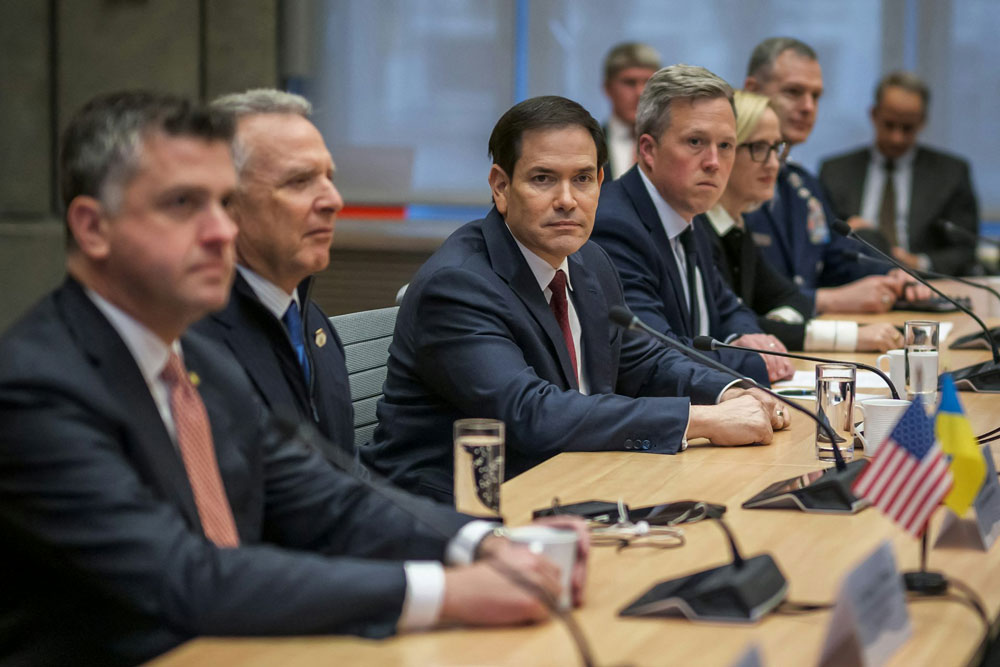
There was a fair amount of confusing back-and-forth on Nov. 23 that Rubio had told some senators that, in fact, the plan wasn’t generated by the United States, that it reflected a Russian wish list. The senators revealed this publicly. Then a State Department spokesman called that claim “blatantly false.” You’re a former diplomat. When you see that kind of thing happening, what do you think?
It’s amateur hour. We’ve seen this before. With this administration, it puts a lot of very amateurish people – Rubio’s not one of them – in place in important offices, like Steve Witkoff, the special envoy for Russia and Ukraine who is also the special envoy for the Middle East. And they’ve gotten rid of all the professionals. They either just fired some or ran some off.
So you know, the problem here is implementation. Politicians can have great thoughts, but they usually then turn to the professionals and say, “Here’s what I’m thinking.” The people they would turn to are gone. And that was their own doing – the left hand doesn’t know what the right hand is doing.
How might that affect the ultimate goal, which is peace?
This is a very delicate situation that calls for delicate peace talks from professional diplomats. There are a couple of things that need to happen and aren’t happening very much. First off, this is a war in Eastern Europe. Europe should be very involved now. They lean against Russia, so they probably can’t be honest brokers, but they need to be involved in every step of this process. If there’s going to be any rebuilding of Ukraine, Europe’s going to have to help with that. If there’s going to be pressure on Russia, Europe buys a lot of its goods, especially energy. They’re just a necessary player, and they haven’t been included.

Chip Somodevilla/Getty Images
What else?
The other is that when people have these great ideas, normally they would turn to their professionals. Those professionals would then talk to the professionals on the other side or other sides. Staff work would be done, then your presidents or your prime ministers or your secretaries of state would meet and hammer out the deal.
None of that’s happening in this process. People are having great thoughts and getting on planes, and that’s not a recipe for a permanent peace deal.
Europe is champing at the bit to try to get involved in this, because they’ve got professional diplomats still in place, and it affects them.
Why is this happening now?
The timing of all this is really interesting. Winter’s coming, and Northern Europe, particularly Germany, is very dependent on Russian natural gas to heat their homes. These sanctions against Russia make that difficult. They make it more expensive. Should Russia decide it wanted to play hardball, it could cut off its natural gas in Northern Europe, and people in Germany would be freezing in the dark this winter. This timing is not an accident.
Trump said he wanted an agreement by Thanksgiving. Is that a reasonable requirement of a process to bring peace after a multiyear war?
No, it’s not. I don’t know if they even realize this in the
Trump administration, but that’s another sign – just as we had ahead of the Alaska Summit between Putin and Trump – that this isn’t really about trying to make peace. It’s for show and to get credit. In a war that’s been going on now for almost four years, you don’t say, “OK, within the next week, come up with a very complicated peace deal and sign off on it and it’s going to stick.” That’s just not the way it works.

Donald Heflin is Executive Director of the Edward R. Murrow Center and Senior Fellow of Diplomatic Practice at The Fletcher School, Tufts University.

























Laurel says
First off, every time I see a photo of Rubio, I think he might as well have stamped on his forehead “I know I’m going to hell now!”😒
Our, once, allies are stepping up, and, of course, without us. Trump doesn’t like democracy, he likes authoritarian leaders. That was clear when he, and absurd Vance, ridiculed Zolenskyy, and rolled out the red carpet, literally, for Putin. Tell me again that Trump isn’t Putin’s bitch.
Absolutely disgusting. I hope Zolenskyy doesn’t give in. It’s a terrible situation.
YankeeExPat says
I would be willing to bet my soul that a decade from now it will be revealed that both Donald Trump and Melania Trump were Russian operatives.
The Boris and Natasha of Amerika
https://pin.it/6oK9z2wwX
Laurel says
I wanna know about “Bubba”!
feddy says
Ask Hillary, that has been Bill’s nickname for many years.
Laurel says
Not a problem. If someone is guilty, drag that person out.
What is interesting about what you wrote, is you went straight for the wife, instead of the possible perpetrator. A bit sexist? Tells me a lot!
Bob says
“Tell me again that Trump isn’t Putin’s bitch.”
Woof! Woof!
OaulT says
Let’s be real here. Donald Trump doesn’t care about death and destruction in Ukraine or the fate of Ukranianian sovereignty. but he’s desperate for a Nobel Peace Prize.
Excited by the ‘sucessful’ Gaza Deal Trump decided to revive his abandoned idea of a glorious Trump Ukraine Deal to add to his ‘peace-maker’ credentials, hoping a Ukranian corruption scandal and Russian gains in the east would put Ukraine on it’s back foot.
So to Trump, his 28 point Deal based on Russian demands without Ukranian input would be a winner.and The Team who’d hashed out The Deal in Miami agreed.
(The Team consisted pf 2 US real estate billionaires, a hard right buddy of JD Vance and met with a sanctioned Russian trust fund oligarch/Putin buddy.). .
For once Marco Rubio deserves spme credit. He gave Senators Mike Rounds and Jeanne Shaheen a heads up, explaining the origins of The Plan whily flying to Switzerland to try to rescue The Deal. Rubio met and negotiate with the Ukraians and their Europwan allies (but of course no Russian representative), trying to save Trump’s Deal while Trump sat watching TV and muttered on his social media site about lack of gratitude because His Glorious Deal wasn’t instantly accepted.
And now we wait for the indignation that the Putin-Trump alliance has once again failed to restore Catherine the Great’s historic conquests to Mother Russia
Laurel says
Allow me to sum it up: That black guy, who claims to have been born in Hawaii, got a Nobel Peace Prize. It’s actually that simple.
Michael J Cocchiola says
Trump is opening up Eastern Europe to Russian annexation. Putin will not stop his aggression even if he does get to keep 20% of Ukraine, as in the Trump plan. He’ll come back in 2 years and get the rest. Then set his sights on satellite states like Bulgaria, Moldova, Serbia, and Belarus.
Putin has at least three years to make his moves because Trump will not interfere, and Putin would love to see NATO implode as it will without U.S. intervention. From a national security standpoint, the Trump plan is a disaster.
Skibum says
You can bet your bottom dollar that if both the morally bankrupt occupier of the WH and Putin are pushing this so-called peace plan, then it would be a loser deal for Ukraine in the near term and a threat to NATO countries and all of Europe in the long term. When a murderous, aggressive despot like Putin shows the world that he will not stop invading other countries until he is ultimately successful in remaking a very weakened present day Russia into it’s former “glorious” imperial communist powerhouse, BELIEVE HIM the first time!
Laurel says
Not to mention that Trump is helping Putin to worm his way into South America, our back door.
Pogo says
@Trump and Putin, and US oil magnates and Putin, before Trump
… have been carving up the planet’s polar regions, the arctic, in particular, for decades. Trump 2.0 practically announced the strategy with his naked push for the conquest of Canada, Greenland, and the Panama Canal Zone (kneecap China at PCZ, and by control of the year round ice free polar shortcut for shipping) — duh.
Trump 1.0 foreign policy — made in Texas
https://www.bing.com/search?q=tillerson+russia+highest+honor
Meanwhile, one man is playing winner take all
https://www.bing.com/search?q=china+nuclear+reactor+thorium
Ray W. says
Russian President Putin recently told an audience (translated from Russian): “We have a saying, a parable. Where the foot of a Russian soldier steps, that’s ours.”
The idea military conquest for purposes of sovereign expansion is not new.
In 1776, Adam Smith published his book titled An Inquiry into the Wealth of Nations. Smith’s premise was that other economic inquiries of his day had asked questioned about how the wealthy of his day had acquired their wealth. He went in a different direction. He asked how it was that the poor did not acquire wealth.
That same year, Gibbon published the first volume of two-volume The Decline and Fall of the Roman Empire. He, a British youth on his first trip to Rome, saw goat herding families living amidst the ruins of the Senate complex; he wondered of just how the wealth and splendor of the Roman Empire had been lost.
These two works posed great questions, perhaps many still not yet completely answered today.
Up until the times of publication of these two works, it was widely believed among those few economists of the day that nations acquired wealth by forcefully taking it from other nations, a zero sum form of economics. Nations not only conquered neighboring nations for gold, they conquered them to steal labor. This was how wealth of nations had long been defined and understood before the time of Adam Smith.
Few persons of that day understood that two neighboring countries engaging in the act of producing goods and services for trade and then consuming those traded goods could create wealth without having to forcefully take gold and laborers from neighbors.
But it remains obvious from President Putin’s comment that the idea of gaining wealth by stealing gold and labor from neighbors has never completely gone away.
Over time, mercantilism came to be a preferred form of capitalism, in which exports are to be maximized and imports minimized. Such was 19th century British colonial economic thought. Bring in raw materials from all over the empire and export manufactured items to the entire world.
Winston Churchill understood these competing ideas.
As explained by Barbara Tuchman in her acclaimed history of the early days of WWI, The Guns of August, in the years just prior to WWI, an economic form of thought had matured within English governmental and educational circles, derived from the words of Norman Angell’s 1909 book, The Great Illusion. Angell argued that modern international economic intertwining through trade had made war too irrational and economically destructive to justify any new wars.
Two years later, General von Bernhardi published his book, Germany and the Next War, in which he argued, as Tuchman wrote, the Prussian form of militarism that “[w]ar ‘is a biological necessity’; it is the carrying out among humankind of ‘the natural law, upon which all the laws of nature rest, the law of the struggle for existence.'”
These two books advocated significantly opposite points of view. Had war indeed become so irrational and economically damaging as to prevent any new wars? Was war so deeply ingrained in human nature that new wars were a necessity of the human condition?
WWI broke out. Prussian militarism, war of the type advocated by von Bernhardi, dominated in the beginning. But in the end the allied war effort prevailed, or so the allies thought. The allied effort soon came to be recognized as the “war to end all wars”, in homage to Angell’s influence among allied leaders.
During Armistice negotiations, Churchill railed unsuccessfully against the allied views of reparations. He worried that the Armistice would not break the ideal of Prussian militaristic sovereign expansionism. But Churchill’s understanding of Prussian militaristic sovereign expansionism come to differ from his understanding of the not-yet-existent Nazi nationalism. Churchill detested the new Soviet militarism, too. Following the signing of a peace treaty, Churchill gained a reputation for warmongering as he pushed for British military commitments to the Russian White armies, greatly damaging his political fortunes, but he foresaw the deadly ruthlessness of the Soviet Reds.
In the 1920’s, Mussolini formed a political party on the concept of fascism, which differed from the concept of Nazi nationalism. During the early days of the Caesars, whenever the Roman Senate deemed it necessary to hand off Senatorial powers to defend the empire, they would hand a staff of intertwined vines to the chosen military leaders, with each vine symbolizing those limited Senatorial powers necessary to accomplish that task. Each vine of the twined fasces represented but one of the several powers temporarily gifted to the early Caesars by the Senate. Fascism as it was originally intended was to last only for the term of the mission, with the symbolic staff to be returned to the Senate. Later Caesars never returned the symbolic staffs to the Senate.
In Japan, all political power inhered in the Emperor, with the Emperor handing to the military whatever political power it needed to expand the Empire.
Each form of militaristic sovereign expansionism, be it Prussian, Nazi, Soviet, Italian, or Japanese, meant that wherever a soldier’s boot touched soil, sovereignty followed.
Churchill warned against each of these differing forms of aggressive militaristic expansionism to the point that he spent most of the 1930’s out of the British government, a period he deemed his years in the “wilderness.” The Angellists had prevailed for the moment. Reasoned appeasement for the purpose of preventing war became official British government policy.
When Hitler became Chancellor of Germany, Churchill along with a few Conservative backbenchers raised the call. When the German Army marched into the Ruhr Valley, Churchill along with a few Conservative backbenchers raised the call. When Hitler organized the Austrian Anschluss, Churchill along with a few Conservative backbenchers raised the call. When the Czech government was forced to surrender the Sudeten mountain defenses to Hitler, Churchill along with a few Conservative backbenchers raised the call. When Germany marched into the heart of Czechoslovakia, Churchill along with a few Conservative backbenchers raised the call.
But when Germany invaded Poland, France and England declared war. Churchill was returned to the Navy; his years in the wilderness at an end. Eight months later, the King of England elevated Churchill to the premiership. Churchill announced to the world that England had only one goal, i.e., to extirpate Prussian militarism and Nazi nationalism from the face of the earth. Neither Italy nor Japan had declared war on Great Britain at the time.
At around the same time, Churchill spoke of his vision of a new European order:
On December 12, 1940, he said, in a diarist’s words, “We had got to admit that Germany should remain in the European family; ‘Germany existed before the Gestapo’. When we had won the war he visualized five great European nations: Great Britain, France, Italy, Spain and Prussia. In addition there would be four great confederations: the Northern, with its capital at The Hague; the Middle European with its capital at Warsaw or Prague; the Danubian including Bavaria, Wurttemburg, Baden, Austria and Hungary, with its capital at Vienna; and the Balkan with Turkey at its head and Constantinople as its capital. These nine powers would meet in a Council of Europe, which would have a Supreme Judiciary and Economic Council, and each would contribute men to a Supranational Air Cohort. None might have its own Air Force, but each would be allowed its own militia, since democracy must be secured on a people’s army and not left to the mercy of oligarchs or a secret police. Prussia alone would, for a hundred years, be denied all armaments apart from her share of the Supranational Air Cohort.
“Britain would be a part of Europe, but she would also be a part of the English-speaking world which, as the reward for victory, would alone control the seas, though bound by covenant to respect the commerce and colonial rights of all peoples. Russia would fit into an Eastern Confederation and the whole problem of Asia would have to be faced; but as far as Europe was concerned a system of confederation was necessary to allow the small powers to continue to exist and avoid balkanization. There must be no war debts, no reparations and no demands on Prussia. Certain territories might have to be ceded, and exchanges of population would have to take place on the lines of that so successfully achieved by Greece and Turkey after the First World War. But there must be no pariahs, and Prussia, though unarmed, should be secured by the guarantee of the Council of Europe.”
In January 1943 during the Casablanca conference with allied leaders, Churchill and President Roosevelt issued a joint doctrine that the Allies would never seek Armistice with any Axis power. Each Axis form of government associated with militaristic sovereign expansionism was to be completely destroyed and replaced with a constitutional form of government.
The Soviet form of militaristic expansionism was not listed for extirpation in the Casablanca declaration. The Soviet, nee Russian, form of militaristic sovereign expansionist thought remains unextirpated to this day.
The Ukrainian people understand this; they are fighting for life and sovereignty.
Nearly all of the nations of Europe understand this; they insist that peace can only come from a complete Russian withdrawal from all of the sovereign soil of the Ukraine, including Crimea.
Many American Senators of both parties understand this.
Only the Russian government and the current American executive branch of government are arguing for appeasement of Russian sovereign theft.