



By James Piazza
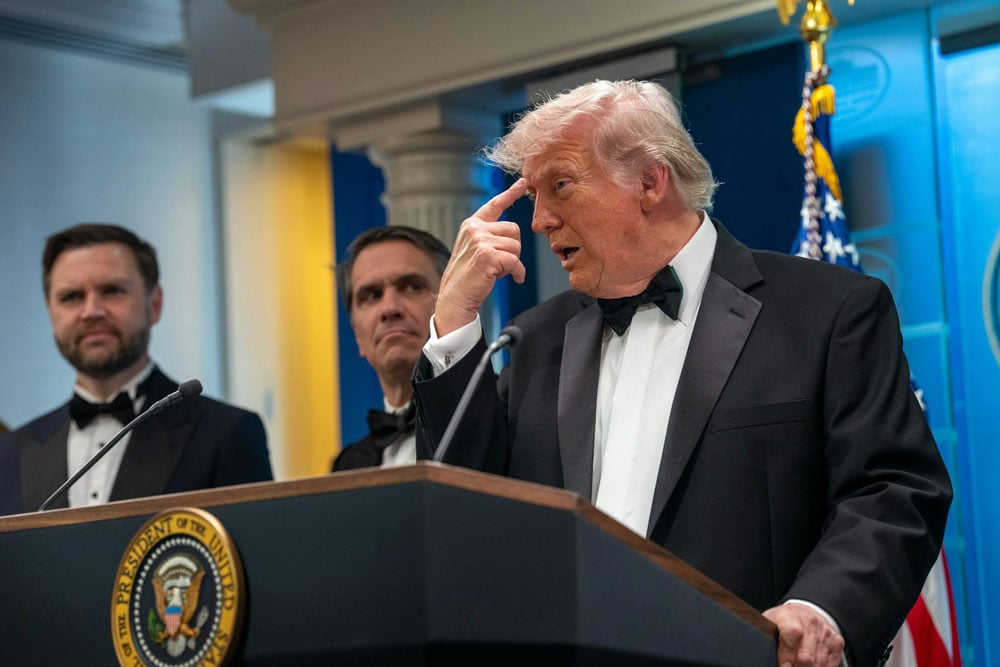
For the third time in three years, Donald Trump has come under threat by an attacker. Many facts remain unclear after a gunman stormed the Washington Hilton on April 25, 2026, during the White House Correspondents’ Association dinner.
As the investigation into the shooting continues, Alfonso Serrano, The Conversation’s politics and society editor, spoke with James Piazza, a political violence scholar at Penn State, about what is driving the rise of political violence in the U.S. and what can be done about it.
This is not the first time Trump has faced political violence. What stands out after the latest attack?
I think the events of April 25 underscore how dangerous this political moment is in the United States. For the past several years – certainly since Jan. 6, 2021 – the U.S. has been experiencing a period of increased political violence, which is generally defined as violence that is motivated by politics or is intended to communicate a political message or achieve a political objective.
Researchers at the Polarization & Extremism Research & Innovation Lab have documented that political violence has increased in the U.S. in recent years. Several recent examples come to mind: the Jan. 6, 2021, insurrection at the U.S. Capitol building; multiple assassination attempts on President Trump; the deadly attacks on Minnesota lawmakers Melissa Hortman and John Hoffman that left Hortman and her husband dead; the attempted murder of Paul Pelosi; the assassination of Charlie Kirk. In my home state of Pennsylvania, Gov. Josh Shapiro was targeted in an attack on the governor’s mansion.

AP Photo/Allison Robbert
What’s driving that apparent plague of political violence afflicting the country?
There are several important drivers of political violence at work in the U.S. today, according to my own research and research by other scholars. The United States is currently very politically polarized, meaning that Americans are sharply divided against one another along partisan lines. They are suspicious and hostile toward one another, and this produces a tense and volatile environment for politics and public life. This has produced a “zero-sum” environment in which every election and political contest is a “do or die” moment.
What stands out to me is the moral dimension of polarization in the U.S. Each side views members of the other party not as merely having a different view on politics but rather as evil or immoral. The polarized environment has made political violence more normalized. It has also dampened public backlash against political violence when it occurs. This makes political violence more likely.
Political rhetoric has become much more divisive and violent in nature. This works hand in hand with polarization and helps to further normalize political violence. In particular, when politicians use demonizing or dehumanizing rhetoric to attack their opponents – for example, using words that depict their opponents as subhuman – this fosters extremism and helps motivate extremists to hurt their opponents physically.
Disinformation is also an important driver of political violence. A number of people who have engaged in recent acts of political violence seem to have been motivated by conspiracy theories and other forms of disinformation, often gleaned from social media. Disinformation plays a particularly important role in the context of social media communities, where people are exposed to large amounts of disinformation and are hermetically sealed off from other sources that might challenge their worldview. This facilitates radicalization and has been shown to fuel political violence in some cases.
Finally, I think an important factor is also the current assault on democratic norms and democratic institutions in the United States. U.S. democracy is experiencing pressures that are unprecedented in the modern era. This has had a very damaging effect on Americans’ trust in government, confidence in democratic institutions and value for democratic rule itself.
My work shows that individuals who are skeptical about democracy are much more likely to express support or tolerance for political violence.

Mandel Ngan/AFP via Getty Images
How does this moment of political violence stand out from other violent periods in U.S. history – are we in uncharted waters?
While the U.S. is currently experiencing an uptick in political violence, unfortunately it is not unprecedented. One example would be the highly polarized period in the 1850s in the run-up to the Civil War. In this era, there was a sharp division between abolitionists and advocates of slavery. This culminated in political assassinations, an assault on an abolitionist member of Congress by a pro-slavery member of Congress, and a bloody civil conflict in Kansas between pro- and anti-slavery armed groups.
The early 1900s, right after World War I, saw another increase in political violence due to labor issues and violence by the second generation of the Ku Klux Klan.
Finally, the 1960s also saw a period of intense political violence surrounding opposition to the Vietnam War and backlash to the Civil Rights Movement.
Though there are some unique features about political violence today – namely the influence of social media – I think we can look for some parallels in these early periods of political violence.
Any last thoughts?
I believe it is absolutely critical that both Democratic and Republican politicians – politicians from all sides – unite to condemn this attack and all political violence. Political commentators and influencers can also condemn this and all use of political violence.
Research amply shows that what political elites – politicians, political leaders, media commentators, online influencers – say in the wake of these sorts of events has a huge effect on citizens’ attitudes. Political elites can adopt rhetoric that does not normalize this sort of behavior.
If the message comes from across the political spectrum, it will be that much more effective at reducing the public attitudes that nurture political violence.

James Piazza is Liberal Arts Professor of Political Science at Penn State.




























Samuel L. Bronkowitz says
Ah yes, probably one of the most inept false flags ever. Literally broadcast in advance and handled like a WWE event.
Skibum says
The rot starts at the very top. Why is it often said that the current president has a “mob boss” mentality? He has stated publicly that he hates his opponents. He vilifies others who do not disagree with him. He has been the most vulgar, contemptable person ever to occupy the presidency. He has called for both imprisonment as well as death for politicians in the democratic political party for no reason other than when they have spoken out against him, taking advantage of their 1st amendment right.
The ONLY time he ever wants violent rhetoric to not be used is when it is turned on him, but he has continued to use threats, intimidation and violent rhetoric toward other politicians, journalists and news media, as well as other world leaders, sovereign countries and entire civilizations.
As far as the act of violence at the correspondents’ dinner on Saturday night, every single politician and administration official in attendance who witnessed the fear on people’s faces as secret service personnel stormed into the ballroom telling everyone to get down on the floor should understand what our nation’s school children have had to endure over and over and over again in school classrooms all over America… for DECADES! While administration officials have their own armed protective details ready to jump in at the first sign of danger and quickly escort their protectees to safety, school kids continue to be slaughtered in mass shootings because politicians are unwilling to enact stricter gun legislation.
And what lesson did the convicted felon president take away from this shooting incident in D.C.??? He said afterward that it justifies the continued building of his big beautiful ballroom at the WH! That is ALL he cares about… himself. Despicable.
And he cannot fathom why unhinged people with guns apparently want to do him harm??? The rot starts from the top!
Sherry says
Thank you Skibum. . . I couldn’t agree more!
Jean Johnson says
This paper is polarizing. I have contacted you before about this. You show no respect for the presidency but print your negative comments that fuel hate.
Pierre Tristam says
This, in exactly this format (yes, it had the bracketed [recipient Name], betraying revealing carelessness), is the email we received from “Jean Johnson” on April 9, which leads me to believe “Jean Johnson” is a) a troll, b) a bot, c) a party faithful assigned to serially target any media that don’t align with the party line or d) an AI serf, e) all of the above. To wit:
Dear [Recipient Name],
I am writing to express my concerns regarding the recent coverage in your publication. I have noticed that your reporting regarding our current president appears to be one-sided.
I believe it is important for reporting to remain unbiased. In my opinion, keeping personal viewpoints separate from news coverage is essential for maintaining journalistic integrity and appealing to a broader readership.
Thank you for your time and for considering this feedback.
Best regards,
Jean Johnson
Ms. Johnson, try thinking for yourself, you might discover that it’s equally virtuous to let others do so as well.
Sherry says
Thank You Pierre, for alerting us to this Bot/non-thinking person. . . same thing!
Gina Weiss says
Pierre,
also can be someone living in another country! Alot of paid trolls
out there.
Skibum says
American citizens can, and SHOULD have respect for the office of president. At the same time, it is ethically and morally right for people to have complete disdain, dissatisfaction, even contempt for an elected president:
1) who has abused the office of president and violated his oath of office
2) who is a 34 count convicted felon
3) who continues to hide the Epstein files, ignoring the victims demands for complete transparency, and who has intentionally and willingly protected those who sexually abused underage girls
4) who has publicly made fun of and has mimicked disabled people, veterans, gold star families and true American heroes like Sen. John McCain
5) who is one of the most unapologetic racist bullies this country has ever seen, referring to immigrants he knows nothing about with disparaging terms such as “rapists” and “murderers” for no reason other than the color of their skin
Should I go on, Jean??? If YOU respect and agree with this despicable man, there obviously must be something terribly wrong with YOU too, dear! Just saying.
Don’t like this news website? GO AWAY! STOP READING IT ALREADY! Buh bye!
Keenan Hreib says
No Jean it is the hateful individual residing in The White House now that shows no resect for the office of the Presidency.
Laurel says
The current President of the United States, Vice President of the United States, Speaker of the House, and so on, do nothing, nothing, NOTHING to bring the American public together. Why? Division works for them. Authoritarian governments need division to survive.
It will cave in on them eventually, but it may take decades to get past the damage done.
Vote for democracy.
Ed P says
Hello Laurel,
Would the left listen?
Sherry says
Thank You Laurel! Well said!
Mike Cocchiola says
If Trump were to be fatally shot, he would be both victim and cause. He’s his own agent provocateur, and his death would be brought about by his own actions.
Since Trump has been on this nation’s political stage, he has engaged in publicly insulting, demeaning, humiliating, and even issuing death threats against his perceived political enemies. He has baked hatred and violence into the political arena like no politician before him. And he is now reaping what he has sown.
Don’t ever accuse Democrats of lighting this fuse. The flame started with Trump.
Ed P says
Hello Mike,
Thanks for clearing things up.
It’s Trump fault.
Got it.
Ed P says
I was being sarcastic.
Blaming Trump is like blaming a scantily clad rape victim.
“Come on man”. “Malarkey”
Jim says
I really don’t understand how you can imply/state that Trump is not one of the major causes of violent rhetoric and actions in this country.
-President Trump accused six Democratic lawmakers of seditious behavior that is, quote, “punishable by death” in an online post, all because lawmakers who have military or national security backgrounds recorded this video speaking directly to service members.
-On the actions of January 6, Trump stated: “That was a day of love from the standpoint of the millions—it’s like, hundreds of thousands—it could’ve been the largest group I’ve ever spoken before.” This after many Capitol Police were injured and four died as a result of that incident.
-March 16,2024: “If I don’t get elected … it’s going to be a bloodbath for the country.”
-September 23, 2023: “This is an act so egregious that, in times gone by, the punishment would have been DEATH.” This was directed at General Mark Milley, then the chairman of the Joint Chiefs of Staff.
-March 24, 2023: “What kind of person can charge another person, in this case a former President of the United States, who got more votes than any sitting President in history, and leading candidate (by far!) for the Republican Party nomination, with a Crime, when it is known by all that NO Crime has been committed, & also known that potential death & destruction in such a false charge could be catastrophic for our Country?” Donald Trump in reference to the investigations into his actions on January 6 and in regards to holding Top Secret papers at Mar-a-Lago.
-November 7, 2022: “You tell the reporter, ‘Who is it?’ And the reporter will either tell you or not. And if the reporter doesn’t want to tell you, it’s bye-bye, the reporter goes to jail. And when the reporter learns that he’s going to be married in two days to a certain prisoner that’s extremely strong, tough and mean, he will say, ‘You know’ … I think I’m going to give you the information.’” Regarding the press publishing information that the government does not want out.
This is a very condensed list of statements Trump has made that imply or flatly state some kind of violent action is needed. I guess he spouts this crap so constantly that some people just get numb to it.
Now, let some moron lefty say something similar and MAGA wants to scream how unjust, unwarranted and unfair it is. All the lefty’s just want violence. The level of hypocrisy is astounding.
I see James Comey just got indicted again. This time for his post “86-47”. I don’t care for Comey but indicting him for that is just absolutely vindictive and insane. But, since that’s the new normal under this DOJ, tell me why Trump should not be held to the same standard, say for the “death” threat to the Senators, for example?
Either we all live under one set of laws for everyone or we live in a dictatorship. Based on what’s been going on, pardon many of us for seeing a wanna-be dictator.
Ed P says
Hello Jim,
No, I did not say Trump is not responsible for a portion of the rhetoric.
I was responding to Mike’s above post that Trump is responsible for the 3 assassination attempts.
Mike stated Trump would be the cause if assassinated.
Let’s extend that logic. If Trump were the cause then everyone who spread any hate, name calling, joke, political cartoon or negative analysis toward Trump
equally shares some small piece as well.
By that logic, a rape victim must have been asking for it!
The whataboutery needs to end. But since you brought it up… did Governor Josh Shapiro recently say “heads have got to roll in this administration”?
Give up the asinine moral high ground and finger pointing. This isn’t Grade school.
Everyone misspeaks and no one is perfect.
And yes, everyone lies. Everyone.
Here’s some reality. The political hatred has gone beyond common decency and human respect. The chronic drumbeat from the left, from mainstream media to fringe left podcasts/websites has enlisted
weak minded people. They are believing they are serving a higher purpose and saving our democracy. It would be patriotic to kill Hitler.
There is a sickness that is so deeply engrained, friendships, marriages, and even family members have been alienated.
Everyone needs to reflect on their own actions and decide going forward for the next 3 years if their political hatred of Trump is going to rot their personal relationships…because it will.
Differing ideologies have existed since the beginning of time. Ask. How did we devolve to this point?
Here’s how. You each allowed it to, you are part of it.
You have no one to blame but yourselves.
Discussing or debating policy is totally different from the current political environment. The left doesn’t even understand their actions because pure hatred has blinded them.
Jim says
It’s absolutely amazing to me that you point to the “left” as the main cause for the polarization/hate we’re seeing throughout the country. Donald Trump is the president of this nation. I don’t know that he has ever made a statement or done anything to turn down the temperature or even act as if he’d like to see both sides come together for the good of the country. He is the “so-called” leader of this nation. In my mind, doing all he can to keep the country together is one of the key responsibilities for the job. His vengeful rants and actions fuel a lot of this hate. Yes, left wing people do make stupid statements that don’t help. But you completely ignore the right wing hate-mongers who leap on every stupid statement made (and sometimes not so stupid) and ridicule and accuse the left of all the violence and claim they alone are responsible.
And that is MAGA’s problem in a nutshell. You all are so convince you are right and everyone else is wrong – and therefore an enemy -that this condition persists.
And speaking of debating the issues (which you did state), where’s any comment from you in response to all the garbage vomited from Trump, some of which I listed above? If you’re committed to debate, I’d expect you either to offer a different perspective, outright deny Trump’s comments incite, or agree Trump is a [large] part of the problem.
Skibum says
Thank you, Jim.
Here’s my message to the convicted felon pedo prez: America wants you out, GONE… 8647!!!
Come at me, motherf****r!
Ed P says
Hello Skibum,
You know what you know.
I thank you for the intellectual stimulation you bring to the comment section.
Quintessential Patriot extraordinaire.
BillC says
@Ed P For your own well being, please stay off the beach. You may not be able to control yourself.
Ed P says
Hello BillC,
Once again, I thank you you for adding so much to the intellectual portion of the debate missing on Flagler live.
BillC says
Go back to your make believe boardroom in your garage. Your comments are arrogant and venomous but you think you’re fooling everyone with your fake impartiality.
Ed P says
Hello BillC.
Alas, you’re the gift that keeps on giving.
Name calling and nonsense.
What you dub as arrogant is quit possibly my inability to hide my frustration from individuals like yourself.
You’ve yet to have any intelligent interaction with me in your last 6 attempts.
Your sticks and stones diatribes are the root cause of what you sense.
BillC says
@Ed P PS Your little rape analogy is sick, twisted and disgusting.
Mothersworry says
Apparently you forgot JANUARY 6th!
He has been doing this for years. He has this country on its heels with his mindless BS. I call it mindless because of those who believe it.
Him and his clowns won’t be happy until there is another civil war. Enough is enough.
Remember its also about Epstein, that isn’t going away no matter who he appoints.
Sherry says
BRAVO Mike! You nailed it!
Laurel says
Mike Cocchiola: You are correct.
https://www.documentcloud.org/documents/6131533-trumpdeathpenaltyad05011989/
Sherry says
Each and every day it astounds me that although we all know that trump constantly spews the most “divisive” rhetoric ever uttered by a president of the US, somehow his sycophant supporters refuse to acknowledge trump’s culpability in dividing our citizens. His passionate maga followers simply join in the bullying “double down” of villainizing each and every person who dares to speak “truth to power” !
Defending a twice impeached guilty sexual abuser, convicted criminal, adulterer, pathological lier at “every turn”, no matter what! That is incredibly divisive, but Maga members somehow simply cannot/refuse to comprehend that fact! Astounding, and beyond any reasonable understanding!
Ed P says
Hello Sherry,
When might we see a policy issue?
Deborah Coffey says
Policy issue: Murdering thousands….in speedboats, on American streets, in concentration camps, in schools in Iran. All policies seem to make the cult deliriously happy and wanting more of the same. Most of us don’t want the murdering to continue. So yes, we speak out against it.
Sherry says
Thank You Deborah! You are most certainly right on!
Me, my time is much too precious to waste it in responding to Maga trolls.
Ed P says
Hello Deborah,
Taking your 1000 murders seriously is beyond any response or lucid discussion.
Your response is not hyperbole or an exaggerated statement.
It pure nonsense.
Skibum says
Oops! So much for Ed P breathlessly waiting to hear about “policy”, then blatantly disregarding the comment about current policy issues! Predictable.
Sherry says
Hi Deborah,
While not “technically” murders. . . I was shocked, but not completely surprised, to see that trump’s policies, during both terms, contributed to the deaths of well over “200 Hundred Thousand” innocent people, and are projected to contribute to the unnecessary DEATHS of “MILLIONS” more within the next 25 years!!!!
Take a good read ALL:
Excess Annual Deaths: A 2021 Lancet Commission report estimated that approximately 461,000 excess deaths occurred annually during the first term of the Trump administration compared to the mortality rates of other G7 nations. For example:
* COVID-19 Response: Studies suggest that 40% of U.S. COVID-19 deaths during 2020—roughly 130,000 to 210,000 lives—could have been averted with an earlier and more robust federal response.
Environmental Rollbacks:
* The rollback of environmental and workplace protections, such as clean air standards, was linked to roughly 22,000 excess deaths in 2019 alone. Further modeling suggests that current rollbacks could lead to 200,000 early deaths in the U.S. over the next 25 years due to increased pollution.
Nutrition and Social Services:
* Proposed and enacted cuts to programs like SNAP (food stamps) are projected to cause approximately 93,000 premature deaths by 2039 due to increased food insecurity.
Global and Humanitarian Impact:
* USAID Shutdown (2025): The abrupt closure of USAID in July 2025 is linked to an estimated 600,000 deaths in the following year due to the loss of lifesaving health and food aid.
* Long-term Global Aid Projections: Researchers estimate that the dismantling of U.S. foreign aid programs could result in 14 million additional deaths globally by 2030, including more than 4.5 million children under the age of five.
* Climate Change: Modeling of increased carbon emissions resulting from the administration’s “anti-green” agenda suggests a long-term toll of 1.3 million additional climate-related deaths by 2115.
Immigration and Border Enforcement Migrant Fatalities:
*Humanitarian groups have reported at least 100 migrant deaths along the U.S.-Mexico border since the start of 2025, though officials note that precise, border-wide totals are difficult to verify due to reporting lags.
Ed P says
Hello Sherry,
I’m unable to verify the claims you posted through any reputable source. They all appear to be estimates that have been loosely assigned to Trumps policies.
Would you be willing to point me in the direction of factual reality so I could do my own due diligence?
Who assembled the information and what publication reported it?
Sherry says
Hey there’s “Nothing Divisive” about trump,s vendetta against James Comey, right Maga right?
Mr. Comey was just indicted again today! Take a good read regarding the “absolutely horrible” thing he did. . . OMG! I guess we are living in Russia now! This from the AP:
The prosecution arises from a May post on Instagram in which Comey shared a photo of seashells he saw on a walk in the arrangement of “86 47.” He has said he assumed that the numbers reflected a political message, not a call to violence. Comey deleted the post shortly after it was made, writing: “I didn’t realize some folks associate those numbers with violence” and “I oppose violence of any kind so I took the post down.”
Nonetheless, Comey was swiftly interviewed by the Secret Service after Trump administration officials asserted that he was advocating the assassination of Trump, the 47th president.
Laurel says
The term “86” means “we are out of,” it does not mean “kill.” As an example, “86 the potatoes” means “we are out of potatoes,” not ” kill the potatoes.”
The head snowflake loves drama.
Skibum says
Absolutely correct! My first real job out of high school was in the restaurant industry, and I have worked in numerous restaurants many years ago. In addition to “86” meaning they were out of a specific item, it was also used when a customer who was out of line for some reason or another was ejected and no longer allowed in the business… he or she was “86’d”. Nobody killed them, they booted them out of the establishment.
That’s exactly what is needed with the current convicted felon in the WH… Americans need to 86 his ass out of the oval office and replace him. At this point, even Daffy Duck will suffice!
Laurel says
The First Lady Snowflake loves drama too.
Sherry says
BTW. . . before Maga starts with their BS. . . Here is the definition of “86”:
Eighty-six is slang meaning “to throw out,” “to get rid of,” or “to refuse service to.” It comes from 1930s soda-counter slang meaning that an item was sold out. There is varying anecdotal evidence about why the term eighty-six was used, but the most common theory is that it is rhyming slang for nix.
bob says
The way i see it…. Seeing these Anti Trump cartoons Day afte r day has to mentally affect you. Case in point.. I ran .an acquaintance of mine . He asked me for whom are you voting. I said Trump. I was then sujected to a blistering tirade of Hate and disgust.. Cartoons like this makes you hate and there is never any purposeful discussion Its a one way street Name calling and full of hate.. WAKE UP AND SMELL THE ROSES. THERE IS MORE TO LIFE THAN POLITICS..
Jim says
There is more to life than politics. However, when you have lived your whole life in a democracy – hardly perfect but never have I doubted we would always be a democracy – and that democracy is at risk due to a wanna-be dictator who uses his office to punish his enemies, starts a war without a plan on how he expects to end it, does everything he can to undermine our elections as well as the many, many other despicable things he’s done, I think it’s okay for Americans to be paying a lot of attention. I think if we lose our democracy than life is going to get a lot worse so it’s important to be paying attention.
I’m sorry your acquaintance wasted time subjecting you to “Hate and disgust…”. He should have just moved on as soon as you told him you voted for Trump. As I’ve heard it said, “you can’t fix stupid”.
Sherry says
@ bob. . . and, yet here “you” are defending despicable trump! Perhaps you should follow your own advice. . . Joy! Peace! and Love, bob! Joy! Peace! and Love!
Laurel says
Oh yeah, it’s the cartoons! Not the actions, and words, of Toxic Trump.
Atwp says
Was the attack fake. I don’t know but I believe it was. As long as this country is the laughing stock of the world under Trumps leadership I’m very happy. People don’t like his lying self. He is the worse President in my life time. Have before and will say again where Trump goes chaos follows. Gas prices up again, thank you Republican Party.
Sherry says
OM Goodness. . . Does that complete “Egomaniac” just have to put his picture and name on absolutely “EVERYTHING”??? Completely Disgusting!
WASHINGTON (AP) — The State Department said Tuesday that it is preparing a limited release of commemorative U.S. passports celebrating America’s 250th birthday that feature a picture of President Donald Trump, who would be the first living president to be featured in the travel document.
The concept for the special passport, including a rendering of Trump’s stern-looking visage, had been under consideration for months before finally being approved late Monday. Between 25,000 and 30,000 of the new passports will be available to applicants at the Washington, D.C., passport office beginning shortly before July 4.
Laurel says
Ew.
Would it be illegal to draw on it?
Canada is accepting applications for citizenship by those who have relatives born in Canada. They already have thousands of applications.
Voter says
Our country is no longer respected around the world; our country isn’t safe because of the division our current administration has caused.
Prices are rising every day and there is no end in sight. Trump lied to the American people and has done nothing to lower the cost on the people as he promised to do on day one if elected.
All we hear about day in and day out is him building his gold ballroom or building an arch in his honor. It is all about for him not for the people.
Get out and vote the Republican party is trying to cheat to win. They know they’re going to lose in upcoming elections, or they wouldn’t be trying to cheat as hard as they are.
George says
We are living in Trump and his families Reality Show and each day the American people suffer more as our taxpaying dollars make him and his family richer and richer.
Do they care about us paying higher prices, absolutely not they are saying suck it up if you a true patriot.
Wake up to this Reality Show because it isn’t going to get better for the people or our country.