


By Farah N. Jan
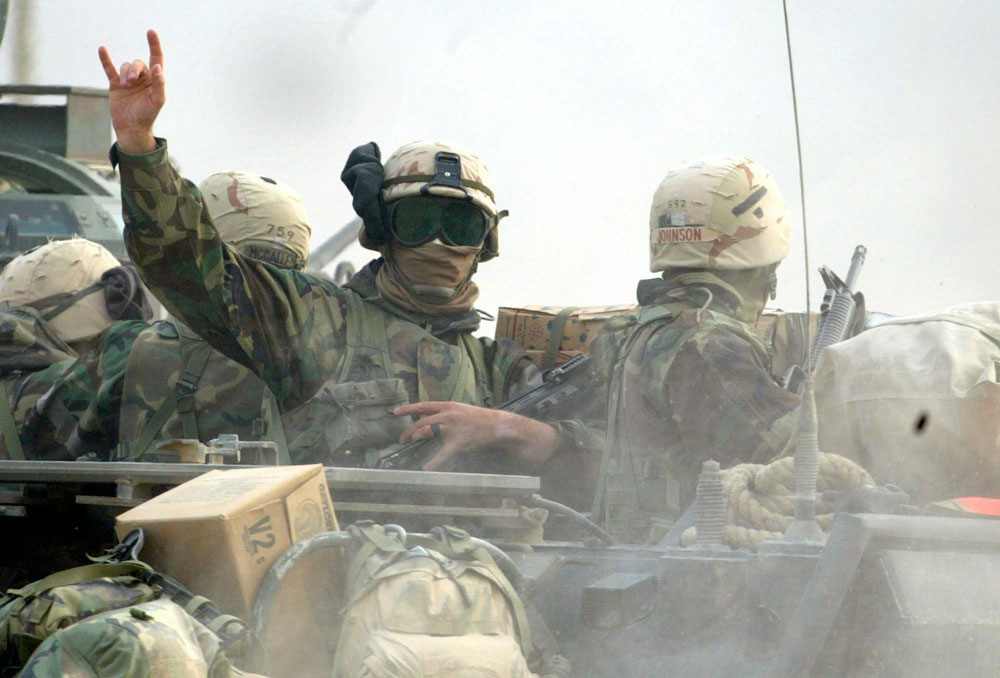
The United States military achieved every objective it set when it went to war in Iraq in 2003. Decapitation: Saddam Hussein was captured, tried and hanged. Air dominance: total, within days. Regime collapse: The Iraqi government fell in 21 days.
Now, consider Iraq more than 20 years after the U.S.-Iraq war. Iraq is still an authoritarian state governed by political parties with deep institutional ties to Tehran. Iranian-backed militias operate openly on Iraqi soil – some holding official positions within the Iraqi state.
The country the U.S. spent US$2 trillion and 4,488 American lives to remake is, by any reasonable measure, within the sphere of Iran’s influence.
As an international security scholar specializing in nuclear security and alliance politics in the Middle East, I have tracked the pattern of U.S. military success across multiple cases.
But the military outcome and the political outcome are almost never the same thing, and the gap between them is where wars fail.
Two and a half millennia ago, Thucydides recorded the Athenian empire at its most confident in his “History of the Peloponnesian War”: “The strong do what they can and the weak suffer what they must.” Athens then destroyed Melos and launched the Sicily Expedition with overwhelming force and no coherent theory of governance for what came next.
The lesson, then and now, is not that empires cannot destroy. It’s that destruction and governance are entirely different enterprises. And confusing them is how empires exhaust themselves.
The U.S. military can destroy the Iranian regime. The question that the Iraq precedent answers – with brutal clarity – is what fills the power vacuum when it does?
The military and political ledger
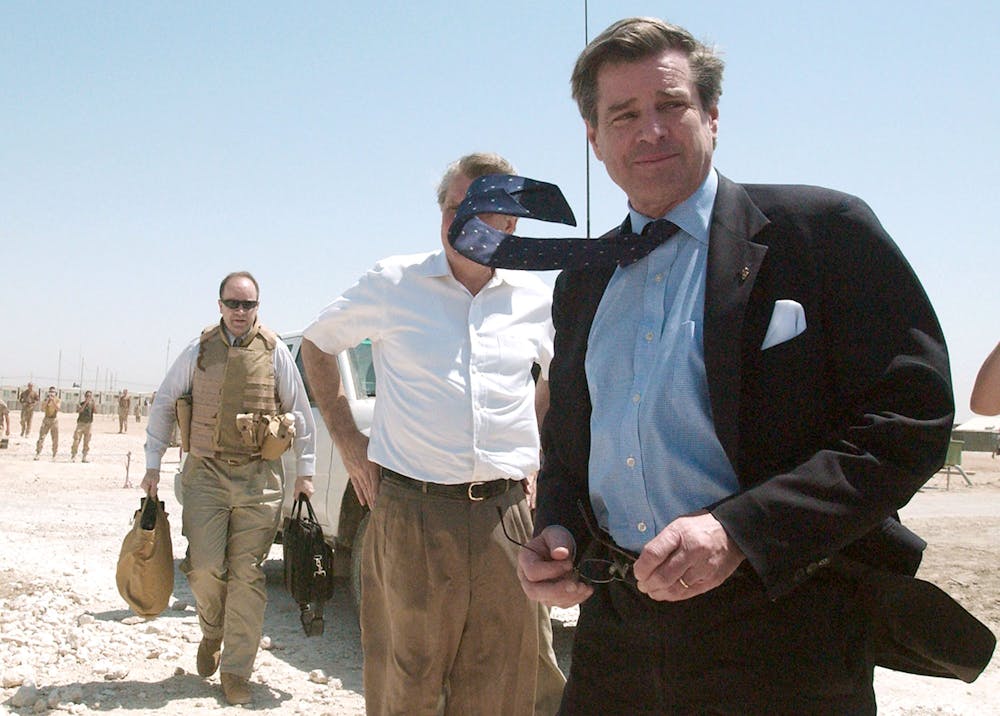
In April 2003, American L. Paul Bremer arrived in Baghdad as the head of the Coalition Provisional Authority, which served as a transitional government, and issued two orders that would define the next two decades.
Order 1 dissolved the ruling Baath Party and removed all senior party members from their government positions, purging the administrative class that ran its ministries, hospitals and schools. Order 2 disbanded the Iraqi army but did not disarm it. Approximately 400,000 soldiers went home with their weapons and without their paychecks.
Washington had just handed the insurgency – the Sunni-led armed resistance that would turn into a decade-long war – its recruiting pool. The logic behind Bremer’s de-Baathification was intuitive: You cannot build a new Iraq with the people who built the old one. The logic was also catastrophic
AP Photo/Wathiq Khuzaie
Political scientists have long observed that countries are held together not by ideology but by organized coercion. That is, by the bureaucratic machinery, institutional memory and trained professionals who keep the lights on and the water running. Destroy that machinery, and you do not have a clean slate. You have a collapsed state, and collapsed states do not stay empty of leadership.
They fill, and they fill with whoever has the most organizational capacity on the ground. Iran had been building that capacity in Iraq since the 1980s, cultivating Shia political networks, exile parties and militia groups during and after the Iran-Iraq War and beyond with the explicit goal of ensuring a post-Saddam Iraq would never again threaten Iranian security.
Tehran did not need to build infrastructure in Iraq after the U.S. invasion, because it had spent the previous two decades building it. When the old order collapsed, Iran’s networks were ready.
The opposition the U.S. had cultivated in Iraq – Ahmed Chalabi and the Iraqi National Congress – had Washington’s ear but no Iraqi constituency. They had not governed the country, or built networks inside it.
The lesson is that military success created the precise conditions for political catastrophe, and that chasm is where American strategy has gone to die – in Iraq and in Libya, where the Obama administration helped bring about regime change in 2011, but where political instability has endured since. And perhaps now in Iran.
The vacuum is not neutral
The fundamental misunderstanding at the heart of American regime-change strategy is the assumption that destroying the existing order creates space for something better.
It does not.
It creates space for whoever is best organized, best armed and most willing to fill it. In Iraq, that was Iran.
The question now is who fills it in Iran itself.
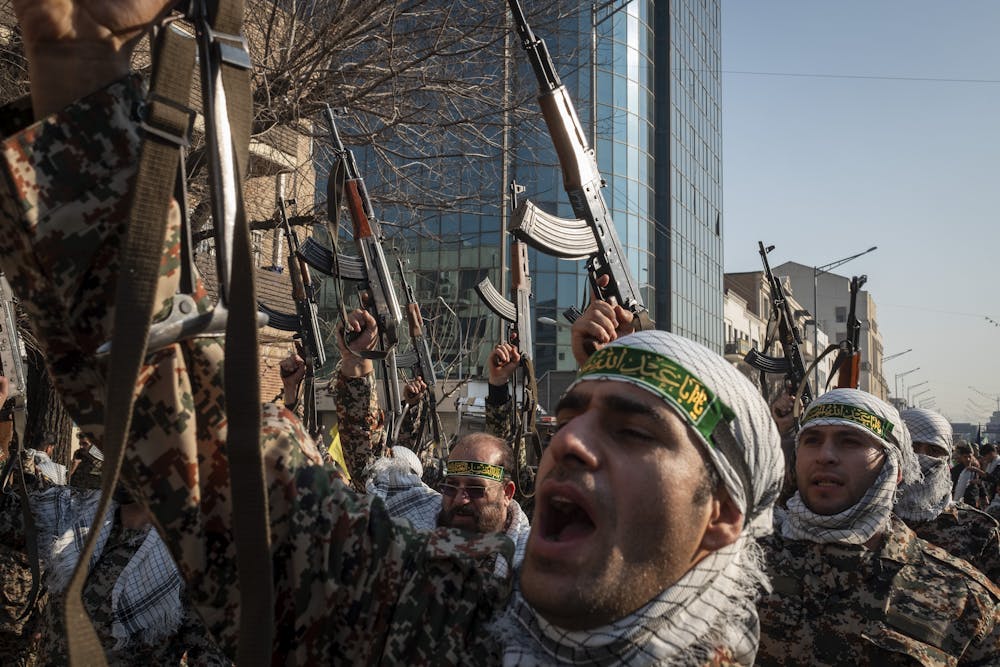
In Iran, the group that meets all three criteria – organized, armed and willing – is the Islamic Revolutionary Guard Corps. The Revolutionary Guard is not simply a military institution. It controls an estimated 30% to 40% of the Iranian economy and runs construction conglomerates, telecommunications companies and petrochemical firms. And it has cultivated a parallel state infrastructure for decades.
Since Ayatollah Ali Khamenei’s death at the start of the U.S.-Israeli bombing campaign, the Revolutionary Guard has taken effective control of decision-making. As one Iran expert told NBC News: “Even if they replace the supreme leader, what is left of the regime is the IRGC.”
The succession confirmed it: Mojtaba Khamenei, with deep ties to the Revolutionary Guard, was named supreme leader on March 8, 2026. It’s a Revolutionary Guard-backed dynastic succession that represents maximum continuity with the old regime, not regime change.
You cannot dismantle the Revolutionary Guard without collapsing the economy, and a collapsed economy does not produce a transition government; it produces a failed state. Washington has already run that experiment in Libya.
You cannot leave the Revolutionary Guard in place without leaving the regime’s coercive core intact. There is no clean surgical option of dropping bombs, killing certain people and declaring it a new day in Iran.
The Iranian opposition in exile, the Mujahedeen-e-Khalq; the monarchists who support the return of the late-shah’s son to lead the country; and the various democratic factions all present the same problem Chalabi did in 2003: Washington access, no domestic legitimacy.
Morteza Nikoubazl/NurPhoto via Getty Images
The Mujahedeen-e-Khalq is listed as a terrorist organization by Iran and is widely despised inside the country. The monarchist movement has not governed Iran since 1979, and its corrupt, despotic leader was overthrown in the revolution. The democratic reform networks that had been building momentum inside Iran were not saved by the U.S. strikes. The regime had already crushed the movement in January, detaining and killing thousands.
Decades of research on rally-around-the-flag effects confirm what common sense suggests: External attack fuses regime and nation even when citizens despise their leaders. Iranians who were chanting against the supreme leader are now watching foreign bombs fall on their cities.
Iraq in 2003 had 25 million people, a military degraded by 12 years of sanctions, and no active nuclear program. Iran has 92 million people, proxy networks that would not disappear if Tehran fell – in fact, they would activate – and a stockpile of over 880 pounds of highly enriched uranium that the International Atomic Energy Agency has been unable to fully account for since the 2025 U.S. and Israeli strikes.
The question Washington hasn’t answered
Who governs 92 million Iranians?
President Donald Trump has said whoever governs Iran must receive Washington’s approval. But a veto is not a vision.
Approving or rejecting candidates from Washington requires a functioning political process, a legitimate transitional authority and a population willing to accept an American imprimatur on their leadership — none of which exists.
Washington has a preference; it does not have a plan. If the objective is eliminating the nuclear program, then why does Iran still hold an unverified stockpile of weapon-usable uranium eight months after the 2025 strikes? The strikes have not resolved the proliferation question. They have made it more dangerous and less tractable.
If the objective is regional stability, why has every round of strikes produced a wider regional war?
Washington has no answer to any of these questions – only a theory of destruction.
Farah N. Jan, Senior Lecturer in International Relations, University of Pennsylvania
This article is republished from The Conversation under a Creative Commons license. Read the original article.

Farah N. Jan is Senior Lecturer in International Relations at the University of Pennsylvania.



























Pogo says
Farah N. Jan is Senior Lecturer in International Relations at the University of Pennsylvania
and
https://www.arabnews.pk/authors/dr-farah-jan
A word; and reminder.
https://www.google.com/search?q=transparency+definition
I met a traveller from an antique land
Who said: Two vast and trunkless legs of stone
Stand in the desart. Near them, on the sand,
Half sunk, a shattered visage lies, whose frown,
And wrinkled lip, and sneer of cold command,
Tell that its sculptor well those passions read
Which yet survive, stamped on these lifeless things,
The hand that mocked them and the heart that fed:
And on the pedestal these words appear:
“My name is Ozymandias, King of Kings:
Look on my works, ye Mighty, and despair!”
Nothing beside remains. Round the decay
Of that colossal wreck, boundless and bare
The lone and level sands stretch far away.
— Percy Shelley, “Ozymandias”, 1819 edition
https://en.wikipedia.org/wiki/Ozymandias
EC: File
Al says
When ww1 ended we didn’t occupy and rule until it was stable. That was the beginning of ww2 . At the end of ww2 we occupied Japan and Germany until they were stabilized and it worked out well. We negotiated the end of the Korean war and it still goes on. We negotiated the end of Nam and it didn’t workout for the south. We didn’t do a complete job of nation building in Afghanistan or Iraq and they became disasters. In most of these cases it was protest and rioting from the left that caused ignorant politicians to retreat and nothing gets solved. Why didn’t we negotiate the end of the Civil War, if we had it would still be fighting it. The problem is the desire for a quick solution which never works as there has to be ar least one generation to pass before things change.
The other solution would’ve been to let them fire a nuke into California. That would have destroyed some beautiful redwood trees and damaged nice scenery. That thought alone should get the lefts support.
PaulT says
In 1945 the US fire bombed Tokyo killing 100,000 civians then dropped atomic bombs on both Hiroshima and Nagasaki causing 250,000 more Japanese civilian deaths, And yes there was unconditional surrender followed by a successful US occupation.
By the end of the war in Europe in 1945, Allied strategic bombing had ,devastated Germany’s major cities and killed 400,000 t0 600, 000 civilians prior to Germany’s unconditional surrender. The US, Britain and France successfully occupied two thirds of the country,
one third of Germany along with a number of Eastern European countries were occupied by the Soviet Union, the success of that occupation is a subjective judgement.
But the real reason those pos-war plans were successful is because the US spent $millions to help rebuild industry and infrastructure in both defeated countries.
As you say the aftermath of the Iraq and Afghanistan wars was a failure, because the US attempted regime change but hid in protected camps such as the Green Zone and Bagrma air base while attempting to control an undefeated opposition.
In Iran the US and Israel want regime change and de facto control of the country but do you suggest that the US should carpet bomb Iranian civilians to destroy their homes and morale in pursuit of that aims?
Even then are you confident a long term US occupation of Iran would be tolerated by the American population. Would the rebuiding and modernizing of Iran’s infrastructure and industry, paid for by the US taxpayers happen if that might ensure a lasting peace?
Would that suit Donald Trump’s ‘for profit’ political agenda or please his ‘America First’ base?
Be realistic.
PaulT says
I had to check who wrote this article, it reads like an essay by John Bolton.
The parallel between the Iraq war and Trump’s war on Iran is apt, the excuse for war is similar but the alignment is different. The current aggressors are Israel and the US. The Gulf States have beed dragged in and while there was softening of their enmity for Israel the destruction of the Gaze Strip has reversed that progress.
Iran’s influence in Iraq certainly grew prior to the Iraq War but the alignment was religious as much as political. Both Iran and Iraq are Shia Muslim majority countries and share some of that religion’s holy places. Saddam Hussein’s brutal Baathist Iraq was ruled by the Suni minority. The Iranian Revolution saw Shia uprisings elsewhere in the Gulf and an attempt to take over the Grand Mosque in Mecca, the heart of Islamic devotion.
The Israeli – US war is against Iran but post-war the US has to be sensitive to religious alignments between not just religions but also sects.
Most Americans are familiar with Alexander Dumas’ story of ‘The Three Musketeers’. ‘The Musketeers’ were involved in the Siege of La Rochelle part of the Catholic French King’s desire to eradicate the Hugenot Protestant sect in that region of France. The siege took place during The Thirty Years War, a sectarian religious conflict between Christians, Catholics against Protestants and was probably the most devastating of the many Europpean Wars.
Trump needs to take care. Hegseth and many Islamaphobes and supporters of Israel have characterized the war against Iran as a ‘holy war’. This rhetoric is dangerous, it could rekindle religious strife across the region and beyond.
Does Trump have the sense to stamp that out or will his instinct be to encourage divisive chaos rather than tame it?
Ray W. says
FOX News reports that on March 11, a single Iranian or multiple Iranians remotely controlling unmanned small wooden craft laden with explosives and disguised as fishing dhows struck two oil tankers in the Strait of Hormuz. The reporter dubbed them “suicide skiffs.” Per the reporter, large craft can be targeted by patrolling American air assets, but 50 or so remote-controlled small craft are not so easy to stop.
Make of this what you will.