



Note: An English translation of the story discussed below is available here: François de Rosset, “Of a Brother and Sister’s Incestuous Love and Tragic End.”

On December 2, 1603, a young woman and her brother were led to the scaffold on Place de Grève in Paris. Marguerite de Ravalet was 17, Julien was 21. They had been lovers–before and after their marriages to others. Marguerite had just given birth, though she’d been separated from her husband for over a year. They were tried and condemned to die.
Place de Grève is today the Place de l’Hôtel-de-Ville, or City Hall. It had been the city’s torture and execution grounds since the Middle Ages. It was where books, heretics, criminals and political prisoners were burned, where in more civil times people met to chat and the unemployed gathered to seek work, hence the French terms for going on strike: faire la grêve (literally, to grêve). It was Paris’s most happening place for free entertainment.
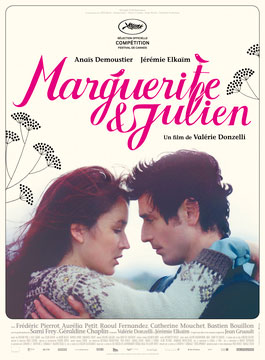
 The siblings were beheaded–not so much for incest but because, as the king told their father when he pleaded for his children’s mercy, they had sinned outside of marriage. The king would have spared their lives otherwise. Throngs of spectators lured by the titillating subplot and the seductive sight of the lovers, both of whom looked ravishing, were torn between sympathy and sanctimony. Among them were a state official and a scandal sheet’s reporter who left written records. Several writers, among them François Rosset in 1619, John Ford in 1626 and Barbey d’Aurevilly in 1882, have turned the story into literature. In 2015 a French production turned a 1,575 percent profit on a low-budget but pretty bad movie called “Julien and Marguerite” (you can see it in full here with English subtitles).
I lucked into Rosset’s story after recently buying an 1,810-page volume of 17th century French short stories (Nouvelles du XVIIe siècle in the 1997 Pléiade edition), itself a chance discovery. I had been under the chauvinistic assumption, reinforced by teachers and read in many star-spangled anthologies that, respectful nods to Chekhov and Maupassant aside, the short story is an essentially American form. It unquestionably has bounties of American perfections, and the world would be poorer without them. But taking ownership of the genre as if it were literary jazz is closer to cultural appropriation than fact when you could call the Persian- and Indian-inspired, Arab-written Thousand and One Nights of a thousand years ago the first anthology of short stories and novellas, if not telenovellas.
François Rosset was born around 1570, becoming a famous short story writer and something of a bestseller with his Tragic Stories, or Histoires tragiques, which had five editions between 1614 and 1620 and 40 more editions through 1757, with translations in German and Dutch. “Of the Incestuous Loves of a Brother and a Sister and of Their Unfortunate and Tragic End,” from 1619, was one of the stories.
 It begins with what appears like an unfortunate comparative choice, at least to our racially-conscious 21st century eyes: “One must no longer go to Africa to see some new monster. Our Europe produces only too many today.” Race-consciousness was an anachronism in Rosset’s day. France considered itself civilized and considered everywhere else not, whatever the creed or color. More specifically, it considered Catholic Christendom civilized and everyone else not. That was the context of Rosset’s line about Africa, as the word “infidel” in the next sentence suggests: “I would not be astonished by the scandals that occur there every day if I lived among infidels. But to see that Christians are tainted with vices so execrable that those who have no knowledge of the Gospel would not dare commit, I am constrained to confess that our century is the sewer of all the villainies of others, just as the following stories bear witness and particularly this one, which I am going to begin to recite to you.”
The indictments are daring. Rosset declares France a cesspool of godless debaucheries unlike any on earth. What could possibly be the vilest debauchery of all? Adelphic incest, or incest between brother and sister, as he’s about to tell us. He calls Marguerite and Julien Doralice and Lizaran. Then page after page, he alternates between condemning them and humanizing them. The condemnations are plugged in like hymns at a church service. Between the condemnations, Rosset makes you fall in love with Doralice and Lizaran and question a judicial system, a king’s devout heartlessness and a nation’s punishing brutality so much as to leave you with little doubt who the perverts are.
Rosset decries social norms that leave a brother and sister in the same bed almost until their teens, as Doralice and Lizaran were, already distancing them from blame: it was their parents’ fault. Lizaran goes off to college for four years. Doralice is courted by “an infinity of cavaliers” but her bourgeois father betroths her to Timandre, an “already grayish” rich neighbor (“déjà grison,” in Rosset’s perfect phrase). Torrents of tears later, Doralice surrenders, and Lizaran is called back to help with the wedding. He and Doralice can’t keep their hands off each other. The family attributes it to sibling love. He promises her never to leave her (“It is almost impossible for me to live without seeing you”) and she decides Timandre will be the ideal cover as their incestuous relations resume.
Auguste and Louis Lumière invented cinema, but not the cinematic technique. Rosset drops words like “so execrable a sin,” “execrable desire,” “cursed passion,” “the horror of such a crime,” and when he has Doralice reflecting on sin, desire and passion, has her confess in her own words, like a girl denuding herself on screen, to her “foolish and incestuous passion,” “so detestable a sin” and “so detestable a crime.” Why so many repetitions? Clever Rosset: the gratuitous and recurring allusions to the absolutely illicit is enough to evoke what cannot be written explicitly, making it that much more sensual. The allusive, condemning words fill the exact role that recurring erotic scenes do in our movies. They add nothing to plot or character. The story has already made the point. But prurience at one level or another is the magnet that keeps us glued–to page or screen, it’s all the same–and the flash of a tit or a tuft of fur in a 2026 Netflix sequence is indistinguishable from how “cursed passion,” “foolish and incestuous passion” and “execrable desire” must’ve read under a candle in 1626 Normandy. Rosset knew how to give his readers what they craved and stay clear of the church censors. He knew cinematography. His words condemn and evoke, decry and describe, each a trigger of the reader’s imagination likely more powerful than what we see on screen.
Rosset’s coded appeal to prurience is a means to his end. The prurience captures the reader, makes her complicit in the pleasures and passions of the siblings. The reader becomes invested in Doralice and Lizaran and more receptive as Doralice pleads, as she might have before the judges: “‘And who can,’ she said afterward, ‘prevent me from loving? Is it not a natural thing? During the time of innocence and when one lived in the Golden Age, did one have all these considerations? Men have made laws for their pleasures, but Nature is stronger than all these considerations. I want to follow her, since she is a good and sure guide of our life.’ Thus spoke this execrable woman, as her brother lived in the same pains.”
How delicious, how leering, that word “execrable,” so that when Rosset then himself pleads that “My design is to depict and make appear the filthiness of vice, and not to defend it,” you’re onto his game. This story is all winks and nudges using morality to condemn its hypocrisies.

The turning point that led to the couple’s downfall is also a surprise. The siblings’ public intimacy had gone unremarked. They may have kissed, held hands, embraced and swooned together, but they kept their clothes on. When a servant discovers them unclothed and in the act, she upbraids Doralice but, loyal to the end, warns her of terrible consequences if she were ever found out by others. It is Doralice who brings about her own downfall: she beats the maid and fires her. Incensed, the maid tattles on Doralice–to Timandre. Hurt, Timandre is not cruel. Not yet. He banishes Lizaran from his estate and threatens harm if he reappears.
The couple can’t stand the separation, and a few months later elope. Timandre reveals the “execrable vileness” to his in-laws. The in-laws are crushed. The story is all over France. Doralice and Lizaran are Bonnie and Clyde without the guns. They dream of escaping to Canada. But Timandre is financing the manhunt. They are nabbed in Paris and brought back to town for their trial and condemnation. By then Doralice is four months pregnant but never accuses her husband, making up all sorts of stories to explain it. The judges decide to wait until she delivers before pronouncing her death sentence as friends, family and others plead for mercy all the way to the king.
Rosset’s art places the reader in different shoes–those of Doralice’s father, of Doralice herself, of the crowd at the execution, each time letting the sympathy crowd out and even shame the sanctimony of shame, down to Doralice’s last plea to the judges: “I confess that I justly deserve death, but I implore you to give it to me the most cruel that can be imagined, provided you give life to this poor gentleman. It is I who am the cause of all the ill. I alone should receive the punishment for it. And then his great youth should touch you to compassion. He is capable of serving his prince one day on some good occasion.”
Nothing doing. The scene moves to the Place de Grève, “full to suffocation.” The crowd weeps at the kids’ beauty–for, really, they were still kids–and Rosset doesn’t spare emotions on their behalf. Almost all gone are the “execrable” and “vile” condemnations (and the titillations), replaced by words like “courage,” “resolution,” “tragedy,” “mercy,” “beauty,” as Doralice wins the crowd’s hearts. Even the executioner is in tears as Rosset delivers one of his most erotically charged and almost unforgivably explicit images even in death: “When this execution was done, one of the valets of the executioner pulled the body aside and, in pulling it, uncovered it up to the mid-calf and showed a crimson silk stocking, which so angered the executioner, who could not contain himself from weeping, with all the assistants, that he pushed his valet with a kick, so that he made him fall from the scaffold down.”
Then was Lizaran’s turn. Rosset should have left the end to the words on the lovers’ tomb:
HERE LIE THE BROTHER AND THE SISTER. PASSERBY, INQUIRE NOT INTO THE CAUSE OF THEIR DEATH; PASS ON, PASSERBY, AND PRAY TO GOD FOR THEIR SOULS.
He provides instead a coda as if cribbed from the sermon of a New England Puritan of the time, boasting of his story as a “Memorable example, which should make the incestuous and adulterous tremble with fear.”
Executions for incest were not nearly as common as the act, whose convenience has ensured its existence since the first hominids. Then as now, when the victims (or perpetrators) are beautiful, rich, young and from the kind of family whose patriarch could get an audience with the sovereign, privilege survived death all the way into literature. Would we have cared as much if Doralice and Lizaran were poor white trash? That version would have to wait until modernism’s defiances and Faulkner’s Quentin, whose unconsummated desire for his sister Caddy is one of the labyrinthine headknockers of The Sound and the Fury.
Maybe the larger question, which Rosset implies with the conclusion that the couple’s lives would have been spared had they not been adulterous, is: what’s the big deal? Art, literature, even theology and law have tended to be more indulgent than dogmatic toward incest, transforming the act from an outright crime, if it were ever so, into metaphor, allegory, parable, and at worst, superstition.
I’m not referring here to criminal acts. It is indisputable that incestuous acts between an adult and a child are among the worst crimes imaginable. But those aren’t “acts” or “relations,” or even incest, as they are rape. That’s how they’re prosecuted. In the main Florida law–to take one example–is relatively mild on incest, and full of outs. It does not distinguish between children and adults, and applies blanketly to any “lineal consanguinity,” whether “brother, sister, uncle, aunt, nephew, or niece.” It’s a third-degree felony, presumably whether the offenders are adolescents, like Franny and John Berry in John Irving’s Hotel New Hampshire, or adults like Siegmund and Sieglinde in Thomas Mann’s “Blood of the Walsungs” (1905).
The theoretical maximum penalty in Florida is five years in prison. The more common penalty is probation and the withholding of adjudication of guilt, assuming the offenders are not criminals otherwise. The more realistic penalty is no penalty at all, because there are no modern records of the “offense” being prosecuted. Marriages of consanguinity are still forbidden, but the Florida Legislature in this spring failed to pass HB 733, which would have added first cousins to the list (which is prohibited in 32 states). Notably, the prohibition is not moral but a matter of health: “There are potential adverse health effects for children born from consanguineous unions,” a legislative analysis of the bill states. That, ultimately, is the only convincing prohibition.
Where the law is merciless, the trials and plea deals frequent and the sentences unforgiving, is when a parent or an uncle or a grandpa sexually assaults a child. But consanguinity is irrelevant in these cases. The charges are rape, molestation, “lewd and lascivious” acts, as they would be without consanguinity. Incest is never charged, again underscoring the near irrelevance of incest as actionable. The taboo’s history has had other purposes.
Like the crowd’s reaction to Marguerite and Julien, incest, or at least what we call adelphic incest–the brother-sister kind–has the curiously conflicted history of a taboo that cannot clearly justify itself anymore than it had been consistently punished even then or before. In the Book of Samuel, Amnon is in love with his sister Tamar, pretends to be ill to trick her into baking something for him, and when she feeds him, he rapes her. His brother Absalom eventually kills him, though it’s never clear whether Absalom is avenging the incestuous act itself or the fact that his sister–as with our French siblings–was premaritally dishonored, or that his brother threw her out in hatred after the act instead of marrying her. King David–Bathsheba’s peeping tom–had been merely “furious” over the whole thing.
In the Catholic church’s canonization hearing for Francis of Assisi, his sister Claire was said to have reported a dream where her brother–and I mean her brother in the biological, not Franciscan, sense–exposes his breast and tells her, “here, suck.” Claire does so and finds her brother’s milk especially sweet, happily nursing on. As with innumerably problematic scriptural passages and theological history, the church rounded that square peg’s hole by translating the vision into a characteristically sexist metaphor: Francis as a church father spiritually nursing his sister. The subtext may be that, unlike Amnon, Francis could resist his sister. But with such a blatantly sensual act, did he really? (I find the metaphor ridiculous for both its sexist and appropriative connotations, as if the church were desperate to outflank a mother’s life-giving powers with a manly teat.)
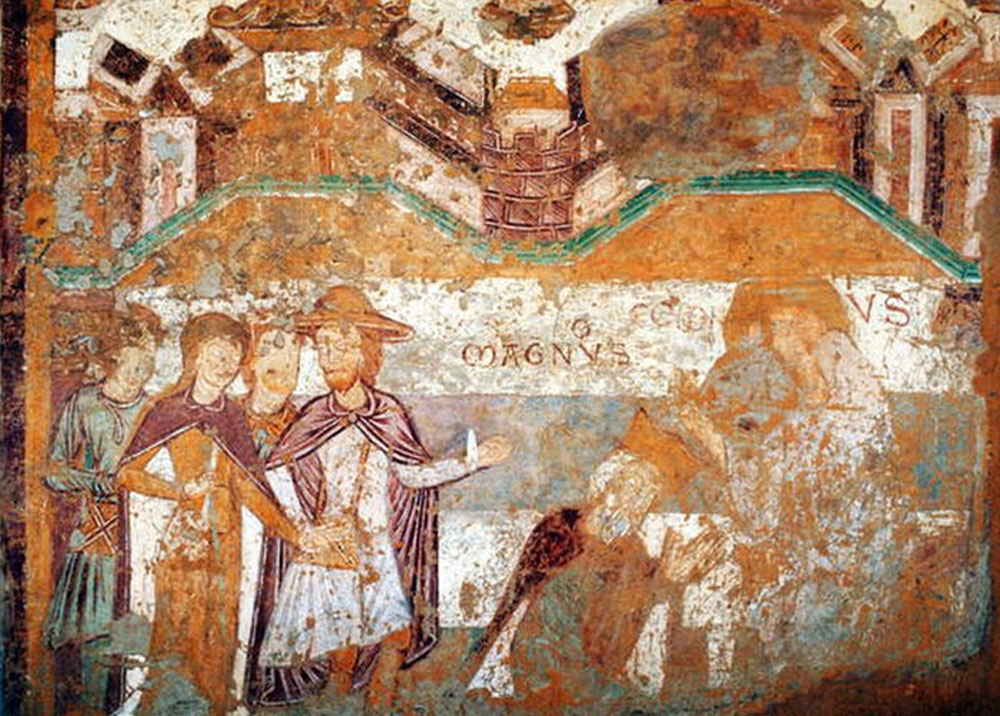
Charlemagne, France’s greatest monarch before Henry IV, lucked out even more when, after giving birth to a child–the famous Roland of the Song of Roland–from a union with his sister Gisèle, he was forgiven by Gilles, the saint. The scene is the subject of a 13th century fresco still viewable in the church of Loroux-Bottereau in France.
In literature there may be accounts as seemingly accusatory of incest as Rosset, but I don’t know of any. Maupassant’s story, “The Port,” features the story of a sailor who frequents a brothel where he finds out that the woman he slept with was the sister he’d left 11 years ago, but you can’t blame the unknowing.
Nabokov and Casanova both wrote science-fiction novels with young incestuous siblings as protagonists who remake their own world: Casanova’s Icosameron is an odd, never-read precursor to Jules Verne’s Voyage to the Center of the Earth, with Edward and Elizabeth somehow shipwrecked amid a colony of small humans at the center of the earth and living 80 years there. (Casanova was a joyful habitue of incest, proudly writing in his memoirs of impregnating his 20-year-old daughter Leonilda when her husband’s impotence failed her. He “liked to play with the idea that the incest taboo was nothing more than an arbitrary convention,” his biographer Leo Damrosch wrote.)
Ada is set in Nabokov’s alternate version of the Earth called Antiterra and follows the lifelong love of Van and Ada Veen from the time they’re 14 and 12, and as in Icosameron, going on 80 years. Robert Musil in The Man Without Qualities, Ian McEwan in The Cement Garden, Arundhati Roy in The God of Small Things have all–among many others–explored the same adelphic theme, mostly as an exploration of isolation, renewal or defiance, never as judgment or sin.
Seen through those prisms the compassion in Rosset becomes more familiar, the judgments set out as nods to convention so he may be free to explore the unconventional. In a story filled with double-entendres, you eventually realize that when he writes that “I am constrained to confess that our century is the sewer of all the villainies of others,” it is just another double-entendre that appears to target Doralice and Lizaran, but that just as convincingly targets their tormentors–Timandre, the church, the king, and a society that (like Saudi Arabia, the Taliban and Pakistan’s tribal regions today) would chop the heads off adulterers with incest as a crowning excuse.
There are no allusions to witches and wizards in Rosset. But there were thousands more executions for witchcraft than for incest in 17th century France, and in the end, but for a sword instead of flames, there is little to distinguish the killing of Doralice and Lizaran from the church’s serial murder of witches. The last witch was burned in France in 1746. I do not know when the last incestuous or adulterous couple had its heads chopped.


























Pogo says
FWIW
https://www.google.com/search?q=consequences+inbreeding
“Sometimes the first duty of intelligent men is the restatement of the obvious.”
— George Orwell
What Else Is New says
Pierre, once again you have regaled your readers with another beautiful literary seminar exploring the beheading and reasoning behind the act for young Doralice and Lizaran. Bringing historical similarities into the mix was of major significance, yet troubling to learn Florida’s outdated laws for adult/child incest. Yet, I loved being caught up in the tale of Dormice and Lazaran hoping they would escape their fate, thus capturing the essence of love.
Would that we sit with you leading a university literary seminar.