



By Christopher F. Meindl
“Behold … a vast circular expanse before you, the waters of which are so extremely clear as to be absolutely diaphanous or transparent as the ether.”
Naturalist William Bartram wrote these words in the 18th century as he gazed in wonder at Salt Springs, located in Ocala National Forest in what is now Marion County, Florida.
Springs are points where groundwater emerges at the earth’s surface, and Florida boasts more than 1,100 of them. North and central Florida comprise one of the largest concentrations of freshwater springs in the world.
Many of these springs provide a home to a variety of wild animals and plants. But they are also canaries in the coal mine for Florida’s groundwater system, because they draw upon the same groundwater that many Floridians depend on for drinking water, farm irrigation and industrial use.
Right now, many Florida springs suffer from reduced flow and habitat loss, as well as excessive algae and heavy pressure from human use. Because most of the state’s springs are not monitored by any research institution or government agency, the full scope of the problem remains unclear.
The state Legislature has designated 30 Outstanding Florida Springs whose health must be protected under the Florida Springs and Aquifer Protection Act of 2016. But 24 of the 30 were impaired by pollution – primarily nitrogen – at the time of this designation, and today, their condition has not improved.
In 2025, 26 of the 30 – the same 24 springs, plus two more – to be impaired.
and my own observation, many other popular springs are impaired by pollution as well. Since 2011, the state of Florida has spent roughly US$357 million on springs restoration.
As a geography professor, I study springs in the context of people and their use of water. My research has taught me that Florida’s springs vary based on location and local circumstances. Because of this, I believe reviving their health will require several multidimensional solutions.
Recalling healthy springs
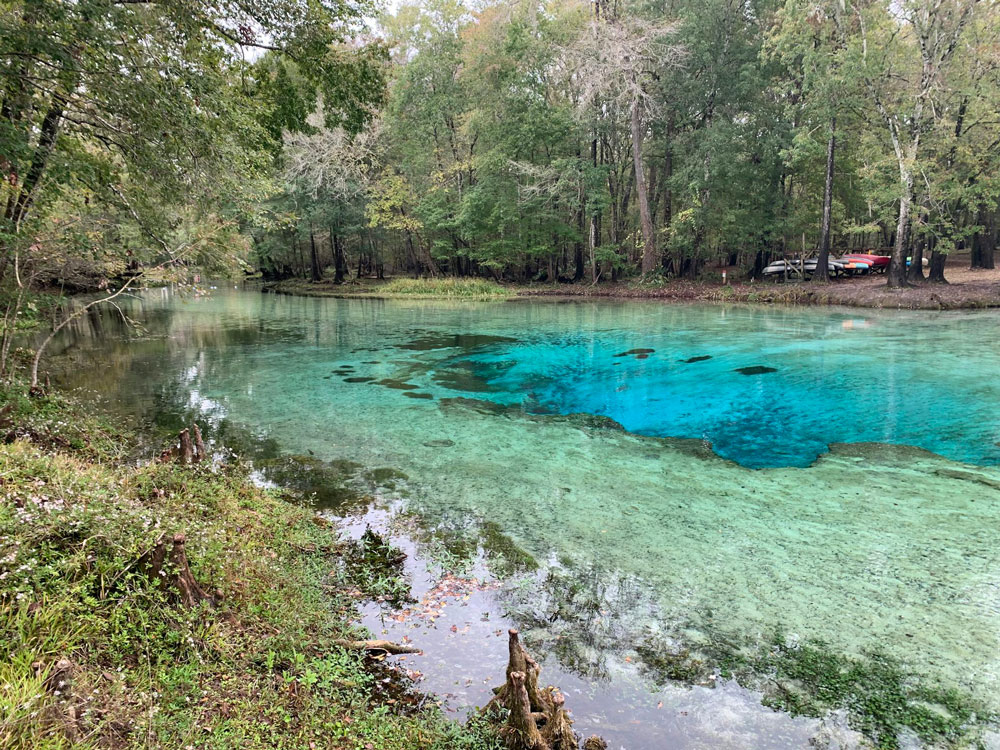
What should a healthy spring look like? The answer to this can be harder to articulate than you might think. Many springs feature a visible boil at the water surface above the spring vent, crystal clear water, submerged grasses waving in the current, and a range of fish, turtles, snails and other aquatic animals hiding in the grasses.
Yet because many springs are changing slowly, changes in flow and water clarity can go unnoticed. Some scientists call this the shifting baseline syndrome: Each generation perceives springs in a slightly more degraded state, but absent prior observations, we assume that what we see is “normal.”
Fortunately, in the case of Florida springs, historical observations from naturalists and area residents give scientists clues going back centuries.
When Bartram visited Manatee Springs near Chiefland and the Suwannee River in the Big Bend in 1774, he wrote that the spring’s flow was “astonishing” and that “it is impossible to keep the boat or any other floating vessel over the fountain.”
Similarly, senior citizens who grew up in north central Florida in the early 20th century told writer P.C. Zick that spring flow at Ichetucknee Springs was once so strong that they could hear the spring boil before getting close enough to see it.
Both springs’ boils are noticeable today, but they are clearly not what they used to be.
When naturalist John James Audubon visited Volusia County’s De Leon Springs in 1832, he found that “The water was quite transparent, although of dark color.” And Bartram wrote of Salt Springs that the water was so clear, he thought he could reach out and touch fish that were 20 to 30 feet below the surface.
Water clarity in thriving springs fosters plenty of submerged grasses soaking up sunshine, along with a wide variety and large number of fish and other aquatic animals that depend on this vegetation. Bartram wrote that he spotted gar, trout, bream, “the barbed catfish, dreaded sting-ray, skate and flounder, spotted bass, sheeps head and ominous drum” at Salt Springs.
State Archives of Florida/Burgert Brothers, CC BY

Christopher Meindl, CC BY
A multifaceted problem
Many Florida springs and their runs now suffer reduced flow, wear and tear from hundreds of thousands of well-meaning visitors, and excess algae.
And while some Florida springs, such as Polk County’s Kissingen Springs, have completely dried up, many more produce less flow than they used to.
It is easy to assume that bottled water companies are the reason for seriously reduced spring flows, and in at least one case, bottling spring water has raised concerns of overuse.
Yet a state report published in 2021 that found that bottlers were permitted to extract just over 5 million gallons per day from Florida’s springs – a tiny fraction of the 2.3 billion gallons of groundwater pumped each day from the Floridan Aquifer, which provides drinking water for more than 10 million people in the southeastern United States.
The most problematic reductions in spring flow are from significant groundwater pumping for agricultural irrigation, heavy urban, mining or industrial water use, or in some cases a long-term rainfall deficit. Various springs suffer from one or more of these problems.
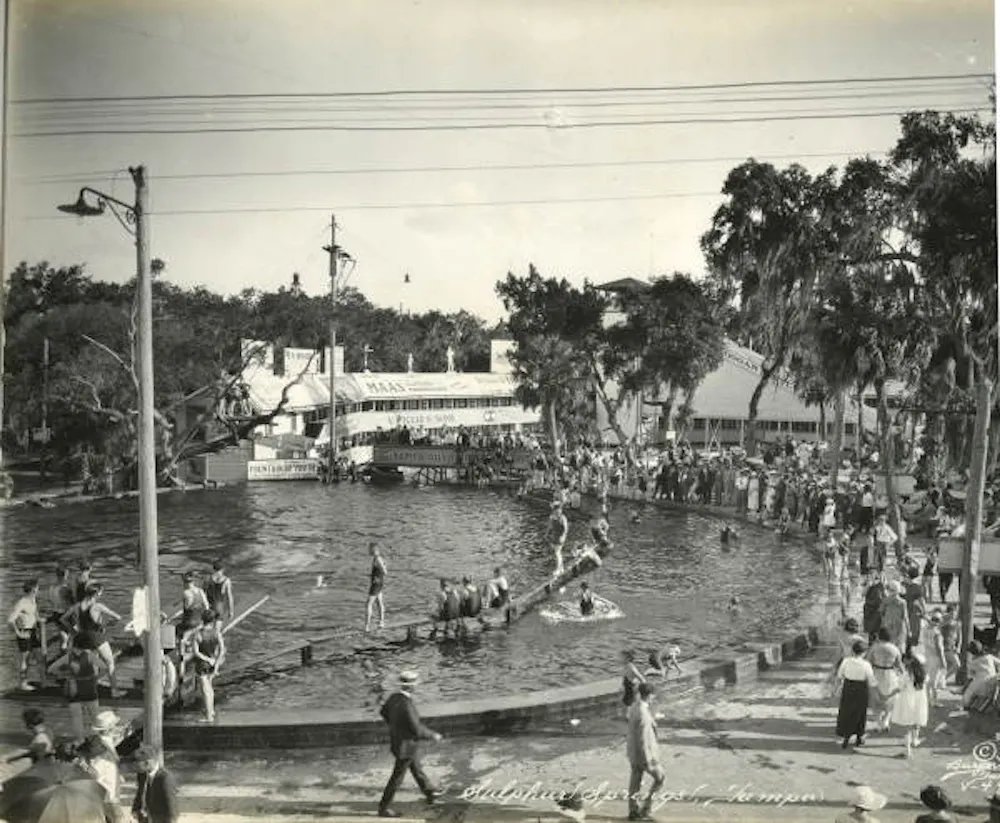
In addition, as Florida’s population and tourism have grown, so have the number of visitors to the state’s most popular springs. In 2019, Florida springs attracted more than 4 million visitors. During the summer, especially on weekends, some springs are so crowded that staff members have to turn away visitors. And in winter, springs that attract manatees can be equally crowded.
In shallow portions of springs and spring runs, this means thousands of happy feet trample and destroy vegetation. And when submerged grasses disappear, so do the aquatic animals that rely on them for food.

Matthew Zorn, CC BY
Unwanted algae
Finally, there is the mystery of excess algae. Algae naturally occurs in most springs, but today, many springs have so much that it clouds the water, or they have stringy filamentous algae that blankets the soil and rocks around a spring and along its run. Still others have algae that sticks to submerged aquatic plants, blocking vital sunlight.
The predominant narrative among many springs scientists, advocates and government officials is that rising nitrate levels in springs over the past few decades fuels the growth of excess algae. Nitrate, a form of nitrogen, is a plant nutrient.
Yet other scientists have suggested that reduced spring discharge creates slower-moving water, which loses its ability to push excess algae away.
Another hypothesis is that if dissolved oxygen levels temporarily fall below a certain threshold, it can kill off the snails and other animals that graze on the algae and keep it in check.
A balanced restoration plan
More than two-thirds of state-funded springs restoration projects over the past decade have been for some form of enhanced sewage treatment. This is because excess nitrogen is assumed to be the cause of excess algae in Florida springs, and Florida farmers are presumed to be in compliance with water quality regulations if they implement best management practices.
Enhanced sewage treatment is a good thing, especially in cases where human waste is clearly a pressing problem. In some cases, investing in advanced sewage treatment, shifting landowners from septic systems to sewage treatment plants or even enhanced treatment of storm water before it sinks into the ground clearly benefits springs.
However, shifting people from septic tanks to central sewage treatment is expensive. Based on the evidence and my own observations of various springs within Florida’s landscape, I believe that many springs need more than this single solution.
Some need shoreline stabilization to prevent erosion or rules that reduce human pressure on spring vegetation. Others need algae or sediment removed and native vegetation reintroduced.
In still other cases, it would help to purchase property to prevent harmful development or to retire farmland. And in nearly every case, the springs would benefit from Florida residents and businesses reducing water and fertilizer use.
And, restoring and maintaining the health of Florida’s 1,100 springs will require further study to tailor appropriate interventions to each one.

Christopher F. Meindl is Associate Professor of Geography at the University of South Florida.


























JimboXYZ says
Let me guess, naturally more money every month & higher taxes are going to reverse this threat ? Maybe if FL wasn’t growing, this wouldn’t be such a big problem ? I can’t imagine anyone swimming at the springs for that use, as cold as it’s gotten since Monday ?
Laurel says
Well, we can never have enough development and tourism, right?
The only life I’ve seen in Salt Springs is mullet and blue crabs. No sheepshead, flounder or skates. Certainly no stingrays!
DeLeon Springs has tons of empty snail shells. We live on top of an underground river, and occasionally find the same shells. Can anyone tell me about them?
Just me. says
Florida municipalities continue to allow building anywhere and everywhere it is destroying the wildlife and all nature in Florida over greed.
Joe D says
The country wide attraction of the WONDERFUL natural resources in Florida for CENTURIES, is becoming the EXACT reason we’re loosing those resources.
There HAS to be a balance of tourism, agricultural use, and residential development, or “soon” (maybe not in my lifetime, but CERTAINLY in my grandchildren’s) those Florida resources will be polluted or simply overused to the point where they are no longer available.
Unfortunately, as is generally the practice here in Florida (and across the country at the moment)….MONEY dictates everything…and in our current administrations (State AND Federal), attitudes that Climate (and resource depletion) are “FAKE NEWS” impeding the chasing of the ALMIGHTY $$$, care for our planet’s resources is almost at the bottom of our priorities list.
Some of those APOCALYPTIC “fantasy” movies of the past (Mad Max/China Syndrome/Andromeda Stain/ Solent Green), might no longer be just FANTASY!
Sherry says
Thank you Joe!
Perhaps watching those old dystopian movies would help the next generations realize just where they are headed when they allow themselves to wallow in their self absorbed techno alternate reality. Certainly my “Baby Boomer” generation is to blame for stupidly putting this planet on the path to self destruction. But it seems the next generations have taken that ball and are now “running” down that path with little consideration for reconnecting with and protecting the environment which is critical to their future lives!
Meanwhile, many of the selfish “Boomers” only care about “saving” their last penny, and to hell with the future of the planet!
We really are living in a de-evolving society!
JimboXYZ says
“Meanwhile, many of the selfish “Boomers” only care about “saving” their last penny, and to hell with the future of the planet!”
One of these days, you’ll come to the realization that saving the planet is just BS that it is. Name one thing that hasn’t cost more money, that has or hasn’t saved the planet ? Boomers worked their lives away in an era of relative affordability. That seems to have gone out the window with home prices doubling up, groceries & cars became increasingly unaffordable. Unaffordable Healthcare, the premiums alone have doubled and they don’t expect anyone to afford procedures that are just as unaffordable. At a certain point, a Boomer is unemployable, too old, a has been to earn a living. Not so in Congress, they seem to prefer to allow napping on the job in those chambers of legislation ? At a certain point it’s about fear of outliving a Social Security Check. With the inflation, credit card debt has never been higher, get to 50-60 years old & face the specter of losing your home that you worked for over unaffordable taxes & home ownership. Maybe pare back your diet from a relatively healthy diet to frozen TV dinners from the grocery store. Eventually forced into an ALF (Assisted Living Faciliy) ir SNF (Skilled Nursing Facility) where the elderly’s own family can’t or won’t visit as the last years tick out of the time bank ? That’s the human/inhumane race in a nutshell. That Covid vaccine, what a fraud that was, a trillion dollar bailout of the healthcare system to create a mRNA vaccine for Covid with the same technique of a flu shot. And that allowed 4 years of Bidenomics & inflation that this nation has never experienced in its existence. I realize California’s ban on ICEV’s isn’t until 2035, But here we are a decade away from that. And there’s going to be a day, that every Californian is going to wake up & realize Gavin Newsom flat out screwed them over the last 4 years. Many will be forced to flee CA for more affordable & sane state economies, if those even exist. Go back a quarter century. More have been left behind, had society tun their backs on them. Then you expect them to be on board with something else they have to go without on a daily basis . Flagler County has food banks, because that’s cheaper than actually paying people to be able to have a real choice & provide for themselves. It is what it is on Planet Earth. They pick the winners & losers. Remember the Biden family got pardons, think any of the rest of us would ? Try not paying your taxes to the IRS, without a legitimate legal tax deduction & to the tune of $ 1.5 million and see where you spend years of your life. This is where we are, where a Pelosi & spouse can insider trade, but you aren’t getting the same information to invest. All the while any 401-K/403-B is leveraged to make those capital gains happen.
As long as the nuclear weapons don’t ever go off, overpopulation is mankind’s worst enemy. Planet Earth doesn’t favor us over any other animal species. If planet Earth had a consciousness like a human being, we all would be a cancer, a virus for our very existences. Fortunately planet Earth is a recycling environment that just happens to do fine with or without human beings, the same life forms that Earth supports. There are 7 other planets that don’t need the human race on it to evolve & exist, the moon in the sky is there to remind us of that. Too many are concerned more about the high tides & global warming. Others just see it as a beautiful source of light for it’s phases.
As human beings, we only matter because we are conscious, even selfish about that consciousness. I got all the answers I needed to know years ago, when anyone of us goes, the world moves on, eventually survivors are erased too. And what is left is perhaps the wikipedia’s for anyone’s existence to remind anyone that we were even here for the years that anyone gets.
Pogo says
@Apparently, something else
… somewhere else, was more urgent.
Deborah Therese Coffey says
A good start would be if we all took better care of our planet. Make THAT the priority instead of making more and more money.
DC says
I can tell you that out local area springs ( although still beautiful) are nothing like they were just 20-25 years ago. The aquatic plants like eel grass is completely gone as well as all the fish by the hundreds or more. So hard to believe as growing up the springs were just so amazing and full of life.
Regardless of the culprit of the decline of their quality, sure would be great to see them thrive again for future generations!
BIG Neighbor says
Maybe the reason a baseline escapes us is because characterizing natural systems change, if there were records, would look more like fuzzy grass rather than a straight line on a graph. If entities like the SJWMD don’t actively monitor/ manage the health of these springs in partnership with local custodians, than maybe we need to question the value of academia as it has evolved to as opposed to what it originally resembled?
Hammock Bear says
Good article that the readers need to know. There is hope for the future of Florida if we work together to learn and repair past mistakes with our environment when possible. We can form groups of people to volunteer to research and share the findings on a list created by those with backgrounds in environmental means of controls that if approved then sent to lawmakers for them to vote. One item could be how to reduce the need for everyday plastic water and food containers that often do not get recycled. Hotels and restaurants seldom offer recycling bins for customers. Less building would be ideal so to save homes of the wild whose land we all now are dwelling upon. Study the main aquafer for our water in Florida and learn when to protect certain areas better. Those a just a few thoughts on a very important topic. Thanks, Mr. Meindl, for your article.
Carolina Tampa says
What policy changes or local actions do you see as the most effective first steps to protect the springs, and how can residents gauge whether improvements are actually happening (e.g., changes in water clarity, flow, or ecological indicators)?