


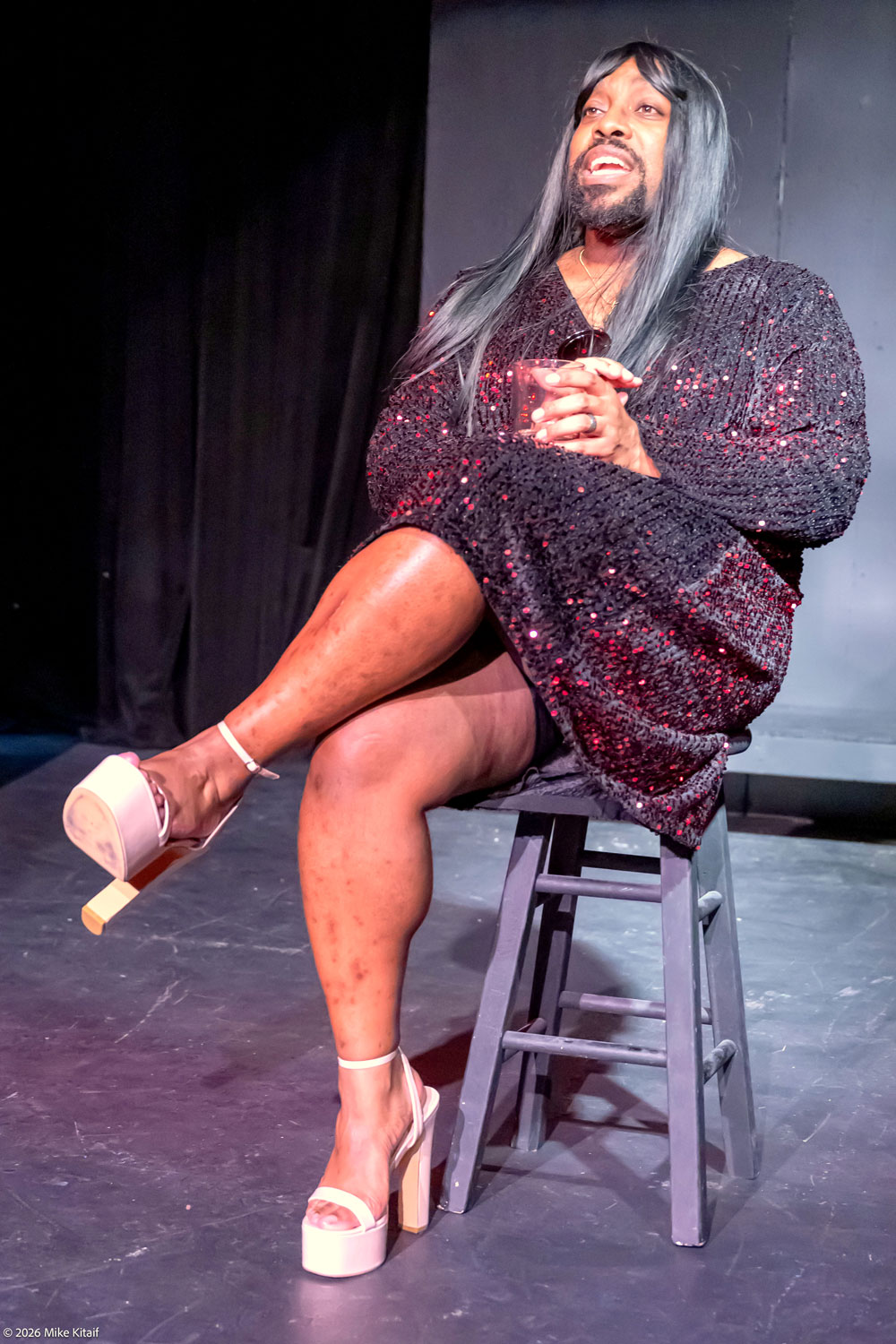
As Miss Roj struts around backstage during a rehearsal at City Repertory Theatre in Palm Coast, she makes a confession: “This is only the second time I’ve worn these heels.”
Miss Roj’s comment will trigger an internal debate in anyone who witnesses her: Which is more improbable – her heels, which are only slightly smaller than the pillars of the Temple of Hercules in Jordan, or her incongruous beard, framed by her long, silvery black hair?
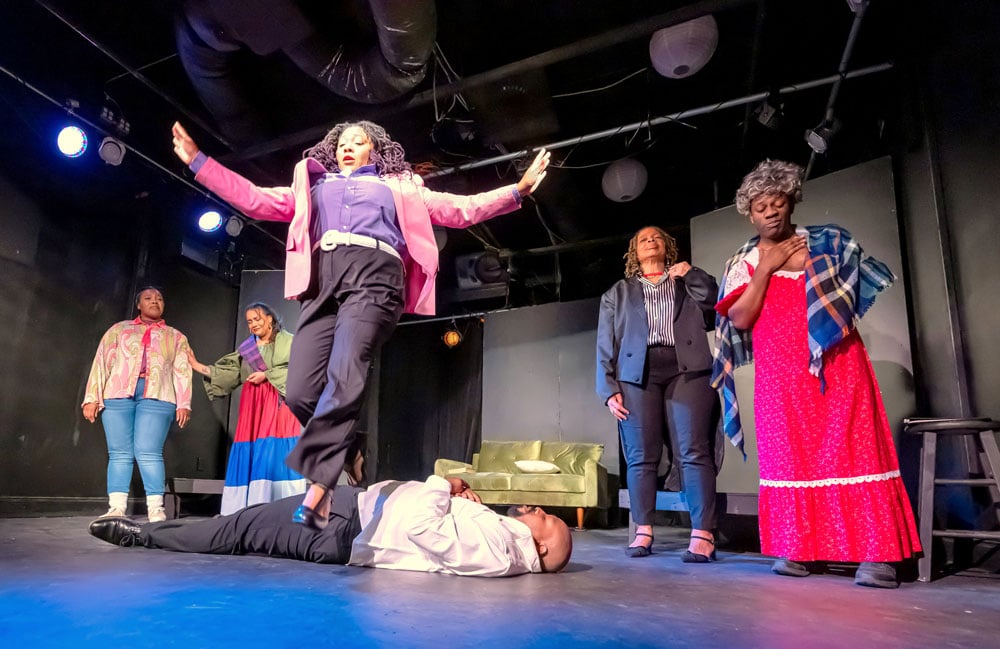
OK, the transgender Miss Roj is actually City Rep veteran actor Kelvin Niebla, who portrays the character in “The Gospel According to Miss Roj,” one of the “exhibits” in CRT’s production of George C. Wolfe’s “The Colored Museum.” The play, which runs Feb. 20-March 1, is this season’s offering in what has become a CRT tradition of celebrating Black History Month by staging a Black-themed play.
Director Sal Jones will be making his City Rep debut. After earning his degree in theater from Monmouth University, Jones owned his own theater company in Lexington, Mass., for 20 years, directing more than 60 plays and musicals before moving to Palm Coast two years ago.
Wolfe’s work, which debuted off-Broadway in 1986, is a freewheeling series of vignettes – those “exhibits” – which mix satire, pathos, slapstick and absurdity (sometimes all at the same time . . . talking wigs, anyone?). It’s all in the service of exploring Black life, Black history, Black culture and Black identity, as well as the stereotypes that have plagued Black people, especially in the 20th century.
Cast member Phillipa Rose, another CRT veteran, sums up the vibe of “The Colored Museum” by comparing it to “In Living Color,” that sketch comedy television series, created by Keenen Ivory Wayans, that ran from 1990-1994. Somewhat akin to the title of the play by the multiple Tony Award-winning Wolfe, the punning title of Wayans’s show was a wink and a nudge to its majority Black cast.
(Millennials and later generations should note that the term “colored” or “colored people” was widely used in the U.S. from the mid-1800s to the 1960s to denote Black people, as was the term “Negro.” Owing partly to the term “colored” being associated with Jim Crow segregation in the early and mid-20th century, the word came to be viewed as derogatory and was superseded by “African American” and “Black.” All of this adds to the pungency of Wolfe’s satire in reviving the word “colored” for use in the title of his play.)

Wolfe’s “Museum” pieces include, among others:
- “Git on Board,” in which Miss Pat (Phillipa Rose), dressed in flight attendant garb, welcomes passengers aboard the “Celebrity Slaveship” bound from West Africa to Savannah, and demonstrates how to “fasten your shackles.”
-
“Cooking’ with Aunt Ethel” satirizes the Mammy stereotype of Black women.
-
In “Soldier with a Secret,” a Black soldier serving in Vietnam (played by City Rep vet Brent Jordan) foresees his Black colleagues’ dismal fates upon returning home to the U.S., and ponders how to help them.
-
In “The Gospel According to Miss Roj,” a nightclub performer holds court, proclaiming “God created Black people and Black people created style,” while also observing that some white men “like their chicken legs dark.” She also confesses that she will “corn row the hairs on my leg so that they will spell out M.I.S.S.R.O.J., and I dare any bastard to fuck with me because I will snap your ass into oblivion.”
-
In “The Hairpiece,” two wigs come to life and throw shade at each other as a woman getting ready for a date ponders which one to wear: a 1960s Afro wig, or the wig with “long flowing” hair – which the Afro piece describes as a “Barbie doll dipped in chocolate.”
-
“The Last Mama-on-the-Couch Play” parodies such classics of Black theater as Lorraine Hansberry’s “A Raisin in the Sun” and Ntozake Shange’s “for colored girls who have considered suicide / when the rainbow is enuf.”
-
In “the Party,” Topsy Washington (played by City Rep veteran Laniece Fagundes) brags about a shindig she attended where “in one corner you got Nat Turner sipping champagne out of Eartha Kitt’s slipper” and “Aunt Jemima and Angela Davis was in the kitchen sharing a plate of greens and just goin’ off about South Africa. And then Fats sat down and started to work them eighty-eights.”
Wolfe once described his play as both “an exorcism and a party” – a characterization that cast member Melinda Morais, a New York native and longtime Palm Coast native who is making her City Rep debut, readily sees.
The “exorcism” of that equation comes from facing “the pain of Black life,” says Morais, a veteran director who directed, produced and starred in an area production of Shange’s “for colored girls.” “You acknowledge that pain, and maybe you’re crazy or maybe it drove you crazy, but once you shed all of that pain then you can laugh at it – hysterically maybe.”
Assistant director Beau Wade, another City Rep stalwart, says he found Wolfe’s play “very interesting in that the show doesn’t really focus too much on the white person’s perspective of the Black experience. There are some mentions of ‘the Man’ and other aspects that are for sure talking about white people, but for the most part it’s Black-centered.”
Wolfe’s deep-dive explorations of Black identity may evoke thoughts of what W.E.B. Du Bois, writing in his monumental 1903 work “The Souls of Black Folk,” called “double consciousness.” In Du Bois’s estimation, Black people, having their psyche infringed upon by a racist white society, are burdened with a “sense of always looking at one’s self through the eyes of others,” leading Black people to experience an internal conflict of “two souls, two thoughts, two unreconciled strivings.”
“There are so many parts of this show where I think, ‘Oh, this is actually serious,’ ” Fagundes says. “There’s so much more context and deeper meaning to what’s being said and what’s happening. I’m still unpacking Topsy sometimes. I’m like, ‘Oh damn, I didn’t realize she was saying this,’ or ‘I didn’t catch that.’ ”
Yes, she adds, the play “is funny and it makes you feel good,” but “ultimately it’s a little bit gut-wrenching, you feel a little bit gutted” by the play’s unflinching portrayals of Black life matters.
While the City Rep cast agrees with Wade’s assessment that “The Colored Museum,” is Black-centered, they also believe the play is not just for Black people. “We created our own culture and it’s more than just what white people have decided to report on, you know,” says cast member Vanessa Pierson, who has performed at the Flagler Playhouse and is making her CRT debut. “This is a good play for white people to come and get an experience of what it’s like to embody” Black people.
Jones, the director, says “The Colored Museum” is “another great production from CRT” just like the other, frequently edgy plays the troupe has presented during its 15-year history.
And, he adds with a smile, white people might realize “that maybe some of their perceptions (of Black people) are ridiculous.”
Jordan offers perhaps the simplest yet most astute take: “I would say Black American culture is also American culture. It may have ‘Black’ in front of it, but it’s still American culture.”
–Rick de Yampert for FlaglerLive
City Repertory Theatre will stage “The Colored Museum” at 7:30 p.m. Feb. 20-21 and Feb. 27-28, and at 3 p.m. Feb. 22 and March 1. Performances will be in CRT’s black box theater at City Marketplace, 160 Cypress Point Parkway, Suite B207, Palm Coast. Tickets are $30 adults and $15 students, available online at crtpalmcoast.com or by calling 386-585-9415. Tickets also will be available at the venue just before curtain time.




























JimboXYZ says
While I’m always down for a good fun evening of entertainment, a good laugh, decades of white shaming and I’m going to hard pass on this one. Too much at stake for risks at the expense of minorities. Felt that way about “In Living Color” to have rarely watched the show for the perception of those that are the true victims of stereotyping & cultural appropriation. See what’s happened here, what BLM did/doing to perpetuate the social movements ? Can’t even support the arts anymore ? One of the reasons that I stopped going to church, got tired of sermons of being told how miserable & wretched I was and then having someone pass around the offering plate as “buying back a clear conscience” ? Even with that I have a special relationship with the Almighty. The judgement(s) will come that day, I guess. All this is counter to what I was raised to be about. I have enough areas of self improvement that entertained & laughing at another’s plight isn’t an escape, just a distraction of the ways, how anyone can become a better version of themselves. There’s just going to be that cringe worthy moment where it’s just not humorous anymore ?
“Yes, she adds, the play “is funny and it makes you feel good,” but “ultimately it’s a little bit gut-wrenching, you feel a little bit gutted” by the play’s unflinching portrayals of Black life matters.
While the City Rep cast agrees with Wade’s assessment that “The Colored Museum,” is Black-centered, they also believe the play is not just for Black people. “We created our own culture and it’s more than just what white people have decided to report on, you know,” says cast member Vanessa Pierson, who has performed at the Flagler Playhouse and is making her CRT debut. “This is a good play for white people to come and get an experience of what it’s like to embody” Black people.”
Deborah Coffey says
Thank you. It looks awesome!
Atwp says
Great play. Enjoyed it.