• Skip to primary navigation
  • Skip to main content
  • Skip to primary sidebar
MENUMENU
MENUMENU
  • Home
  • About
    • Contact Us
    • FlaglerLive Board of Directors
    • Comment Policy
    • Mission Statement
    • Our Values
    • Privacy Policy
  • Live Calendar
  • Submit Obituary
  • Submit an Event
  • Support FlaglerLive
  • Advertise on FlaglerLive (386) 503-3808
  • Search Results

FlaglerLive

No Bull, no Fluff, No Smudges

MENUMENU
  • Flagler
    • Flagler County Commission
    • Beverly Beach
    • Flagler History
    • Mondex/Daytona North
    • The Hammock
    • Tourist Development Council
    • Marineland
  • Palm Coast
    • Palm Coast City Council
    • Palm Coast Crime
  • Bunnell
    • Bunnell City Commission
    • Bunnell Crime
  • Flagler Beach
    • Flagler Beach City Commission
    • Flagler Beach Crime
  • Cops/Courts
    • Circuit & County Court
    • Florida Supreme Court
    • Federal Courts
    • Flagler 911
    • Fire House
    • Flagler County Sheriff
    • Flagler Jail Bookings
    • Traffic Accidents
  • Rights & Liberties
    • First Amendment
    • Second Amendment
    • Third Amendment
    • Fourth Amendment
    • Fifth Amendment
    • Sixth Amendment
    • Seventh Amendment
    • Eighth Amendment
    • 14th Amendment
    • Sunshine Law
    • Religion & Beliefs
    • Privacy
    • Civil Rights
    • Human Rights
    • Immigration
    • Labor Rights
  • Schools
    • Adult Education
    • Belle Terre Elementary
    • Buddy Taylor Middle
    • Bunnell Elementary
    • Charter Schools
    • Daytona State College
    • Flagler County School Board
    • Flagler Palm Coast High School
    • Higher Education
    • Imagine School
    • Indian Trails Middle
    • Matanzas High School
    • Old Kings Elementary
    • Rymfire Elementary
    • Stetson University
    • Wadsworth Elementary
    • University of Florida/Florida State
  • Economy
    • Jobs & Unemployment
    • Business & Economy
    • Development & Sprawl
    • Leisure & Tourism
    • Local Business
    • Local Media
    • Real Estate & Development
    • Taxes
  • Commentary
    • The Conversation
    • Pierre Tristam
    • Diane Roberts
    • Guest Columns
    • Byblos
    • Editor's Blog
  • Culture
    • African American Cultural Society
    • Arts in Palm Coast & Flagler
    • Books
    • City Repertory Theatre
    • Flagler Auditorium
    • Flagler Playhouse
    • Special Events
  • Elections 2024
    • Amendments and Referendums
    • Presidential Election
    • Campaign Finance
    • City Elections
    • Congressional
    • Constitutionals
    • Courts
    • Governor
    • Polls
    • Voting Rights
  • Florida
    • Federal Politics
    • Florida History
    • Florida Legislature
    • Florida Legislature
    • Ron DeSantis
  • Health & Society
    • Flagler County Health Department
    • Ask the Doctor Column
    • Health Care
    • Health Care Business
    • Covid-19
    • Children and Families
    • Medicaid and Medicare
    • Mental Health
    • Poverty
    • Violence
  • All Else
    • Daily Briefing
    • Americana
    • Obituaries
    • News Briefs
    • Weather and Climate
    • Wildlife

25 Years of the International Space Station

December 24, 2025 | FlaglerLive | Leave a Comment

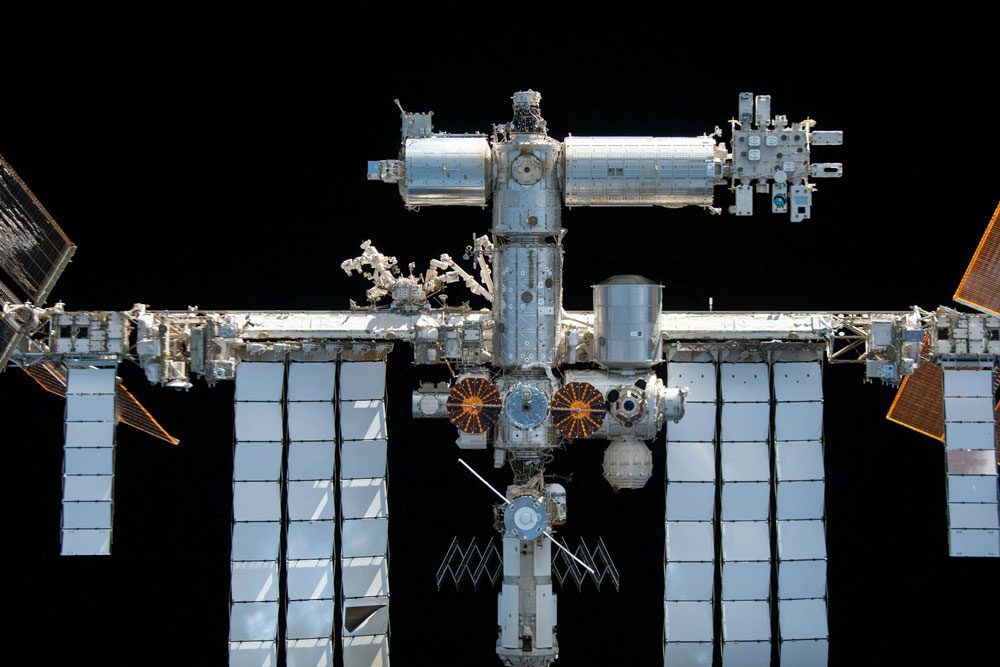
The International Space Station has housed visitors continuously for roughly 25 years. NASA
The International Space Station has housed visitors continuously for roughly 25 years. (NASA)

By Justin St. P. Walsh

The International Space Station is one of the most remarkable achievements of the modern age. It is the largest, most complex, most expensive and most durable spacecraft ever built.

Its first modules were launched in 1998. The first crew to live on the International Space Station – an American and two Russians – entered it in 2000. Nov. 2, 2025, marks 25 years of continuous habitation by at least two people, and as many as 13 at one time. It is a singular example of international cooperation that has stood the test of time.

Two hundred and ninety people from 26 countries have now visited the space station, several of them staying for a year or more. More than 40% of all the humans who have ever been to space have been International Space Station visitors.

The station has been the locus of thousands of scientific and engineering studies using almost 200 distinct scientific facilities, investigating everything from astronomical phenomena and basic physics to crew health and plant growth. The phenomenon of space tourism was born on the space station. Altogether, astronauts have accumulated almost 127 person-years of experience on the station, and a deep understanding of what it takes to live in low Earth orbit.
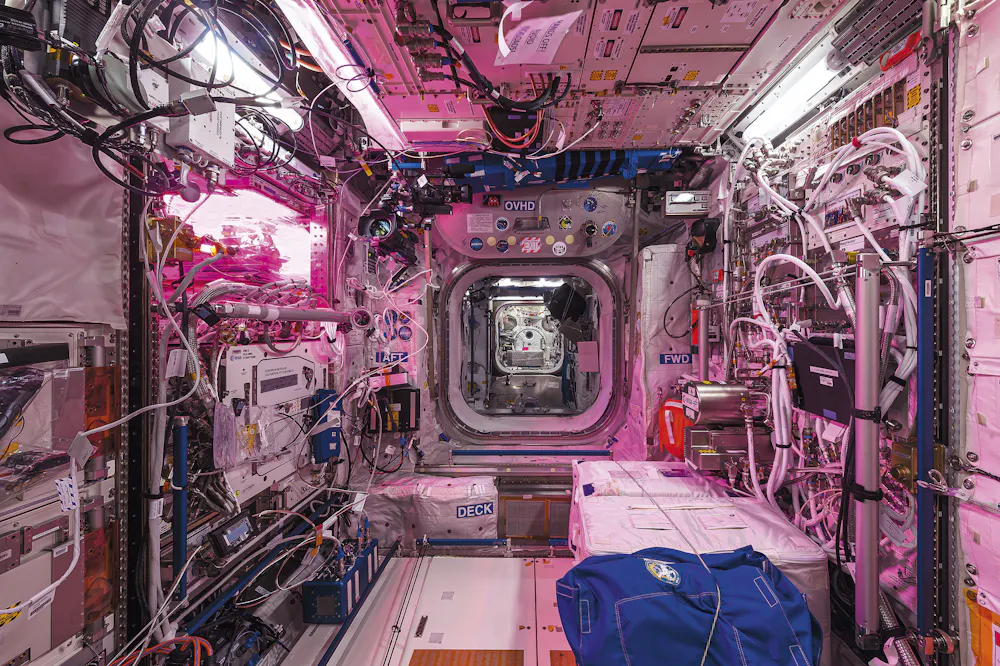
A module of a space station. It has white plastic walls, but the light is pinkish-purple from a plant habitat on one side. The space is cluttered with cables and equipment. Other modules are visible through the hatch at the far end.
A view of the European Space Agency’s Columbus laboratory module on the International Space Station.
Paolo Nespoli and Roland Miller, courtesy of NASA and ASI.

If you’ve ever seen photos of the inside of the International Space Station, you’ve probably noticed the clutter. There are cables everywhere. Equipment sticks out into corridors. It doesn’t look like Star Trek’s Enterprise or other science fiction spacecraft. There’s no shower for the crew, or a kitchen for cooking a meal from scratch. It doesn’t have an area designed for the crew to gather in their downtime. But even without those niceties, it clearly represents a vision of the future from the past, one where humanity would live permanently in space for the first time.

Space archaeology

November 2025, by coincidence, also marks the 10th anniversary of my team’s research on the space station, the International Space Station Archaeological Project. The long history of habitation on the space station makes it perfect for the kind of studies that archaeologists like my colleagues and me carry out.

We recognized that there had been hardly any research on the social and cultural aspects of life in space. We wanted to show space agencies that were already planning three-year missions to Mars what they were overlooking.

We wanted to go beyond just talking to the crew about their experiences, though we have also done that. But as previous studies of contemporary societies have shown, people often don’t want to discuss all their lives with researchers, or they’re unable to articulate all their experiences.

Astronauts on Earth are usually trying to get their next ride back to space, and they understandably don’t want to rock the boat. Our research provides an additional window onto life on a space station by using archaeological evidence: the traces of human interactions with the objects and built spaces of the site.

The problem, of course, is that we can’t go to the station and observe it directly. So we had to come up with other ways to capture data. In November 2015, I realized that we could use the thousands of photos taken by the crew and published by NASA as a starting point. These would allow us to track the movement of people and things around the site over time, and to map the behaviors and associations between them.

In 2022, the International Space Station Archaeological Project also carried out the first archaeological fieldwork off the Earth, an experiment designed by my collaborator, Alice Gorman. We asked the crew to document six sample locations in different modules by taking photos of each one every day for two months.

A view from one module of a space station into the airlock. In the airlock are two spacesuits facing each other. At the threshold, there is a hatch door at the top with pictures of people and other items on it. Below is a salmon-colored bulkhead with stickers of mission patches on it.
A view of the hatch from the Node 1 (Unity) module of the International Space Station into the U.S. airlock displays a crew-created memorial to deceased colleagues on the hatch door at the top.
Paolo Nespoli and Roland Miller, courtesy of NASA and ASI.

Lessons from photos

We learned that the crew of the International Space Station is a lot like those of us on Earth – perhaps unsurprising, since they live 95% or more of their lives here with the rest of us. They decorate the walls of the station with pictures, memorabilia and, on the Russian side, religious items, the way you might put photos and souvenirs on your refrigerator door to say something about yourself and your family. They make birthday cakes for their colleagues. They love to snack on candy or other special foods that they selected to be sent.

Unlike the rest of us, however, they live without much freedom to make choices about their lives. Their days are governed by lengthy procedures overseen by Mission Control, and by lists of items and their locations.

Crew members do show some signs of autonomy, though. They sometimes create new uses for different areas. They used a maintenance work station for the storage of all kinds of unrelated things, just because it has a lot of Velcro for holding items in place. They have to come up with solutions for storing their toiletry kits because that kind of affordance wasn’t considered necessary by the station’s designers 30 or 40 years ago.
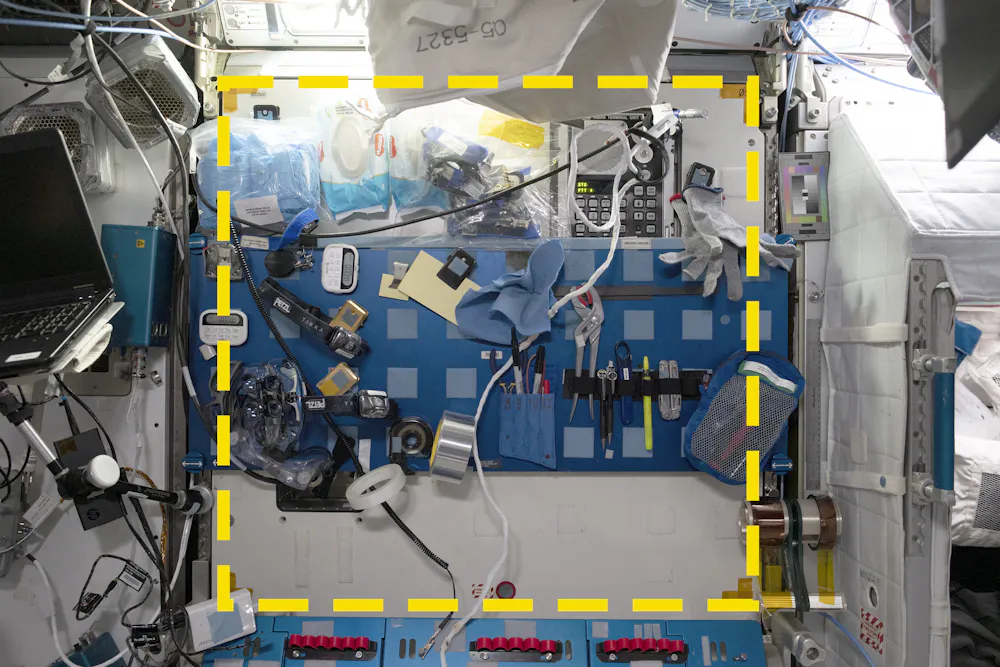
The wall of a space station module. In the center is a blue metal panel with 40 pieces of Velcro arranged in a grid. More Velcro is visible on the wall. Many different items are stuck to the wall. A yellow square is superimposed on the central part of the image.
One of the sample locations for the International Space Station Archaeological Project’s archaeological experiment on the space station was the maintenance work area in the Node 2 (Harmony) module. On the wall, many different kinds of items are stored, mostly attached to patches of Velcro. The yellow dotted line shows the boundary of the sample area.
NASA/ISSAP

We discovered that despite the international nature of the station, most areas of it are highly nationalized, with each space agency controlling its own modules and, often, the activities going on in each one. This makes sense, since each agency is responsible to their own taxpayers and needs to show how their money is being spent. But it probably isn’t the most efficient way to run what is the most expensive building project in the history of humanity.

In our latest research, we tracked changes in scientific activity, which we found has become increasingly diverse, by documenting the use of specialized experimental equipment. This work was the result of questions from one of the companies competing to build a commercial successor to the International Space Station in low Earth orbit.

The company wanted to know if we could tell them what facilities their customers were likely going to need. Of course, understanding how people have used different parts of a site over time is a typical archaeological problem. They are using our results to improve the experiences of their crews.

The archaeology of the contemporary world

Similar archaeological studies of contemporary issues here on Earth can also make future lives better, whether by studying phenomena such as migration, ethnonationalism or ecological issues.

In this way, we and other contemporary archaeologists are charting a new future for studying the past, a path for our discipline that lies alongside our traditional work of investigating ancient societies and managing heritage resources. Our International Space Station work also demonstrates the relevance of social science research for solving all kinds of problems – even ones that seem to be purely technical, like living in space.

Justin St. P. Walsh is Professor of Art History, Archaeology and Space Studies at Chapman University.


The Conversation arose out of deep-seated concerns for the fading quality of our public discourse and recognition of the vital role that academic experts could play in the public arena. Information has always been essential to democracy. It’s a societal good, like clean water. But many now find it difficult to put their trust in the media and experts who have spent years researching a topic. Instead, they listen to those who have the loudest voices. Those uninformed views are amplified by social media networks that reward those who spark outrage instead of insight or thoughtful discussion. The Conversation seeks to be part of the solution to this problem, to raise up the voices of true experts and to make their knowledge available to everyone. The Conversation publishes nightly at 9 p.m. on FlaglerLive.
See the Full Conversation Archives
Support FlaglerLive's End of Year Fundraiser
Asking tough questions is increasingly met with hostility. The political climate—nationally and right here in Flagler County—is at war with fearless reporting. Officials and powerbrokers often prefer echo chambers to accountability. They want news that flatters, not news that informs. They want stenographers. We give them journalism. You know by now, after 16 years, that FlaglerLive won’t be intimidated. We dig. We don't sanitize to pander or please. We report reality, no matter who it upsets. Even you. But standing up to this kind of pressure requires resources. We need a community that values courage over comfort. Stand with us, and help us hold the line. Fund the journalism they don't want you to read. No paywall. But it's not free. Take a moment, become a champion of enlightening journalism. Any amount helps. We’re a 501(c)(3) non-profit news organization. Donations are tax deductible.
You may donate openly or anonymously.
We like Zeffy (no fees), but if you prefer to use PayPal, click here.
If you prefer the Ben Franklin way, we're at: P.O. Box 354263, Palm Coast, FL 32135.
 

Reader Interactions

Leave a Reply Cancel reply

Your email address will not be published. Required fields are marked *

This site uses Akismet to reduce spam. Learn how your comment data is processed.

  • Conner Bosch law attorneys lawyers offices palm coast flagler county
  • grand living realty
  • politis matovina attorneys for justice personal injury law auto truck accidents

Primary Sidebar

  • grand living realty
  • politis matovina attorneys for justice personal injury law auto truck accidents

Recent Comments

  • Basant Club on Warrantless Search of Car’s GPS Data Is Constitutional, Florida Appeals Court Rules
  • Bo Peep on 21 Red States Ask Appeals Court to Uphold Florida’s Sweeping School Library Book Bans
  • Soprano Sanitation on Palm Coast and Flagler County Holiday Schedule for Garbage Pick-Ups, Libraries, Transportation and Government Hours
  • Pogo on Trump Ends Veterans’ Access to Abortion
  • Keep Flagler Beautiful on Joshua Hawkins, 34, of Palm Coast, Accused of Raping Child Under His Care, After Buying Her Sex Toys
  • chris conklin on Community Rallies Around Marineland Dolphin Adventure with Cash and Gift Cards for Employees
  • Skibum on The Daily Cartoon and Live Briefing: Wednesday, December 24, 2025
  • A Concerned Observer on Sticker Shucks: Bill Calls for Eliminate Registration Decals
  • FedUp on Argument on Old Kings Road Ends in Shooting; Victim Claims Assault, Girlfriend Cites Self-Harm
  • Ben Hogarth on Palm Coast Moves to Dismiss Town Center Development Lawsuit, Citing ‘Fundamental Misunderstanding’ of Utility Rules
  • Pogo on The Daily Cartoon and Live Briefing: Wednesday, December 24, 2025
  • JC on Calling CAIR Terrorists While AIPAC Buys Genocidal American Policy
  • Sherry on Calling CAIR Terrorists While AIPAC Buys Genocidal American Policy
  • Powder Residue? on Argument on Old Kings Road Ends in Shooting; Victim Claims Assault, Girlfriend Cites Self-Harm
  • One pick up a week on Palm Coast and Flagler County Holiday Schedule for Garbage Pick-Ups, Libraries, Transportation and Government Hours
  • BillC on Tariffs 101: An Explanation

Log in