


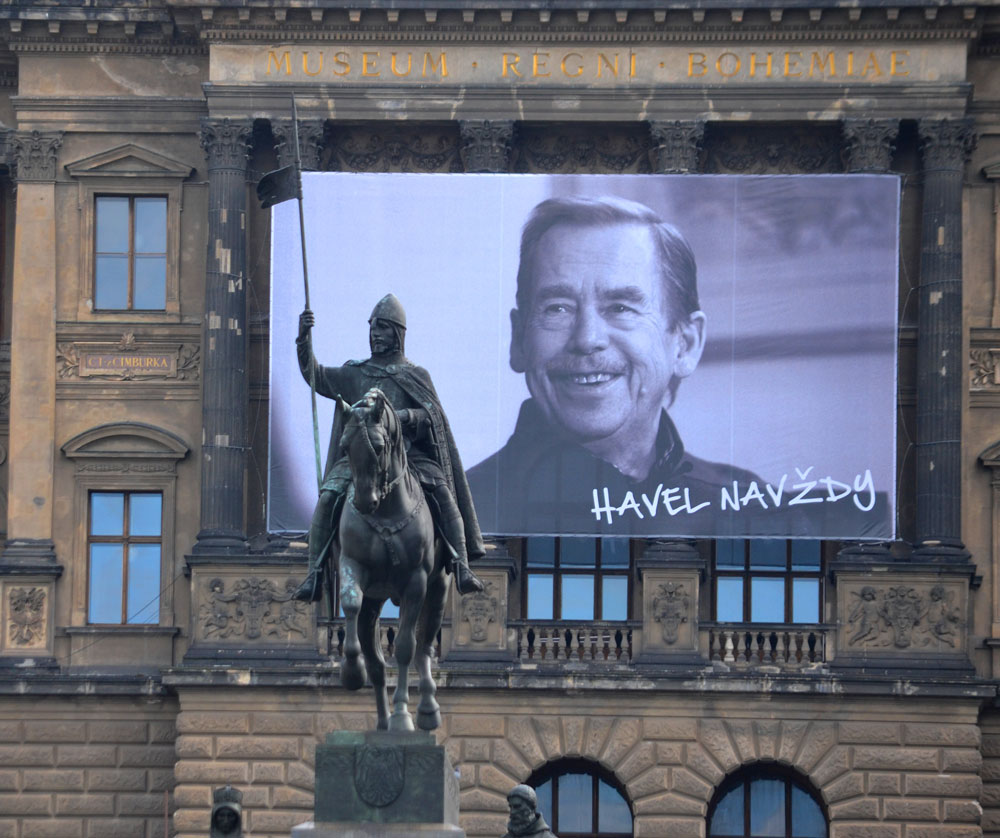
By Darius von Guttner Sporzynski
When Czech political dissident, playwright and poet Václav Havel wrote The Power of the Powerless in October 1978, he was not offering a manifesto in any conventional political sense. Nor was he outlining a program for opposition or regime change.
Instead, he set out to analyse a distinctive form of domination that did not rely primarily on terror, spectacle or charismatic authority, but on routine compliance and the internalisation of untruth.
His central claim was disarmingly simple.
Systems of coercive power endure not only because of police power or elite control, but because ordinary people participate in them by acting as if they believe what they know to be false. They live, as Havel put it, “within a lie”.
His most famous example was of the greengrocer who displays the slogan “Workers of the world, unite!” – not to express revolutionary zeal but to signal conformity. The sign communicates obedience and a willingness to perform the expected ritual – thus helping to sustain a system whose strength lies in habituation. What matters is not belief, but participation. The slogan functions less as political content than as a social password, marking the bearer as safe and nonthreatening.
Havel’s originality lay in shifting attention away from rulers and institutions towards everyday behaviour. Tyranny, in his account, is not only upheld by party elites or security services, but by countless small acts of acquiescence that create what he described as a “post-totalitarian” order.
Such systems normalise untruth.

Havel’s essay, written nearly 50 years ago, speaks with striking force to the present moment. Across a range of democracies, leaders now display increasingly authoritarian reflexes, while public life is sustained by ritualised language masking the erosion of norms and constrains.
Addressing the World Economic Forum last month, Canadian prime minister Mark Carney invoked Havel’s essay, recalling his example of the greengrocer and his sign.
Carney suggested a contemporary “life within a lie” now operates at the level of the international system, where states perform commitment to rules, reciprocity and shared values as those principles are selectively applied or quietly abandoned. The danger lies less in open rule-breaking than in the collective pretence that the system still functions as advertised.
An ethical challenge
The enduring force of Havel’s essay lies in its re-framing of resistance as responsibility rather than victory. Tyranny is challenged not by seizing power, but by depriving falsehood of its audience. Havels’ target is not a particular regime, but a recurring human temptation: the willingness to trade truth for tranquillity.
In an era marked by strategic intimidation, economic pressure and rhetorical cynicism, Havel’s insistence on moral clarity retains its relevance.
To live in truth remains risky, inconvenient and uncertain in its outcomes. Yet Havel’s claim was never that truth guarantees success. It was that systems built on lies are strong only so long as those lies go unchallenged. Once named, their authority begins to weaken.
In this sense, The Power of the Powerless is less a historical document than an ethical challenge. It asks not who governs, but how individuals participate. It insists that even under conditions of asymmetry, the refusal to perform falsehood constitutes a form of power.
‘Living in truth’
According to Havel’s essay, in “post-totalitarian states”, ideology becomes less a doctrine to be argued over than a language to be performed. In this context, the most destabilising act is not armed rebellion or organised protest, but refusal. When an individual ceases to perform the ritual, he exposes it – revealing the emperor is naked.
From this diagnosis follows Havel’s most enduring concept, “living in truth”. This is not a policy platform or a political strategy in the usual sense. It is an existential stance with political consequences. To live in truth is to align one’s public actions with one’s private conscience, even when doing so carries material cost or social risk.
In a system built on universal pretence, even a modest act of honesty acquires disproportionate force. It disrupts the shared fiction on which authority depends, reminding others that alternatives are conceivable.
Havel’s argument was also deliberately unsettling for audiences outside east-central Europe. “Post-totalitarianism” was not a regional anomaly, but an intensified version of tendencies present in modern mass societies.
Comfort could be purchased at the price of indifference and freedom reduced to private consumption detached from public responsibility. In this sense, The Power of the Powerless was a diagnosis of modernity’s susceptibility to moral outsourcing and quiet complicity.

Dan Burton/unsplash, CC BY
Sceptical of heroics
Havel saw the fall of communism, ultimately becoming the president of both Czechoslovakia (in 1989–92) and of the Czech Republic (1993–2003). He died in 2011.
His essay is often misread as a celebration of heroic dissent or moral exceptionalism. In fact, it is sceptical of heroics. The power of the powerless, he suggests, does not lie in spectacle, numbers or immediate success. It lies in example.
Truth operates politically not because it commands obedience, but because it awakens recognition. It speaks to what Havel described as the “hidden sphere” of social consciousness, the half-suppressed awareness that life organised around falsehood is corrosive and degrading.
This helps explain why Havel dismissed conventional measures of political effectiveness in societies dominated by totalitarian power. Elections, parties and platforms mean little when the public sphere itself has been hollowed out and emptied of genuine contestation.
What matters instead is the slow reconstruction of moral agency.
Independent cultural activity, unofficial networks and samizdat publishing, for instance, were not substitutes for politics, but its necessary groundwork. They preserved spaces in which truth could be spoken without immediate translation into slogans or coercive power.
A contemporary invocation
Carney’s argument at Davos turned on a familiar contradiction. Political leaders, diplomats and institutions speak the language of rules, reciprocity, and shared norms, while tolerating practices that hollow out those norms.
Trade regimes are described as rules-based even as economic coercion becomes routine. Security arrangements are framed as collective while asymmetries of power grow more explicit.
The problem, in Havel’s terms, is not simply that rules are broken, but that everyone continues to behave as if they still function as advertised. This collective performance sustains an order that no longer delivers what it promises.
In this reading, the international order begins to resemble Havel’s post-totalitarian system. The slogans differ, but the logic is familiar. Language masks fear, dependency and imbalance. The global greengrocer hangs the sign not because he believes it, but because not hanging it appears too risky.
Carney’s proposed response was not withdrawal or isolation, but a call for what he described as “middle powers” to stop pretending. To live in truth at the level of international politics means acknowledging openly where the system fails, refusing convenient fictions and building coalitions grounded in actual shared interests rather than abstract formulae.
The danger of abstraction
Yet there is a risk that “living in truth” becomes an elevated moral injunction detached from the conditions of everyday life.
Havel’s greengrocer is not a philosopher or an essayist. He is a worker responsible for opening a shop, supplying scarce goods and navigating a collectivised economy. For him, refusal carries immediate and concrete consequences: such as loss of employment, harassment or exclusion.
By contrast, intellectuals such as Havel, writing three decades after the communist takeover, occupied a different position. Their capacity to articulate critique in essays, however restricted the audience, rested on forms of cultural capital and social insulation unavailable to most citizens. Havel understood this tension, but it remains a persistent problem in the reception of his ideas.
The same risk attends contemporary invocations such as Carney’s. Those preoccupied with meeting basic needs, managing precarious employment or coping with rising costs are unlikely to be moved by abstract calls for moral clarity in global governance. For them, the performance of ritual may appear not as cowardice, but as survival.
This does not invalidate Havel’s argument, but complicates its application. Revolutions and transformations do not arise from ideas alone. They occur when ideas intersect with lived experience in ways that make existing arrangements untenable. Havel’s insight acquires political force only when “living in truth’” ceases to sound like moral exhortation and begins to articulate shared grievances and recognisable realities.
The question is not whether truth matters, but how it is made audible to those whose compliance sustains the system in the first place.
In that unresolved tension lies the continuing relevance of The Power of the Powerless. It offers no guarantees, refusing consolation. It insists that participation is never neutral and even the smallest refusal carries ethical weight. Whether that refusal can once again ignite broader change depends on whether truth speaks to the conditions of ordinary life.

Darius von Guttner Sporzynski is Professor of History at Australian Catholic University.



























JW says
Quite a tough read! But in the end I Got it:
“The question is not whether truth matters, but how it is made audible to those whose compliance sustains the system in the first place”
The simple answer is: it is education stupid! Unfortunately we don’t educate (K-12 and beyond or oneself) how to determine what is true and what is false. That requires having been basically educated enough to address that question for a wide variety of topics/situations. Even politicians can not agree on that.
As a minimum we need to teach how to think critically, but we don’t even do that because we live in a feel good society, and that can reverse the (indoctrinated) definition of true and false!
Good luck!
Pogo says
In his own words
https://www.google.com/search?q=Václav+Havel
Time’s glory is to calm contending kings, To unmask falsehood and bring truth to light, To stamp the seal of time in aged things, To wake the morn and sentinel the night, To wrong the wronger till he render right, To ruinate proud buildings with thy hours And smear with dust their glittering golden towers.
― William Shakespeare, The Rape of Lucrece
https://www.google.com/search?q=The+Rape+of+Lucrece
A Concerned Observer says
…and why should we care what a Czechoslovakian dissent said 48 years ago? He apparently had an ax to grind with whatever was going on there at that time. His words may have been relevant to his particular case at that particular time. A logical fallacy is an error in reasoning that makes an argument unsound, often by using invalid or misleading premises to reach a conclusion. It can occur unintentionally due to poor reasoning or intentionally to manipulate others.
Not my farm, not my pigs.