


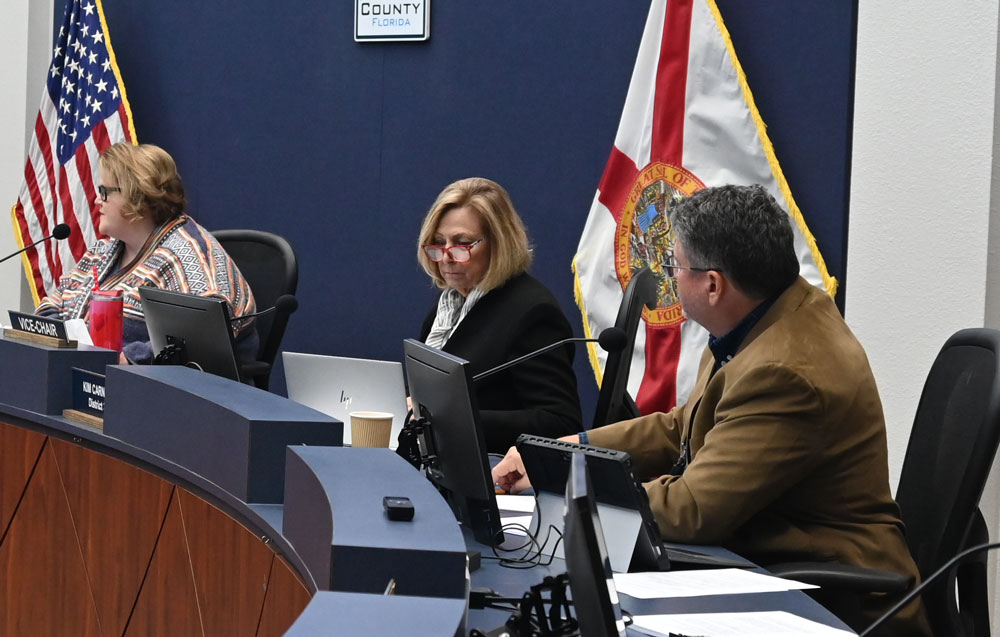
As it turns out, Flagler County Attorney Michael Rodriguez and County Administrator Heidi Petito were wrong. Flagler Beach City Commissioner Scott Spradley and his colleagues on the commission were wrong. Flagler Beach City Attorney Drew Smith was wrong. The negotiated settlement resolving potential litigation over the city’s annexation of Summertown did not resolve potential litigation over Veranda Bay, Summertown’s sister development, as everyone thought it had–as everyone said it had.
Everyone did not take account of County Commissioner Kim Carney. To her, there is still a road to litigation over Veranda Bay, and on Monday, against strong cautions by Rodriguez, Commissioner Andy Dance and even objective cautions from Commission Chair Leann Pennington, she got herself another workshop–with Pennington’s support–to discuss kicking off another conflict-resolution process, the first step before suing.
“I think there may have been some confusion. I know there’s some confusion on the result of the negotiations that took place right after our meeting,” Carney said, referring to the commission’s meeting a month ago that led to the conflict resolution over Summertown. She still considers Veranda Bay’s annexation “illegal.” She does so because she says the county does not have the Veranda Bay residents’ petitions agreeing to annexation.
“They could not prove it. They could not provide signatures,” Carney said of Veranda Bay’s developer, Ken Belshe, and attorney, Michael Chiumento. Strictly speaking, she’s right: annexation petitions as state law spells them out are not in hand. But signatures are.
Belshe and Chiumento have repeatedly said that the property owners’ signatures of their covenants include agreement to be annexed either into Palm Coast or into Flagler Beach. That, too, is not in question. The covenant language makes that clear, and property owners signed their covenants. The Flagler Beach City Commission and its attorneys accept the rationale that signatures of the covenants equate to signature agreeing to annexation. The county administration had also accepted it, to the extent that if there were to be an issue with homeowners there, it would be between the homeowners and the city, not the county.
That was made explicit at the Feb. 13 negotiating session resolving four of the five issues surrounding Summertown (the fifth was resolved days later and the settlement agreement was ratified by the County Commission.)
“One of the things we did work upon on all this,” Rodriguez said at the Feb. 13 negotiating session, with Petito next to him, “is also that, because we have a tentative agreement with the developer in regards to funding the impacts on the John Anderson Highway, that is also taking into account the impacts that would be created by the annexation of Veranda Bay. So the idea is that if we can get these issues resolved, I have advised my folks that if we walk out of this here, this is a universal settlement of everything.”
Rodriguez repeated it: there was no expectation after the Summertown settlement that “we’re going through this whole process again” with Veranda Bay. The main concern with Veranda Bay was its impacts on the highway (he did not mention the petitions), and the developer was providing close to $1 million to defray those impacts.
“That’ll cover it all,” Rodriguez said, with Smith, the Flagler Beach city attorney, and Dale Martin, the Flagler Beach city manager, sitting across the table. “So we’re not going to revisit this after you guys finish the second reading of Veranda Bay. Our goal is to–this finishes it as a universal settlement. If we get this resolved and everything signed, we will not be at the second reading of the ordinance.”
The second reading of the ordinance was last Thursday, a trio of 4-1 votes by the Flagler Beach City Commission. (See: “Flagler Beach Commission Finalizes Historic Annexation of Veranda Bay, Increasing City’s Size by Almost a Third.”) The majority included Spradley, who had also been explicit. He would not vote for annexation unless all shadows of legal threats were removed.
When he voted Thursday, he said today, Smith, the city attorney, had noted that the Veranda Bay petition matter was still causing rumbles. John Tanner, the attorney representing Save Flagler Beach and Bulow Creek (a non-profit that has opposed the developer) was citing it as an issue, as was Carney. But Spradley, an attorney, felt that litigation would not happen, and if it did, the city would prevail–and get attorneys’ fees back. He doesn’t think it would get that far precisely because of the cost: the county will not want to risk paying attorneys’ fees.
He did not think there was confusion previously, and both he and Smith had seen the County Commission ratify the settlement agreement. At that Feb. 23 meeting, Carney voted against the settlement, but she did not say why.
She did so Monday. “In my opinion, this is an illegal annexation,” Carney said. “I swore to uphold the Constitution and the statutes of the state of Florida. So if I, or if we as a board, decide to overlook this, we are basically in violation. It is a very difficult position that we find ourselves in because the willing seller on the 150 acres is the same developer that wants to annex Veranda Bay.”
It did not appear to matter that Flagler Beach, what had appeared to be a majority of Carney’s colleagues on the commission, and both governments’ attorneys, did not, based on the stated conclusions at the settlement meeting, consider it an illegal annexation.
It did not appear to matter that Carney was risking Belshe, the developer, opting out of selling the county 153 acres out of the Summertown parcel for conservation and protection of the headwaters of Bulow Creek, as he has said he is willing to do. It does not seem to matter that he could also opt out of the mitigation payments he said he was willing to make to offset impacts on John Anderson Highway, or that after all this, the county might still lose if it pursued litigation.
Pennington said that while there are no voluntary petitions in hand from the Veranda Bay owners as such, there’s no case law, either, about signatures implicit to covenants. She said it now is “on Flagler Beach,” since Flagler Beach annexed. “The people that live in those houses could bring maybe action, but it would not be against the county. It would be against Flagler Beach,” she said. “That’s very foolish, what Flagler Beach is doing, in my opinion, but they have an attorney, and they understand their risks. The risk to us is that we may lose the opportunity to negotiate and purchase the 150 acres of Bulow based on the posturing that’s happening in this negotiation. That’s a real risk for us.”
She said nothing stops Belshe from carving out those 120-odd properties from the annexed land, either, and leaving them on county land.
Rodriguez echoed Pennington, more explicitly: “What we could be facing is probably, for starters, the agreement we’re currently drafting for the financial contributions to remedy the impacts on to John Anderson highway would probably be pulled,” he said. The city, he said, would rescind the annexation ordinance it just passed and carve out the existing properties. “At that point, we would lose the only legal challenge we had to the annexation,” he said, in addition to losing the revenue to address impacts on John Anderson.
“You could theoretically end up with a Pyrrhic victory, because the impacts that you’re addressing from that annexation are being wrapped up in this agreement that we’re currently drafting,” Rodriguez said, also noting the risks to the 153 acres deal.
“It almost becomes a business decision for this board,” Rodriguez said. “What are the risks you want to undertake to proceed forward with another battle with the city?” He said nothing stops a Flagler Beach resident from suing.
“I don’t think it’s worth us getting involved. It sounds like a court case. That would be ugly,” Commissioner Greg Hansen said. Dance said it’s a matter for the property owners and the developer, not the county.
Nevertheless, Pennington said she was open to initiating the same conflict-resolution process that the county had initiated regarding Summertown, meaning yet another threat to sue. “I would want my representative to be looking out for me before I was additionally taxed without knowledge,” she said. “I could go either way on this, but I’m leaning towards maybe we should have a discussion about it, because I don’t think we should allow the 150 acres of Bulow to get in our heads. Because I think at any time, he can agree not to sell it to us. I had a good feeling down in my gut, and that probably wouldn’t happen either anyways, that what we have with him is not strong.”
Pennington, Carney and Commissioner Richardson agreed to have a workshop followed by a special meeting, in case the county wanted to move with a conflict-resolution process. The county has 30 days from last Thursday (Feb. 26) to start litigation. The workshop is not yet scheduled, but it’s likely next week, when the commissioners would also be looking to appoint an interim administrator.
In a brief interview today, Pennington said the conflict resolution process may or may not kick off, but her intention after an extremely long meeting Monday was to have the opportunity to discuss the matter more deliberately at a workshop, where everyone would have done some homework, enabling a clearer decision. Still, she spoke as Carney did.
“At what point do we keep putting up with this sort of stuff? Flagler Beach should do the right thing, they should get those petitions,” Pennington said. “This is really about doing the right thing, following the state statute.”


























Raymond Royer says
Kim Carney has brought up a very controversial vote by the Flagler County Commission who sworn to uphold the Constitution and State Statute of Florida.
Please refer the recent Flagler County Commission meeting on 03/02/2026 on YouTube.
Mort says
Is she planning on firing the county attorney for not being thorough?
m thompson says
The developer & lawyer say the property owners signed their covenants. Florida law should override those documents.
For transparency & confirmation for everyone on this specific issue, petitions with current dated signatures should be easy to get from all the current property owners. They may believe they are already in the city limits or may not realize their taxes will increase. I would like to see the proof myself……..