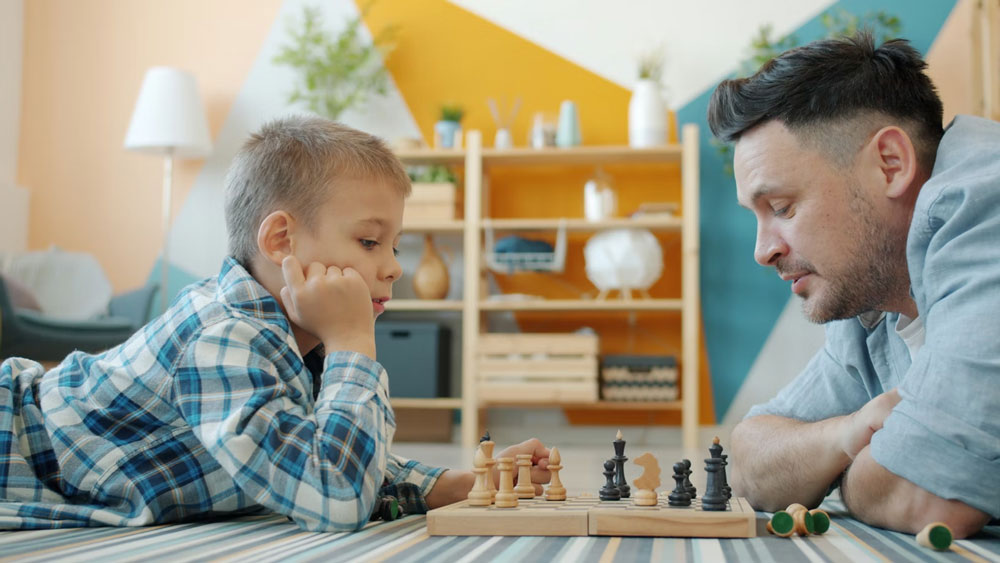
It is perceived by many parents that screen time is merely a time sucker. However, it is possible to transform the same screens into a silent training center of concentration and forbearance through organized chess online. When they play chess on the Internet, children are not tapping blindly, they make their choices, calculate risks, and complete a full online chess game, rather than scroll infinitely. Even a brief game of chess online provides them with a clear purpose, a clear outcome and an instinctive time to log out.
This is easy to access in modern chess websites and chess sites. A child is able to access a trusted chess game website, join a secure virtual chess room and be matched with a similarly level opponent in a few seconds. In a basic web chess board or a child-friendly chess platform, the game board is always correctly configured, the rules are automatically imposed and the result is saved to be reviewed later. The finest chess online experiences remove clutter to ensure that children think about ideas and not menus.
Compared with typical screen time, online chess:
- Has a clear beginning and end (one game, then another)
- Things require thinking and not passive observation.
- Establishes natural pauses where children are allowed to pause without arguments.
Friendly Competition: How Online Chess Tournaments Keep Kids Engaged
To most children, the assurance that you can only play a bit is not sufficient to create an actual habit. Online Chess Tournaments that are small and age-related provide them with a reason to return. A chess tournament online is more of a school party than a sports championship: the games are short, there are definite opponents, the atmosphere is not tense. Every online chess match is a new experiment and not a decision of talent and children soon realize that every chess competition has something to learn.
Regular chess tournaments can be used by the parents and coaches to organize practice. By enrolling in upcoming chess tournaments on a stable chess arena, random matches are made into a basic weekly routine:
- Weekdays: a few casual chess online games or puzzles
- Weekend: a small online chess competition or mini chess tournament
Children get the fun of chess tournaments without even having to get into their cars, incur expenses on hotels and spending hours at the table, and this makes the entire concept more realistic to busy families.
What Kids Actually Learn When They Play Online Chess
Outwardly, online chess is merely a blank board on a sunny display. A lot is going on simultaneously in the mind of a child.
Focus and pattern recognition
Even brief periods of online chess require prolonged concentration. Children must track:
- Where their own pieces may move.
- What the opponent is threatening.
- What squares are safe or dangerous?
This constant scanning develops the routine of devoting several minutes to a single activity, something that most adults are unable to do. Meanwhile, children also start becoming aware of basic tactical concepts, including forks, pins and checkmates. It is these little aha moments that make them go back to chess online games rather than falling back to passive entertainment.
A 2025 open-access study in Frontiers in Psychology comparing the effects of structured chess teaching in kindergarten and primary school on cognitive, emotional and academic development of children provides more information to those interested in the research behind these concepts.
Planning ahead and accepting consequences
Chess is also an instruction on the fact that all moves have their consequences. The outcome of a hasty decision losing a part is instantly felt and seen. Over time, children learn to:
- Slow down before moving
- Compare two or three options
- Learn to live with it and forget it.
Screen Time vs Chess Online: A Simple Comparison
| Aspect | Passive screen time (videos, feeds) | Chess Online / game of chess online |
| Main activity | Watching, scrolling | Reasoning, making decisions, computing. |
| Ending point | Hard to stop, endless feed | Break after every online chess game. |
| Emotional pattern | Quick hits of stimulation | Tension, focus, release after result |
| Skills involved | Very limited | Attention, memory, planning, resilience |
That is why even a family which does not desire to have “more screens” can decide to substitute some passive watch with several games of online chess every week.
Turning Screen Time into “Smart Time” at Home
The online chess also fits a family schedule quite well since it is available in miniature self-contained packages. We can easily agree on restrictions like “two games after homework” or “one fast session to play chess online before going to sleep”.
The most common rules set by parents are simple:
- Limit the amount of games per day, not “as long as you please”.
- Favour slightly longer games (like 10 minutes) to pure blitz.
- Request a brief overview: “What did you plan in this position?
When children play on online chess websites or bigger online chess sites, they read coordinates, control a clock, consider cause and effect and train emotional control. The loss still hurts but they quickly learn that it is better to replay a loss calmly than to lose it emotionally.
Choosing a Safe and Suitable Chess Site for Kids
Parents who do not play themselves usually have a concern where to begin. The first one is simplicity and safety.
Some of the main aspects that one should consider when a child-friendly chess game website is in question are:
- Clean interface – clean board, readable pieces, no aggressive advertisements.
- Chat controls – can be used to turn off or restrict public chat.
- Simple learning materials – puzzles, simple lessons, post-game analysis.
A lot of online chess websites currently have beginner lessons and automatic game analysis, so that a parent and a child can replay important moments together. Other platforms are like an international chess club, where juniors of various nations are able to play on teams and leagues or school-based teams. When these features are properly designed, the site is not just a place to click moves, but gradually becomes a learning environment.
In the case of very young players, parents tend to choose the best chess online that emphasizes serene colours, straightforward navigation and clear boundaries rather than flashy animations.
Social Skills, Confidence and Community
Even though one can play chess alone, chess has the tendency of bringing people together. Children get to encounter peers who share their interests and not their social media feed in online settings that are developed around websites and clubs that deal with chess.
Through regular play, they gradually learn to:
- Congratulate on a “good game” whether they win or lose.
- Give due respect to stronger opponents and enquire what they can learn.
- View every outcome as feedback, and not as a self-identification.
Online play may be a transition to offline events among shy kids. The confidence gained at the Online Chess Tournaments and other junior events can subsequently help in being able to walk into a local club or be able to join a school team.
Conclusion: A Practical Upgrade to Everyday Screen Time
Chess will not change the life of a child and will not substitute sleep, exercise or free play. Nevertheless, it provides something that is hard to find in the digital world; a type of screen time that is active, capped and cognitively challenging. Having reasonable time regulations, an appropriate platform and some regular involvement in chess tournaments or a small chess tournament online, children are able to use their devices to train the ability to focus, memory and resilience rather than merely to consume content.
Online chess is a simple victory for the families that seek realistic and small changes. A secure location, a couple of games each week and the odd tournament on-line chess can usually suffice to transform too much screen time into a regular portion of organized and thoughtful play.