• Skip to primary navigation
  • Skip to main content
  • Skip to primary sidebar
MENUMENU
MENUMENU
  • Home
  • About
    • Contact Us
    • FlaglerLive Board of Directors
    • Comment Policy
    • Mission Statement
    • Our Values
    • Privacy Policy
  • Live Calendar
  • Submit Obituary
  • Submit an Event
  • Support FlaglerLive
  • Advertise on FlaglerLive (386) 503-3808
  • Search Results

FlaglerLive

No Bull, no Fluff, No Smudges

MENUMENU
  • Flagler
    • Flagler County Commission
    • Beverly Beach
    • Flagler History
    • Mondex/Daytona North
    • The Hammock
    • Tourist Development Council
    • Marineland
  • Palm Coast
    • Palm Coast City Council
    • Palm Coast Crime
  • Bunnell
    • Bunnell City Commission
    • Bunnell Crime
  • Flagler Beach
    • Flagler Beach City Commission
    • Flagler Beach Crime
  • Cops/Courts
    • Circuit & County Court
    • Florida Supreme Court
    • Federal Courts
    • Flagler 911
    • Fire House
    • Flagler County Sheriff
    • Flagler Jail Bookings
    • Traffic Accidents
  • Rights & Liberties
    • First Amendment
    • Second Amendment
    • Third Amendment
    • Fourth Amendment
    • Fifth Amendment
    • Sixth Amendment
    • Seventh Amendment
    • Eighth Amendment
    • 14th Amendment
    • Sunshine Law
    • Religion & Beliefs
    • Privacy
    • Civil Rights
    • Human Rights
    • Immigration
    • Labor Rights
  • Schools
    • Adult Education
    • Belle Terre Elementary
    • Buddy Taylor Middle
    • Bunnell Elementary
    • Charter Schools
    • Daytona State College
    • Flagler County School Board
    • Flagler Palm Coast High School
    • Higher Education
    • Imagine School
    • Indian Trails Middle
    • Matanzas High School
    • Old Kings Elementary
    • Rymfire Elementary
    • Stetson University
    • Wadsworth Elementary
    • University of Florida/Florida State
  • Economy
    • Jobs & Unemployment
    • Business & Economy
    • Development & Sprawl
    • Leisure & Tourism
    • Local Business
    • Local Media
    • Real Estate & Development
    • Taxes
  • Commentary
    • The Conversation
    • Pierre Tristam
    • Diane Roberts
    • Guest Columns
    • Byblos
    • Editor's Blog
  • Culture
    • African American Cultural Society
    • Arts in Palm Coast & Flagler
    • Books
    • City Repertory Theatre
    • Flagler Auditorium
    • Flagler Playhouse
    • Special Events
  • Elections 2026
    • Amendments and Referendums
    • Presidential Election
    • Campaign Finance
    • City Elections
    • Congressional
    • Constitutionals
    • Courts
    • Governor
    • Polls
    • Voting Rights
  • Florida
    • Federal Politics
    • Florida History
    • Florida Legislature
    • Florida Legislature
    • Ron DeSantis
  • Health & Society
    • Flagler County Health Department
    • Ask the Doctor Column
    • Health Care
    • Health Care Business
    • Covid-19
    • Children and Families
    • Medicaid and Medicare
    • Mental Health
    • Poverty
    • Violence
  • All Else
    • Daily Briefing
    • Americana
    • Obituaries
    • News Briefs
    • Weather and Climate
    • Wildlife

Jean Baudrillard Predicted AI 30 Years Ago

December 28, 2025 | FlaglerLive | 4 Comments

jean baudrillard artificial intelligence
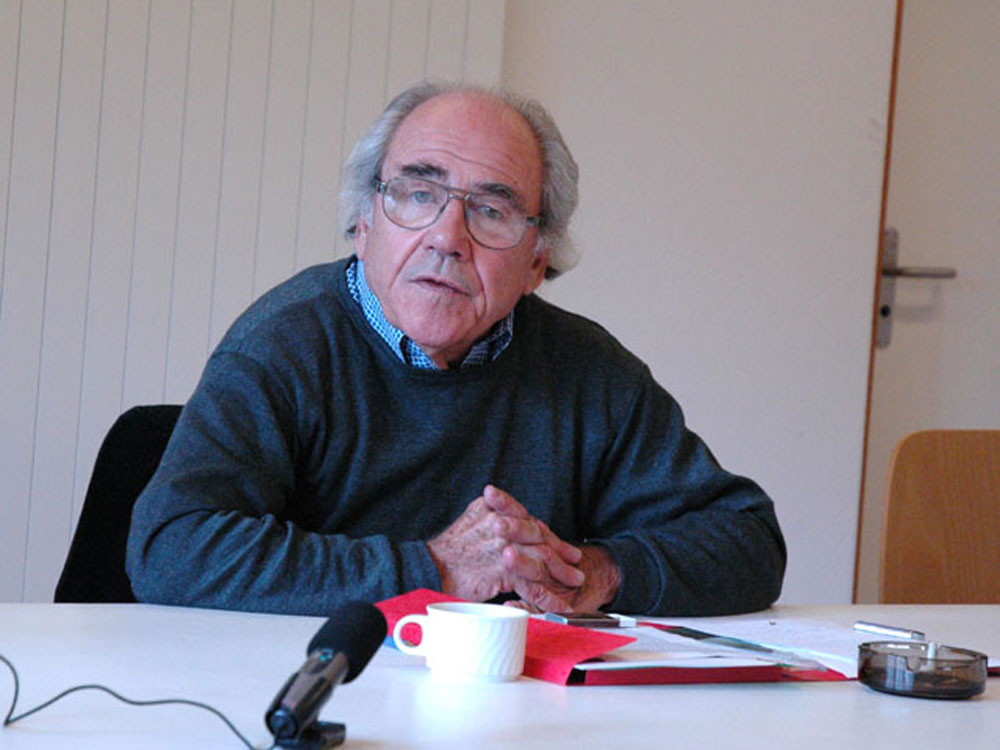
Jean Baudrillard (Wikimedia Commons)

By Bran Nicol and Emmanuelle Fantin

Some writers appear so accurate in their assessment of where society and technology is taking us that they have attracted the label “prophet”. Think of J. G. Ballard, Octavia E. Butler, Marshall McLuhan, or Donna Haraway.

One of the most important members of this enlightened club is the philosopher Jean Baudrillard – even though his reputation over the past couple of decades has diminished to an association with a now bygone era when fellow French theorists such as Roland Barthes and Jacques Derrida reigned supreme.

In writing our new biography of Baudrillard, however, we have been reminded just how prescient his predictions about modern technology and its effects have turned out to be. Especially insightful is his understanding of digital culture and AI – presented over 30 years before the launch of ChatGPT.

Back in the 1980s, cutting-edge communication technology involved devices which seem obsolete to us now: answering machines, fax machines, and (in France) Minitel, an interactive online service that predated the internet. But Baudrillard’s genius lay in foreseeing what these relatively rudimentary devices suggested about likely future uses of technology.

In the late 1970s, he had begun to develop a highly original theory of information and communication. This ramped up following the publication of his book Simulacra and Simulation in 1981 (the book which influenced the 1999 movie The Matrix).

In 1986 Baudrillard was noting that in society “the scene and the mirror have given way to a screen and a network”. He predicted the use of the smartphone, foreseeing each person in control of a machine which would isolate them “in a position of perfect sovereignty”, like “an astronaut in a bubble”. Such insights helped him go on to devise perhaps his most famous concept: the theory that we were stepping into the era of “hyperreality”.

The Matrix was partly inspired by Baudrillard’s work.

In the 1990s, Baudrillard turned his attention to the effects of AI, in ways which help us grasp its pervasive rise in our age, and the gradual vanishing of reality that we now face more acutely with each passing day.

To readers of Baudrillard, the recent case of the AI “actor” Tilly Norwood, an apparently logical step in the development of simulations and other deepfakes, seems entirely in keeping with his view of the hyperreal world.

Baudrillard considered AI a prosthetic, the mental equivalent of artificial limbs, heart valves, contact lenses or surgical beauty enhancements. As he explains in his books The Transparency of Evil (1990) and The Perfect Crime (1995) its job is to make us think better – or to do our thinking for us.

But he was convinced that all it really does is enable us to experience the “spectacle of thought” rather than engaging in thought itself. Doing so means we can put off thinking forever. And, for Baudrillard, it followed that immersing ourselves in AI equated to giving up our freedom.

This is why Baudrillard thought digital culture hastened the “disappearance” of human beings. He didn’t mean literally, nor that we would become forcibly enslaved the way people are in The Matrix. Instead, outsourcing our intelligence to the machine meant that we “exorcise” our humanness.

Ultimately, though, he knew that the danger of sacrificing our humanness to a machine is not created by the technology itself, but how we relate to it. We are increasingly turning to large language models like ChatGPT to make decisions for us, as if the interface is an oracle or a personal advisor.

The worst effects of this dependence are when people fall in love with an AI, experience AI-induced psychosis, or are encouraged to kill themselves by a chatbot.

No doubt the humanised presentation of AI chatbots, the choice of a name like Claude or its presentation as a “companion” doesn’t help. But Baudrillard felt the problem was not so much the technology itself as our willingness to cede reality to it.

Falling in love with an AI avatar or surrendering decision-making to it is a human flaw not a machine flaw. But it’s essentially the same thing. The increasing bizarreness of Elon Musk’s bot Grok’s behaviour can be explained by the fact that it has real-time access to information (opinions, claims, conspiracies) circulating on X, the platform into which it is integrated.

Just as human beings are being shaped by our engagement with AI, so AI is being transformed by its users. The technological developments of the 1990s, Baudrillard thought, meant the question “am I human or machine?” was already becoming impossible to answer.

He was always confident, however, that there was one distinction which would remain in place. AI could never take pleasure in its operations the way the human being – in love, music, or sport, for example – can enjoy going through the motions of being human. But this is one prediction which may yet be proved wrong. “I may be AI-generated”, Tilly Norwood declared in the Facebook post which introduced her to the public, “but I feel real emotions”.

Bran Nicol is Professor of English at the University of Surrey. Emmanuelle Fantin is Senior Lecturer in Information and Communication Sciences, Sorbonne University.


The Conversation arose out of deep-seated concerns for the fading quality of our public discourse and recognition of the vital role that academic experts could play in the public arena. Information has always been essential to democracy. It’s a societal good, like clean water. But many now find it difficult to put their trust in the media and experts who have spent years researching a topic. Instead, they listen to those who have the loudest voices. Those uninformed views are amplified by social media networks that reward those who spark outrage instead of insight or thoughtful discussion. The Conversation seeks to be part of the solution to this problem, to raise up the voices of true experts and to make their knowledge available to everyone. The Conversation publishes nightly at 9 p.m. on FlaglerLive.
See the Full Conversation Archives
Support FlaglerLive
The political climate—nationally and right here in Flagler County—is at war with fearless reporting. Your support is FlaglerLive's best armor. After 16 years, you know FlaglerLive won’t be intimidated. We dig. We don’t sanitize to pander or please. We report reality, no matter who it upsets. Even you. Imagine Flagler County without that kind of local coverage. Stand with us, and help us hold the line. There’s no paywall—but it’s not free. become a champion of enlightening journalism. Any amount helps. FlaglerLive is a 501(c)(3) non-profit news organization, and donations are tax deductible.
You may donate openly or anonymously.
We like Zeffy (no fees), but if you prefer to use PayPal, click here.
If you prefer the Ben Franklin way, we're at: P.O. Box 354263, Palm Coast, FL 32135.
 

Reader Interactions

Comments

  1. Samuel L. Bronkowitz says

    December 29, 2025 at 8:13 am

    No he didn’t. That was done in 1872, and pretty much every prediction he made was done well before him by various sci fi authors, see for example the butlerian jihad from the dune series (first book written in 1965), the movie 2001 included news delivered via tablet, and the seminal fahrenheit 451, asimov’s books, clarke, etc. You’re better off reading your sci fi to see what’s to come, and I don’t mean just orwell and huxley.

    Loading...
    Reply
    • Ben Hogarth says

      December 29, 2025 at 12:06 pm

      Samuel,

      I think you missed the “point” of the article and the more contemporary contributions of Baudrillard and his colleagues. With your arguments position, one could also make the claim that these predictions on artificial intelligence were not made in 1872 but rather 400 BC with “automatons” as the classical epistemologists envisioned.

      It’s a deeply flawed argument and one that relies upon the refined nuances of today’s knowledge to over extrapolate on the thought experiments of those who came before. Science fiction has already (seemingly) “thought of or about” every imaginable paradise, horror, and fantasy. What Baudrillard and his colleagues did was not to regurgitate past predictions on the latest innovations, but rather draw pragmatic conclusions of how people (in our time) will use and experience AI, only to lose “themselves.”

      Yes, science fiction has largely delved into the sociological and psychological as well. Baudrillard was not novel in his approach, but he provided a more modern interpretation as he had more insight into how humans already were behaving with the latest innovations of the 1980s and 90s. Aristotle could only imagine such things.

      Loading...
      2
      Reply
  2. Pogo says

    December 29, 2025 at 11:40 am

    Another tedious exercise in service of ego and vanity.

    Period.

    Everybody is special, just like everybody.

    Loading...
    3
    Reply
  3. Erod says

    December 30, 2025 at 6:22 am

    The original Star Trek series created in 1966 features the AI technologies in its storylines either in discussion or props, and that was a TV show which was cancelled.

    Loading...
    Reply

Leave a Reply Cancel reply

Your email address will not be published. Required fields are marked *

This site uses Akismet to reduce spam. Learn how your comment data is processed.

  • Conner Bosch law attorneys lawyers offices palm coast flagler county
  • grand living realty
  • politis matovina attorneys for justice personal injury law auto truck accidents

Primary Sidebar

  • grand living realty
  • politis matovina attorneys for justice personal injury law auto truck accidents

Recent Comments

  • BIG Neighbor on Florida House Advances Plan to Phase Out Non-School Property Taxes Despite Anguish Over Local Services
  • Denise Calderwood on Jane Gentile-Youd, Flagler County’s Tenacious, Mercurial Civic Firebrand and Commission Fixture, Dies at 82
  • Marek on Controversial Education Bill Mandating Anti-Abortion Videos and Campus ICE Access Moves Forward
  • Skibum on What Air Pollution Does to the Human Body
  • YankeeExPat on The Daily Cartoon and Live Briefing: Thursday, January 22, 2026
  • Using Common Sense on Florida House Advances Plan to Phase Out Non-School Property Taxes Despite Anguish Over Local Services
  • Tired of it on Against 2 Colleagues’ Claims of Inexperience, Lauren Ramirez Achieves Elite FSBA Certified Status
  • NJ on The Consequences of Trump’s Greenland Grab
  • Using Common Sense on What Air Pollution Does to the Human Body
  • Ray W. on Florida Bills Would Give Data Centers Public Record Exemption for a Year and Shield Ratepayers from Energy Costs
  • JimboXYZ on The Consequences of Trump’s Greenland Grab
  • Keep Flagler Beautiful on Flagler Beach Poised to Annex Veranda Bay 2 Weeks After Incorporating Summertown, But Legal Hurdles Loom
  • Ed Danko, former Vice-Mayor, PC on Who Will Pay? Palm Coast Debates Future Growth Assumptions as It Approves New Bond and $582 Million Debt
  • JimboXYZ on Sheriff Staly Quietly Acquires Helicopter from Attorney Dan Newlin, Launching Agency Into Air Operations
  • JS on Sheriff Staly Quietly Acquires Helicopter from Attorney Dan Newlin, Launching Agency Into Air Operations
  • Jim on Against 2 Colleagues’ Claims of Inexperience, Lauren Ramirez Achieves Elite FSBA Certified Status

Log in

%d