


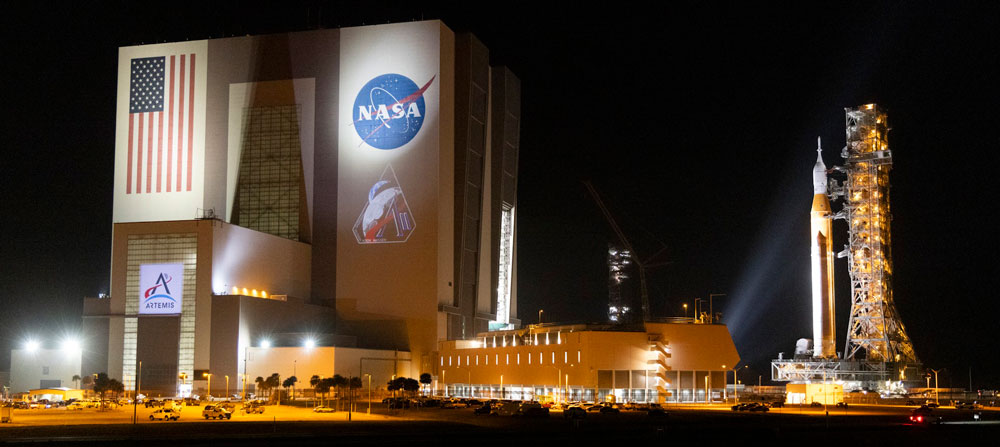
By Michelle L.D. Hanlon
The next U.S. trip to the Moon isn’t about planting a flag. It’s about learning how to live and work there.
NASA has just reset its Artemis program, marking a clear strategic shift: Space exploration is moving away from a race to achieve milestones and toward a system built on repeated operations, a sustained presence and lunar infrastructure that could become part of the technology networks we rely on here on Earth.
That shift is reflected in newly announced plans to invest billions of dollars in building a long-term lunar base, with habitats, power systems and surface infrastructure designed to support ongoing human activity. The message? Humans have already normalized travel to space. The next step is normalizing living beyond Earth.
Artemis is NASA’s plan to return people to the Moon with the goal of staying. Unlike the short Apollo missions of the 1960s and 1970s, it consists of increasingly complex missions: flying around the Moon, landing on its surface and eventually establishing a base near the lunar south pole. The program aims to create a reliable way for humans to live and work there, develop technologies useful on Earth and prepare for the journey to Mars.
Rather than moving straight from the upcoming Artemis II crewed lunar flyby to a surface landing, the new road map adds an intermediate mission in 2027. Astronauts will test docking, life-support systems and communications with commercial lunar landers from SpaceX and Blue Origin, but in low Earth orbit, the region roughly 100 to 1,200 miles (160 to 2,000 kilometers above Earth’s surface, where rescue remains possible.
The first landing near the lunar south pole is now targeted for 2028. This timeline may sound delayed, but in reality, it has been deliberately reset to prioritize building reliable systems that can operate long into the future over speed.
As a professor of air and space law, I’ve been watching these developments closely. The United States is still in a race – particularly with China – but it is choosing to compete on its own terms. Rather than chasing the fastest possible landing, NASA is focused on building a system that can support repeated missions and a lasting human presence.
From sprint to system
The original Artemis plan aimed to leap quickly from test flights to a crewed landing while simultaneously developing new rockets, spacecraft and landing systems. That approach carried risk. Artemis I, an uncrewed mission, flew successfully in 2022. After a few delays, Artemis II is now nearing launch, with windows planned for early April 2026. But the further jump to a safe and reliable landing remains significant.
NASA’s new road map slows the transition deliberately. Instead of stand-alone milestones, NASA is now building a sequence of repeatable steps to gain hands-on experience.
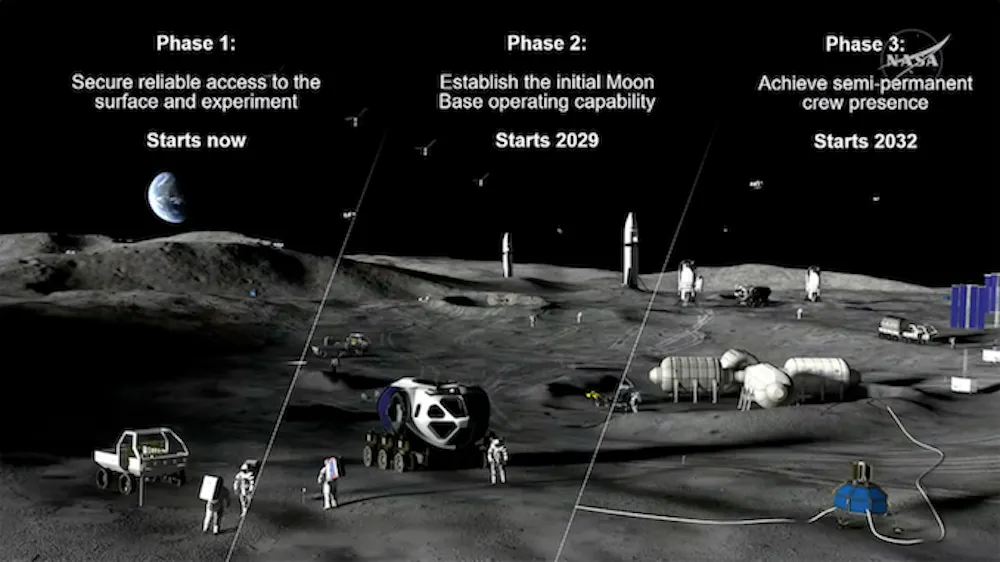
This change includes a substantial new investment, with a multiphase plan for a lunar base with habitats, power systems and the surface infrastructure needed for a long-term human presence on the Moon. Consistent launch cadence and repeatable operations are how teams develop the expertise needed for safe, reliable spaceflight and eventually for traveling to Mars.
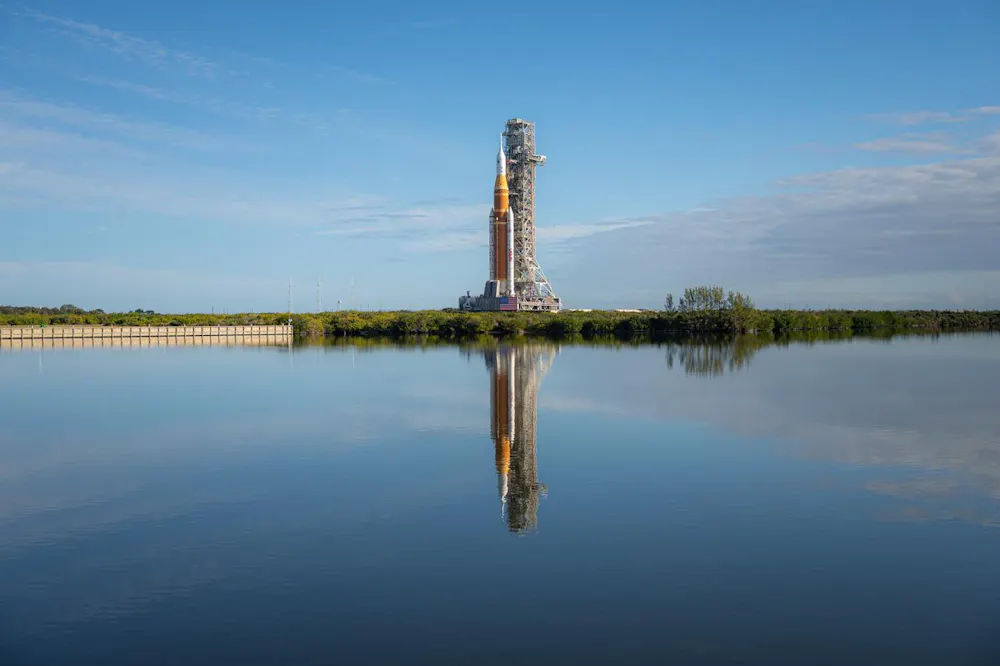
NASA/John Kraus
This shift is reflected in the decision to pause the planned lunar Gateway station, a small space station intended to orbit the Moon, and prioritize infrastructure on the lunar surface itself, where astronauts will live, work and build over time.
The new changes also emphasize a shifting role for commercial companies.
SpaceX’s and Blue Origin’s lunar landers are integrated into the mission architecture.
The 2027 test mission, for example, will practice docking between crewed spacecraft and new commercial lunar landers in low Earth orbit. NASA is coordinating a network of public and private partners rather than running a single government-run Apollo-like program.
This method spreads risk across partners, lowers costs and speeds development, though success now depends on multiple players working reliably together.
Law follows activity
NASA’s road map is not just about lowering technical risk. It is also about shaping the future environment of lunar activity.
International space law, including the 1967 Outer Space Treaty, sets out broad principles to guide space activities, like avoiding harmful interference with others’ activities. But those rules only gain real meaning through repeated, coordinated activity, especially on the lunar surface, where desirable landing sites are limited.
Countries and companies that maintain a sustained presence on the Moon will shape the practical expectations everyone will share while living and working on the Moon. One-off demonstrations, like lunar landings, don’t shape lunar activity like continued operations would.
NASA TV
Why this matters – even if you never go to space
It would be easy to see these changes as purely technical, but they are not. The structure of a space program shapes what technologies are developed, how industries grow and which countries influence how space is used. Technologies developed for sustained lunar activity, including life-support systems, energy storage and advanced communications, have found applications on Earth, from medicine to disaster response.
There are economic effects as well. The Artemis program supports jobs across the United States and among its international partners. It helps build industries that extend far beyond NASA itself.
And there is a strategic dimension. As more countries and companies operate in space, the question is no longer just who arrives first, but who helps define how activity is carried out. Over time, that presence will likely become part of the infrastructure that supports daily life on Earth.
Communications, navigation, supply chains and scientific data already depend on space-based systems. As activity expands to the Moon, facilities there, from energy systems to communications relay systems that transmit data and signals back to Earth, will become integrated into those networks. What is built on the Moon will not sit apart from life on Earth, but increasingly function as an extension of it.
The Moon is becoming a place where infrastructure, industry and rules and expectations for how humans operate there are already beginning to take shape. NASA’s updated plan signals that the United States intends to be present there consistently.
The updates to the Artemis program are a statement about how the United States intends to engage in the next phase of space exploration. Rather than pursuing a single dramatic landing, the U.S. is committing to the steady, repeatable work of building a lasting foothold on the Moon, and redefining humanity’s relationship with space itself.

Michelle L.D. Hanlon is Professor of Air and Space Law at the University of Mississippi.



























JimboXYZ says
Outer space appears to be the last & only prospect for colonization, leveraging military advantage over anyone else on planet Earth. Since the USA has been the only one to land on the moon, plant it’s flag ? See that’s not a one of ? Does that make it a territory of sorts like Guam & Puerto Rico ? How vested would the USA be to retain it’s lunar colony ? Space stations have existed for decades, satellites as well. Those Apollo missions had a progression of accomplishment. Whether anyone wants to admit it or not, the moon is property of the USA for each landing and walk around for the exploration. Apollo Missions 11-17 had moon walkers. If it had been as relatively easy for mankind to be on the Moon, The space race would’ve been more competitive than Russia & USA. And the moon would’ve been carved out just like North America was amongst England, France & Spain. And if there were oil or anything else precious to discover on the moon. We all know that the nature of mankind would involve governing & war for those assets for natural resources. As a kid growing up, the Apollo Program were cool watches for a world that still was 3 broadcast networks, free to air B&W TV, some had color TV. As a child the adults extolled the virtues. Older teen juveniles & adults with more sophistication as to the worldly ways of the human race. I recall watching the skies & TV from Daytona Beach for everything from 1965-present. They are spending that kind of money to share anything that any Government could claim for themselves. That’s just not the way the human race has ever worked after Adam & Eve.
https://en.wikipedia.org/wiki/List_of_Apollo_missions#Alphabetical_mission_types
And China is trying to get there, they have an ally in Russia. So it’s USA vs China/Russia to claim the Moon. If the USA were smart about this, we’d have already done that, made it clear to China & Russia that any foot traffic for a landing on the moon is an invasion of USA Territory, we were here 1st you know. And that’s why Reagan had Star Wars Program. It wasn’t just about satellites or a lunar station (colony) shooting laser beams at Earth based locations in WW3 ? Because that’s just the human race & Governments in general, it’s all about the economics & money. Hate Musk all anyone wants, but he’s integral part of the current space program. same holds with Bezos.
https://en.wikipedia.org/wiki/Chinese_Lunar_Exploration_Program
PaulT says
Why are Republicans like JimboXYZ obsessed with world domination by the United States?
Scientific space research is valuable but are the outrageous costs of manned space flight and exploration justified? I could probably live without Velcro and who even remembers Tang?
As Michael Cocchiola points out, there are millions of human beings on this planet struggling to survive, suffering from severe food insecurity. They include 18 million Amrican households, that’s nearly 14% of the US population..
The US government has cut back on domestic food aid like the SNAO program and stopped most overseas food aid. Gotta save money, right? Need to cut the deficit, right? (Though under Trump the defecit is soaring and No you can’t blame Biden).. Why, maybe it’s the $ 1 TRILLON Defense budget so America can be even more dominant but there’s also $90+ Billion already spent on the Artemis moonshot program and the $ 2 Billion a day ‘needed’ for Trump’s ‘war with ever changing objectives’.
Trump’s latest threat is to send 90 million Iranian human beings, civilians and their children ‘Back into the Stone Age’. Do you Republicans actully believe that’s a worthy objective?
Why not spend that $ 2 billion a day helping the people who are already starving? Why not spend some part of that $ 93 billion ‘space research’ developing solar irrigation systems so some of those who are starving can grow food for themselves?
Pogo says
The ultimate high ground for a fortress for the ruler of Earth; built, and manned, by obedient(?) solar-powered robots.
Yee haw.
Hey, how do you spell Trump in Chinese?
JimboXYZ says
China & Russia :
https://en.wikipedia.org/wiki/Xi_Jinping
https://en.wikipedia.org/wiki/Vladimir_Putin
If anything, is the USA at a major disadvantage at this point. the expansion they credit Biden with is just a list of nations that have no space program ? End of the day, the USA is the only nation to have lunar pedestrians/walkers ? Our flag is the only one to have been planted there. I have no doubt the Chinese can get that done. Russia didn’t for whatever reasons they had ?
https://payloadspace.com/biden-administrations-space-legacy-by-the-numbers/
https://en.wikipedia.org/wiki/Artemis_Accords
James says
Has anyone really been paying attention to the space program?
This is how interested I was. I was so interested in Musk’s SpaceX “Heavy” rocket (or whatever he calls it) that all I was thinking was humm… lots of seats, but where’s the room for all the food?… it’s a long trip out to mars. And I thought about all the things that could go wrong.
Then I thought about it a little more.
Well, it was a simple, uninformed assessment at the time. I’ve recently read of all the mission plans and what have you… sending supplies ahead, establishing a base, etc. So I thunk on it a little’n more, consider’n most importantly the mindset of someone who would wield a chainsaw in public and my conclusion is pretty much the same.
Good luck with that.
PaulT says
In the late 1950’s science fiction author James Blish wrote a 4 book series ‘Cities In Flight’. The premise was that life on Earth had become untenable as a result of over exploitation of it’s resources. The protagonists in the books are nicknamed ‘Okies’ since they are fleeing a ‘dust-bowl’ world.
Is the NASA program a reaction to this likelihood? That humans may be forced to leave this planet because society is too greedy to admit to and deal with man made global warming and pollution which will eventually make ‘Earth’ uninhabitable?
Problem is, unlike the James Blish books, Elon Musk hasn’t invented a ‘Spindizzy’ which would allow mass escape by whole cities from the planet’s death throes..
Michael Cocchiola says
Science is vital to our Earthly well-being. But not this science.
The billions we spend to “learn to live in space” can be done by non-human technology after we learn to feed our hungry, house our homeless, cure our sick, protect our environment, and end our conflicts here on Earth.
Learning to live in space is not a necessity. Learning to live on and with Earth is. Here we are with possibly hundreds of millions of people around our troubled world living on the ragged edge of existence without hope of sustainable food, shelter, or medical care, and we’ll spend billions upon billions to put a few people on a dead rock a mere 239,000 miles from Earth. Supposedly, we’ll then leap to Mars–a mere 142 million miles (on average) away. That’s, at best, a three-day head start on a 7 to 9-month one-way journey with our current technology.
And then, what? We’re on another dead rock. And we do this to get where? Deeper into our solar system? That’s three light-years across (18.6 trillion miles) at the speed of light. Possibly traverse our galaxy? That’s upwards of 200 light-years across (estimates vary).
My point is that our scientific dreams may far outpace our scientific reality for many, many decades if not lifetimes. Meanwhile, we die in droves from famine, pestilence, weather, illness and injury, not to mention guns and conflicts. Things we can fix with the resources we have and the right scientific priorities.
Think about it.