


By Monica Duffy Toft
Wars are rarely lost first on the battlefield. They are lost in leaders’ minds − when leaders misread what they and their adversaries can do, when their confidence substitutes for comprehension, and when the last war is mistaken for the next one.
The Trump administration’s miscalculation of Iran is not an anomaly. It is the latest entry in one of the oldest and most lethal traditions in international politics: the catastrophic gap between what leaders believe going in and what war actually delivers.
I’m a scholar of international security, civil wars and U.S. foreign policy, and author of the book “Dying by the Sword,” which examines why the United States repeatedly reaches for military solutions and why such interventions rarely produce durable peace. The deeper problem with the U.S. war in Iran, as I see it, was overconfidence bred by recent success.
Dismissed concerns
Before the conflict involving Iran, Israel and the U.S. escalated, Energy Secretary Chris Wright dismissed concerns about oil market disruption, noting that prices had barely moved during the 12-day war in June 2025 between Israel and Iran. Other senior officials agreed.
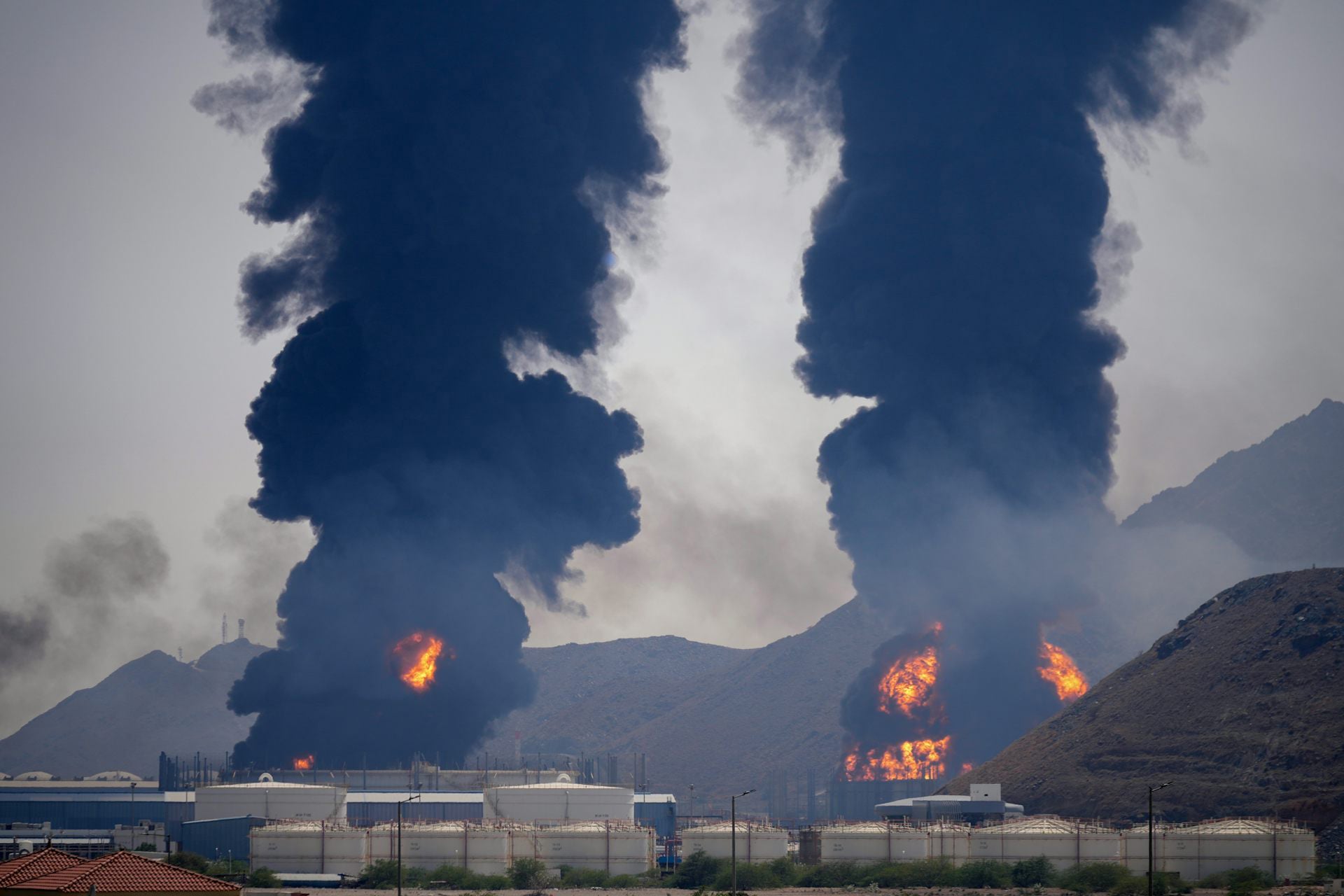
What followed was significant: Iranian-aimed missile and drone barrages against U.S. bases, Arab capitals and Israeli population centers. Then Iran effectively closed the Strait of Hormuz, through which roughly 20% of the world’s oil supply passes daily − not with a naval blockade, not with mines or massed anti-ship missiles, but with cheap drones.
A few strikes in the vicinity of the strait were enough. Insurers and shipping companies decided the transit was unsafe. Tanker traffic dropped to zero, although the occasional ship has made it through recently. Analysts are calling it the biggest energy crisis since the 1970s oil embargo.
Iran’s new supreme leader, Mojtaba Khamenei, has since vowed to keep the strait closed. U.S. Sen. Chris Murphy, a Connecticut Democrat, reported after a closed-door briefing that the administration had no plan for the strait and did not know how to get it safely back open.
With no embassy in Tehran since 1979, the U.S. relies heavily for intelligence on CIA networks of questionable quality and Israeli assets who have their own country’s interests in mind. So the U.S. did not anticipate that Iran had rebuilt and dispersed significant military capacity since June 2025, nor that it would strike neighbors across the region, including Azerbaijan, widening the conflict well beyond the Persian Gulf.
The war has since reached the Indian Ocean, where a U.S. submarine sank an Iranian frigate 2,000 miles from the theater of war, off the coast of Sri Lanka – just days after the ship had participated in Indian navy exercises alongside 74 nations, including the U.S.
The diplomatic damage to Washington’s relationships with India and Sri Lanka, two countries whose cooperation is increasingly important as the United States seeks partners to manage and mitigate Iran’s blockade, was entirely foreseeable. Washington has put them in a difficult position, with India choosing diplomacy with Iran to secure passage for its vessels and Sri Lanka opting to retain its neutrality, underscoring its vulnerable position.
But U.S. planners didn’t foresee any of this.
The wrong lesson from Venezuela
The swift military intervention by the U.S. in Venezuela in January 2026 produced rapid results with minimal blowback − appearing to validate the administration’s faith in coercive action.
But clean victories are dangerous teachers.
They inflate what I call in my teaching the “hubris/humility index” − the more a leadership overestimates its own abilities, underestimates the adversary’s and dismisses uncertainty, the higher the score and the more likely disaster will ensue. Clean victories inflate the index precisely when skepticism is most needed, because they suggest the next adversary will be as manageable as the last.
Political scientist Robert Jervis demonstrated decades ago that misperceptions in international relations are not random but follow patterns. Leaders tend to project their own cost-benefit logic onto opponents who do not share it. They also fall into “availability bias,” allowing the most recent operation to stand in for the next.
The higher the hubris/humility index, the less likely there is to be the kind of strategic empathy that might ask: How does Tehran see this? What does a regime that believes its survival is at stake actually do? History shows that such a regime escalates, improvises and takes risks that appear irrational from an outside perspective but are entirely rational from within.
Recent cases reveal this unmistakable pattern.
The United States in Vietnam, 1965–1968
American war planners believed material superiority would force the communists in Hanoi to surrender.
It didn’t.
American firepower alone didn’t lead to military defeat, much less political control. The Tet Offensive in 1968 – when North Vietnamese and Viet Cong forces launched coordinated attacks across South Vietnam – shattered the official U.S. narrative that the war was nearly won and that there was “light at the end of the tunnel.”
Athough the U.S. and South Vietnamese forces ultimately repelled the attacks, their scale and surprise caused the public not to trust official statements, accelerating the erosion of public trust and decisively turning American opinion against the war.
The U.S. loss in Vietnam didn’t occur on a single battlefield, but through strategic and political unraveling. Despite overwhelming superiority, Washington was incapable of building a stable, legitimate South Vietnamese government or recognizing the grit and resilience of the North Vietnamese forces. Eventually, with mounting casualties and large-scale protests at home, U.S. forces withdrew, ceding control of Saigon to North Vietnamese forces in 1975.

AP Photo.
The U.S. failure was conceptual and cultural, not informational. American analysts simply couldn’t picture the war from their opponent’s perspective.
Afghanistan: Deadly assumptions
The Soviet Union in Afghanistan in 1979 and the United States in Afghanistan after 2001 conducted two different wars but held the same deadly assumption: that external military force can quickly impose political order in a fractured society strongly resistant to foreign control.
In both cases, great powers believed their abilities would outweigh local complexities. In both cases, the war evolved faster − and lasted far longer − than their strategies could adapt.
Russia, Ukraine and the Strait of Hormuz
This is the case that should most haunt Washington.
Ukraine demonstrated that a materially weaker defender can impose huge costs on a stronger attacker through battlefield innovation: cheap drones, decentralized adaptation, real-time intelligence, and the creative use of terrain and chokepoints to find asymmetrical advantages. The U.S. watched it all unfold in real time for four years and helped pay for it.
Iran was also watching − and the Strait of Hormuz is the proof.
Iran didn’t need a navy to close the world’s most important energy chokepoint. It needed drones, the same cheap, asymmetric technology Ukraine has used to blunt Russia’s onslaught, deployed not on a land front but against the insurance calculus of the global shipping industry.
Washington, which had underwritten much of that playbook in Ukraine, apparently never asked the obvious question: What happens when the other side has been taking notes? That is not a failure of U.S. intelligence. It is a failure of strategic imagination − exactly what the hubris/humility index is designed to highlight.
Iran does not need to defeat the U.S. conventionally. It needs only to raise costs, exploit chokepoints and wait for a fracture among U.S. allies and domestic political opposition to force a fake U.S. declaration of victory or a genuine U.S. withdrawal.
Notably, Iran has kept the strait selectively open to Turkish, Indian and Saudi vessels, rewarding neutral countries and punishing U.S. allies, driving wedges through the coalition.
Historian Geoffrey Blainey famously argued that wars start when both sides hold incompatible beliefs about power and only end when reality forces those beliefs to align.
That alignment is now happening, at great cost, in the Persian Gulf and beyond. The Trump administration scored high on the hubris index at exactly the moment when it most needed humility.

Monica Duffy Toft is Professor of International Politics and Director of the Center for Strategic Studies at The Fletcher School, Tufts University




























JimboXYZ says
“Iran’s new supreme leader, Mojtaba Khamenei, has since vowed to keep the strait closed.”
You can bet this individual became a priority for being taken out at the 1st opportunity. He better hope that his exact whereabouts isn’t ever discovered. He’s the new Bin Laden, real or perceived, the retaliation is the tool that will be the justification.
If anything, Iran striking anyone but USA & Israel is just further evidence that Iran funded Hamas to attack Israel in Sept 2023 to get the ball rolling on the whole mess. When has Iran ever not attacked an neighboring Mid East ally ? That’s what terrorists do, Terrorism 101, they either infiltrate & hide amongst the masses for that relative protection or they create a crisis with the other Arab nations for attacking anyone in the region. I’m surprised Israel & USA haven’t already identified the drone launching locations Iran has and taken those launch site bases out of commission yet ?
JW says
Interesting essay!
First it reminds us that if you don’t teach history (that is world history), it will repeat itself!
We barely teach history in the US, because it may make children uncomfortable. So we teach them football to learn to fight?
On top of that we have failed to teach critical thinking. Once my son came from (primary) school and told me his teacher told the class: if you can’t say something nice, say nothing.
This all applies to many including politicians and Trump. They just like to hear good news. If it turns out wrong, they typically blame someone else. Like Trump now blaming NATO allies for not helping with the Iran war. The problem is that these allies teach world history and critical thinking in their schools. So, that is what you can expect, if most Americans never learned to think, they act instead with their guts or bones, like our president. That is not a winning strategy!
BillC says
All that black oily smoke and crude oil billowing into the atmosphere and spilling out all over the land and ocean water of the Middle East, an environmental disaster of epic proportions.
How long before the feckless Trump brags: “Due to record breaking smoke in the air, we are seeing high temperatures in many of our states rise to record breaking levels unheard of before”.
Motherworry says
Our president has not had a conscious, rational, independent thought in some time. Why is everybody surprised? He has lied throughout his entire life, that is common knowledge, yet people voted for him. He does not give a damn how many bodies come home. He has managed to turn this whole deal into one big shit show that is not going to get better while he’s in office.
PaulT says
So many missteps by President Trump and Prime Minister Netanyahu.
Factually (according to Secretary of State Rubio) the United States was dragged prematurely into war by Israel’s strike on and assassination of Iran’s Supreme Leader and other senior government officials. Trump’s pride meant he didn’t want to be left out so prematurely started unannounced strikes, abandoning active negotiations with Iran aimed at ending it’s suspected nuclear weapons ambitions.
An overconfident US administration was dragged (willingly) into an unpopular war by a mecilees and vindictive Israel. What could go wrong. The US has the mightiest military in the world while Israel has it’s ‘Iron Dome’ and had defeated neighboring Arab states in several wars before flattening the troublesome Gaza Strip and subduing Lebanon while no longer having to worry about Syria since Assad had been deposed.
A punitive war against Iran would be a ‘piece of cake’, success would be certain and quick.
Neither Trump nor Netanyahu considered history, that Persians have pride in their long held independence and defiance of powerful invaders. To add to that an ill advertised aim of ‘regime change for Iran’ was like a red rag to a bull. The aggressors are arrogant and impatient but face Persian pride and a tradition of resilence, along with years of planning and preparation to resist a long threatened assault.
Now as the war extends beyond their expectations Trump and Netanyahu issue threats insted of offering negotiations and concessions.
The road to unconditional surrender won’t be easy, this conflict may last forever.